
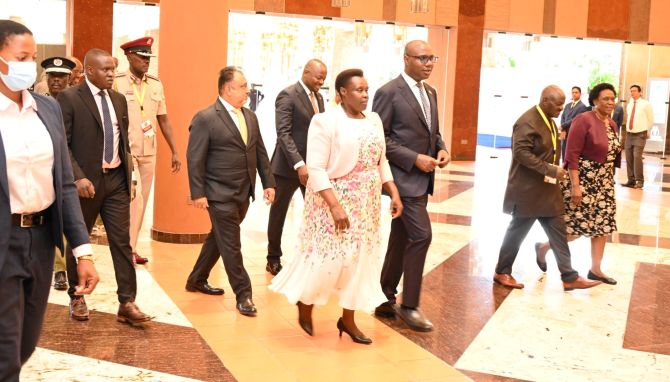
KAMPALA, September 10, 2026 — The Government of Uganda has unveiled seven strategic shifts that will guide the formulation and implementation of the national budget for the 2027/28 financial year [FY], with greater emphasis on domestic revenue mobilisation, private investment, job creation, exports, household incomes and economic transformation.
Speaking at the National Budget Conference 2027/28 in Kampala this Thursday, the Minister for Finance, Planning and Economic Development, Henry Musasizi, said the strategy is intended to accelerate implementation of the Government’s Tenfold Growth Strategy through the effective execution of the Agriculture, Tourism, Minerals and Science and Technology [ATMS] priorities and their enablers.
Presenting the FY2027/28 Budget Strategy at the National Budget Conference, Musasizi said the new approach would also strengthen fiscal discipline, improve accountability and ensure that public resources are directed towards programmes capable of delivering measurable economic results.
The first shift will be revenue-led fiscal consolidation, with domestic revenue mobilisation placed at the centre of the budget formulation process.
Musasizi said government would broaden the tax base through greater use of data and technology, address revenue leakages, improve taxpayer compliance and strengthen the mobilisation of complementary financing, particularly non-tax revenue.
He said the resources raised would be prioritised towards the ATMS priorities, their enablers and essential public services.
The second shift will focus on the prudent management of oil revenues as Uganda moves closer to commercial oil production.
Musasizi said oil revenues would be managed transparently and sustainably in accordance with the Public Finance Management Act, Cap 171, to ensure that the expected revenues contribute to national development without undermining fiscal stability.
The third strategic shift will involve mobilising private capital to support the ATMS priorities, accelerate economic growth, create productive employment and increase household incomes.
According to Musasizi, government will explore innovative financing mechanisms, strengthen public-private partnerships and continue improving the business environment to attract higher levels of foreign direct investment.
He said government must also ensure stronger coordination among public institutions and deeper cooperation with the private sector to accelerate implementation of the Tenfold Growth Strategy.
The fourth shift will therefore focus on accelerating the realisation of the Tenfold Growth Strategy through effective implementation of the ATMS priorities and their enablers.
Musasizi said consistency between government policies and their implementation would be critical if Uganda is to achieve faster economic transformation.
The fifth shift will place jobs, exports and household incomes at the centre of the national budget.
He said Uganda must translate higher economic growth into structural transformation by building an increasingly export-oriented economy, creating productive jobs and ensuring that growth is supported by sustainable public finances.
The sixth shift will strengthen wealth creation programmes, with the Government building on initiatives such as the Parish Development Model, Emyooga and the Presidential Skilling and Industrial Hubs.
Musasizi said the programmes are part of government’s efforts to deepen the monetisation of Uganda’s economy by increasing production and household participation in commercial economic activity.
“Government will strengthen the wealth creation programmes to increase production, employment and household incomes,” Musasizi said.
The seventh shift will involve enforcing key budget reforms aimed at improving budget discipline, credibility and accountability.
The reforms will focus on improving the allocation of public resources, strengthening internal controls and audit systems, improving procurement and ensuring greater accountability for results.
Musasizi said the FY2027/28 Budget and the medium-term framework are expected to accelerate socio-economic transformation, strengthen results and further improve service delivery.
“The ultimate objective is to ensure that every shilling of public resources contributes directly to the Tenfold Growth Strategy and full monetisation of Uganda’s economy,” Musasizi said.
He said Uganda’s economy is projected to grow by 10.2 per cent in FY2026/27, driven partly by the expected onset of commercial production of oil and gas, while the economy is projected to maintain average real growth of at least seven per cent per year over the medium term.
Musasizi also said Uganda’s public debt remains sustainable, citing the Government’s continued commitment to fiscal consolidation and economic growth.
He said public debt stood at 54.4 per cent of GDP during FY2025/26.


Museveni calls for faster economic transformation
President Yoweri Museveni said Uganda had built a strong foundation from which faster economic transformation could now be achieved.
The President made the remarks in a message delivered on his behalf by Vice President Jessica Alupo during the National Budget Conference for FY2027/28.
“That is why economists have been rating our economy so highly on the basis of its proven consistency in several areas,” Museveni said.
He pointed to Uganda’s sustained long-term economic growth of more than five per cent despite repeated global shocks as one of the indicators of the country’s economic resilience.
Museveni said Uganda’s GDP had reached Shs 250.4 trillion, equivalent to about US$ 69.35 billion, while gross national income per capita had risen to US$ 1,389, above the lower middle-income threshold of US$ 1,136.
The President also highlighted Uganda’s performance in exports, expanded access to health, education and other social services, improved infrastructure and the country’s growing capacity for investment, industrialisation and manufacturing.
However, Museveni said more work was required to address challenges that continue to limit the pace of transformation, particularly the large number of Ugandans still engaged in subsistence economic activities.
He said about 30 per cent of Ugandans remain trapped in the subsistence economy despite the investments the Government has made in wealth creation programmes.
“We have solved the problem of capital. Our people have adopted the Parish Development Model and other wealth creation programmes,” Museveni said.
The President said Uganda must now address three major constraints affecting agricultural and household productivity: dependence on rainfall, limited value addition to agricultural commodities and inadequate access to markets.
He called for increased investment in irrigation to reduce dependence on rainfall and enable farmers to produce throughout the year.
Museveni also urged government to increase domestic revenue mobilisation, saying Uganda needs to raise its tax-to-GDP ratio from about 14 per cent to approximately 25 per cent by closing revenue leakages and improving compliance.
“Overall, our focus will continue to be on full monetisation of Uganda’s economy through commercial agriculture driven by irrigation, industrialisation for value addition, expanding access to critical services and market access,” Museveni said.
Hundreds of stakeholders including; local development partners, Local governments, civil society, private sector, cultural leaders made submissions on what they want to see in the budget for FY 2027/28.
Some of the issues they want to see improved include: Management of tax exemptions & incentives, tax disputes and resolution mechanisms, debt management and accountability, public investment management, digital tax administration, clearance of domestic arrears, funding for roads and remuneration of local government leaders including district chairpersons, mayors and their deputies.


Buy your copy of thecooperator magazine from one of our country-wide vending points or an e-copy on emag.thecooperator.news


