
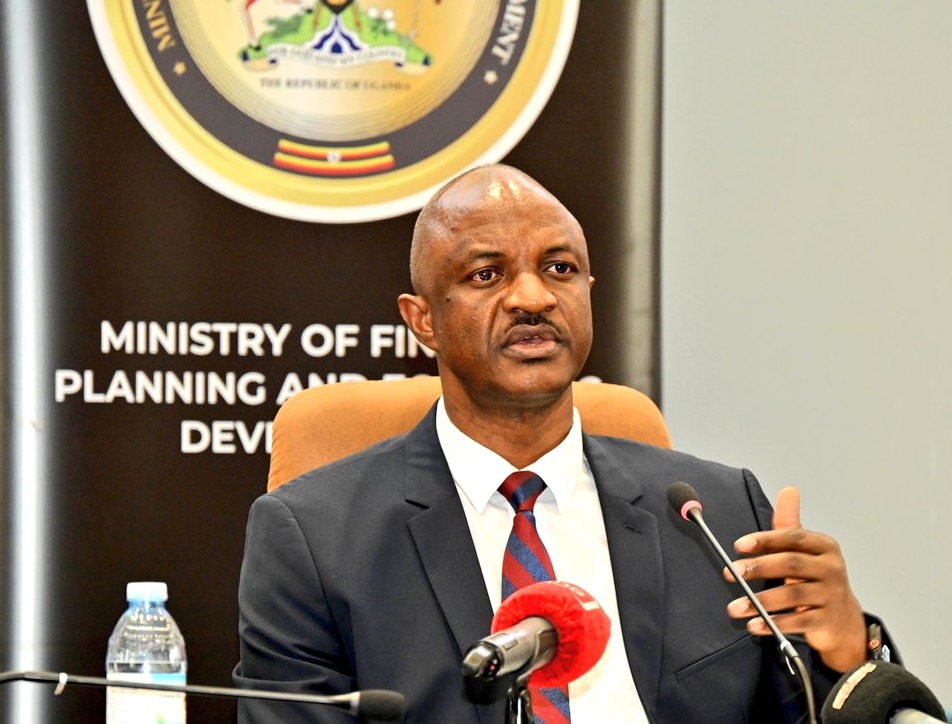
KAMPALA, July 11, 2026 — The Ministry of Finance, Planning and Economic Development [MOFPED] has released Shs 23.03 trillion for the first quarter of the 2026/2027 financial year [FY], representing 27 percent of the approved national budget, as government moves to accelerate economic growth, create jobs and improve service delivery.
The first-quarter expenditure releases have been aligned with implementation schedules, projected domestic revenue collections and expected external financing disbursements, according to the Permanent Secretary and Secretary to the Treasury [PSST], Ramathan Ggoobi.
Speaking during a briefing on the expenditure releases yesterday, Ggoobi said the funds are intended to support priority government programmes while maintaining fiscal discipline and debt sustainability.
“The Quarter One expenditure releases have been carefully aligned to sustain this momentum while preserving fiscal and debt sustainability,” Ggoobi said.
He said Uganda enters the new financial year with a strong economic foundation characterised by improved economic growth, low inflation, a stable exchange rate, rising exports and increased investor confidence.
“The releases have been aligned with implementation schedules, projected domestic revenue and expected external financing disbursements,” he added.
Ggoobi noted that government’s fiscal strategy for the 2026/2027 financial year is focused on financing key growth drivers under the Ten-fold Growth Strategy while ensuring responsible management of public resources. The Ten-fold Growth Strategy is an ambitious blueprint aimed at expanding the Ugandan economy from roughly US$ 50 billion to US$ 500bln by 2040
The priority areas include agro-industrialisation, tourism development, mineral beneficiation, science, technology and innovation, information and communication technology [ICT], the ATMS sectors, and the creative economy.
“Every shilling released must contribute to economic growth, job creation and improved delivery of public services to citizens,” Ggoobi emphasised.
According to the PSST, Uganda’s economy maintained steady momentum during the 2025/2026 financial year, growing by 6.4 percent in real terms, up from 6.3 percent recorded the previous year.
He attributed the growth to increased aggregate demand and continued implementation of government initiatives, including the Parish Development Model [PDM] and Uganda Development Bank [UDB] interventions, which have expanded access to affordable credit and seed capital.
“Real GDP growth is projected to accelerate to 10.2 per cent in FY2026/27, supported by first oil production, ongoing investment in ATMS and public infrastructure, stronger export growth, a stable macroeconomic environment and improved public spending efficiency,” Ggoobi said.
He added that annual headline inflation averaged 3.3 percent in the 2025/2026 financial year, down from 3.5 per cent the previous year, reflecting effective coordination between monetary and fiscal policies.
Uganda’s Gross Domestic Product [GDP] increased to Shs 250.4 trillion [about US$ 69 billion] in the last financial year and is projected to rise to Shs 287.23 trillion [about US$ 75.7 billion] in the FY 2026/2027.
Ggoobi said the projected economic expansion is expected to translate into increased incomes, improved livelihoods and greater economic opportunities for Ugandans.
He said government resources will be channelled towards high-impact areas, including security, infrastructure development, human capital development, ongoing projects requiring counterpart financing, and essential operational costs for ministries, departments, agencies, local governments and Uganda’s missions abroad.
Ggoobi added that government will continue controlling non-essential expenditure while protecting strategic investments and priority programmes.
“Public resources will continue to be managed efficiently to ensure that Government programmes deliver tangible benefits to citizens,” he said.
The Finance Ministry also revealed that funds had been provided to support preparatory activities for Uganda’s hosting of the Africa Cup of Nations 2027 [AFCON 2027].
Accounting Officers were urged to ensure timely and effective implementation of approved budgets so that released funds translate into improved public services.
Ggoobi reaffirmed government’s commitment to budget transparency and public accountability, saying citizens must have access to information on national priorities and how public funds are being utilised.
The Quarter One releases mark the start of implementing government’s priorities for the 2026/2027 financial year that began on July 1, and whose budget is Shs 84.39 trillion, with emphasis on sustainable economic transformation, job creation and improved livelihoods for Ugandans.
Buy your copy of thecooperator magazine from one of our country-wide vending points or an e-copy on emag.thecooperator.news
-

-

-

-


