
KAMPALA, July 8, 2026 — Uganda’s strong macroeconomic fundamentals have enabled the economy to sustain robust growth, with Government now targeting an increase in domestic revenue collection from 14 per cent to 20 per cent of Gross Domestic Product [GDP] over the medium term, the Finance Minister, Henry Musasizi, has said.
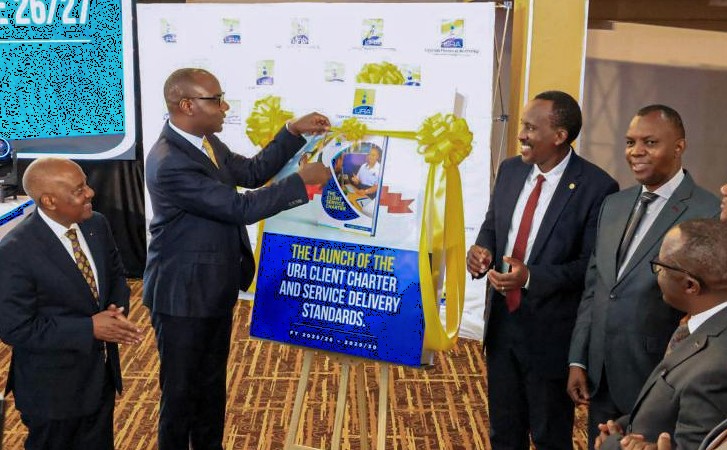
Speaking while officiating at the URA FY2026/27 Post-Budget Breakfast Dialogue and the launch of the URA Service Charter at Hotel Africana in Kampala on Tuesday, Musasizi said the ambitious revenue target would be achieved through digital transformation, formalisation of the economy, stronger inter-agency coordination, rationalisation of tax policy and improved taxpayer services.
The Minister said government projects domestic revenue of Shs 45.96 trillion in the FY2026/27 Budget, of which Shs 40.16 trillion is expected to come from tax revenue.
He noted that the resources will finance strategic investments required to sustain Uganda’s socio-economic transformation while maintaining fiscal sustainability.
“To every Ugandan, paying taxes is not merely a legal obligation but a contribution towards the collective future of our country. Every compliant taxpayer is a partner in national development,” Musasizi said.
He observed that countries which have successfully transformed their economies have progressively strengthened their capacity to finance development through domestic resources.
“The Government remains firmly committed to implementing the Second Domestic Revenue Mobilisation Strategy. We recognise that sustained development cannot rely indefinitely on borrowing or development assistance alone,” he said.
Musasizi noted that Uganda’s strong macroeconomic fundamentals have underpinned sustained economic growth despite global economic uncertainties.
He said the FY2026/27 Budget prioritises investments in sectors with the greatest potential to transform the economy under the Agriculture, Tourism, Minerals and Science, Technology and Innovation [ATMS] strategy.
He explained that these investments form the foundation of Uganda’s Tenfold Growth Strategy, which seeks to expand the country’s economy to US$ 500 billion over the medium to long term.
“The true measure of our success is whether economic growth translates into better lives for the people. Growth must create productive jobs. Growth must raise household incomes. Growth must expand opportunities for businesses. Growth must reduce poverty. Growth must improve the quality of public services, and growth must reach every region of Uganda,” the Minister said.
He appealed to the private sector to continue investing in Uganda by creating jobs, adding value to local products, embracing innovation and formalising businesses.
“Together, we have an opportunity to build a stronger economy, deepen our domestic resource mobilisation efforts and create shared prosperity for all Ugandans,” he added.
Musasizi said the FY2026/27 National Budget is ultimately centred on improving the lives of ordinary Ugandans.
“It is about the farmer seeking better markets, the entrepreneur building a successful business, the manufacturer adding value to Ugandan products, the young innovator creating tomorrow’s technologies, the exporter competing confidently in regional and international markets, the worker whose income supports a family, and every Ugandan who dreams of a better future,” he said.
Meanwhile, URA Board Chairperson, Emmanuel Katongole, said Uganda’s economy expanded by 6.4 per cent in FY2025/26 and, with commercial oil production expected to commence later this year, growth is projected to accelerate to 10.2 per cent in FY2026/27, marking the country’s first return to double-digit growth since the economic reforms of the 1990s.
Katongole said Uganda’s economy is now valued at approximately US$ 69.3 billion, while exports have nearly tripled over the past five years and foreign exchange reserves have risen to US$ 6 billion.
“This is not abstract macroeconomics; it is the difference between a country that depends on others and a country that stands on its own resources,” he said.
He added that domestic revenue is projected to rise to Shs 45.96 trillion in FY2026/27, including Shs40.16 trillion in tax revenue, to finance the national budget of Shs84.39 trillion.
“Every trillion we fail to collect domestically is a trillion we must borrow instead. Tax compliance, then, is not only a legal duty but the only way for Uganda to finance its own transformation on its own terms,” Katongole said.
On the other hand, the URA Commissioner General John Musinguzi reiterated the need for Ugandans to play a greater role in financing the country’s development and reducing dependence on external funding.
He said the new tax reforms and ongoing digital transformation initiatives would support Government’s target of raising Uganda’s tax-to-GDP ratio to 20 per cent over the medium term.
“Today’s engagement is anchored on clarity. We want taxpayers to understand the FY2026/27 tax amendments, how they affect businesses and individuals, and how, together, we can align our expectations as we implement them,” Musinguzi said.
“Our ambition is clear. We want to build a stronger, more formalised economy by raising Uganda’s tax-to-GDP ratio to 20 per cent and financing more of our national development through our own resources. This is patriotism in action—every taxpayer playing their part in Uganda’s story of self-reliance.”
Musinguzi said URA remains committed to simplifying tax compliance and strengthening its partnership with taxpayers through integrity, transparency and professionalism.
“A fair and transparent tax system is built on trust. I encourage every Ugandan to understand these reforms, engage with us whenever clarity is needed, and continue playing your part in building a stronger, more prosperous and self-reliant Uganda,” he said.
He also said the newly launched URA Client Service Charter outlines clear service standards and commitments that will improve service delivery, strengthen accountability and enable taxpayers to resolve disputes more efficiently without necessarily resorting to the courts.
The dialogue was held under the theme, “Budgeting for Investment and Economic Opportunities.”
Among the panellists were Julius Mukunda, Executive Director of the Civil Society Budget Advocacy Group [CSBAG]; Grace Kobusinge, Programmes Manager at the Uganda Debt Network [UDN]; Moses Kaggwa, Director of Economic Affairs at the Ministry of Finance, Planning and Economic Development; and Marlon Agaba of the Anti-Corruption Coalition of Uganda [ACCU].
The event brought together officials from the Ministry of Finance, the Uganda Revenue Authority, the private sector, civil society organisations, political leaders and members of the media.
Buy your copy of theCooperator magazine from one of our countrywide vending points or an e-copy on emag.thecooperator.news


