
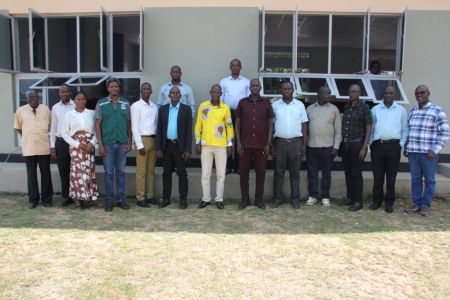
SERERE, September 26, 2026 – The National Semi-Arid Resources Research Institute [NaSARRI] in Serere district has started implementing a new climate-smart project aimed at increasing livestock production in the Teso and Karamoja sub-regions.
The project, Resilience Pathways to Sustainable Intensification and Climate-Smart Beef Production in the Dry Lands of Uganda [RESIBEEF], will specifically target semi-arid areas of Bukedi, Teso and Karamoja, where livestock farming is a key livelihood activity.
The project will focus on animal health and preservation, improving livestock production, feeding and nutrition, as well as disease management during prolonged dry spells, when herds are exposed to various diseases and other risks.
The project’s Principal Investigator, Dr Brian Babigumira, said the project would also pay particular attention to genetic breeding and nutrition to help farmers understand different livestock breeds and available feed resources and identify factors affecting their performance.
Babigumira said researchers would develop sustainable feeding packages based on locally available resources, including grasses and crop residues, to ensure good livestock performance regardless of weather conditions and location.
“There is a common belief that animals feed on dried hay during the dry season, yet they perform badly during the wet season, thus calling for a mindset change,” he said during an inception meeting held in Katakwi district headquarters recently.
The project will also promote new farm management protocols, address nutritional challenges and build the capacity of farmers, scientists and extension workers.
Dr Robert Onzima, a specialist in animal breeding and genetics and a lecturer at Muni University, said capacity building was essential for the sustainability of research activities.
“I really want to appreciate the project for covering key farmer challenges like animal nutrition. A farmer is empowered to improve on indigenous knowledge of feeding animals,” he said, encouraging project participants and farmers to fully participate in its implementation in order to contribute to the Government’s Vision 2040.
During implementation, researchers will work directly with communities to ensure the sustainability and adoption of the technologies developed. This approach will enable researchers and farmers to learn from each other and ensure that research findings are translated into practical solutions.
The Government has invested more than Shs 300 billion in restocking programmes in Teso, Karamoja, Bukedi, Lango, Acholi and parts of West Nile, with the aim of helping communities rebuild their livestock assets and restore their livelihoods.
The new project is expected to complement the restocking programmes and enable communities to derive greater benefits from their livestock investments.
Meanwhile, the 2021 Uganda National Livestock Census [NLC] results indicate that Uganda’s cattle population increased by 27.2 per cent between 2008 and 2021, while the chicken population increased by 54.5 percent and the pig population doubled during the same period.
According to the Uganda Bureau of Statistics [UBOS], which conducted the census in partnership with the Ministry of Agriculture, Animal Industry and Fisheries, Uganda’s total cattle population stood at 14.5 million in 2021, up from 11.4 million in 2008.
Sub-regional analysis showed that Karamoja had the highest cattle population, with 2.4 million head, accounting for 16.7 percent of the national total.
On the other hand, the national sheep population stood at 4.4 million in 2021, an increase of 27.8 percent from 3.4 million in 2008.
Karamoja had the highest sheep population, with 1.8 million, accounting for 40.4 percent of the national total. It was followed by Teso with 405,000 sheep [9.3 per cent] and West Nile with about 398,000 sheep [9.1 percent].
Uganda’s goat population stood at 17.4 million in 2021, representing a 39.4 percent increase from 12.4 million in 2008.
Sub-regional analysis showed that Karamoja had the highest goat population, with 2.6 million goats [15.2 percent], followed by West Nile with 1.99 million [11.5 percent] and Ankole with about 1.98 million [11.4 percent].
Buy your copy of thecooperator magazine from one of our country-wide vending points or an e-copy on emag.thecooperator.news


