
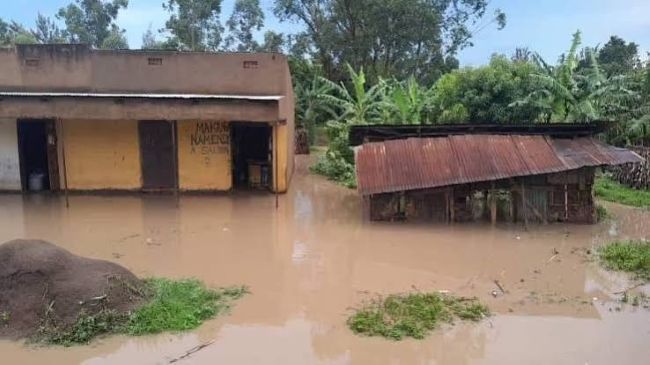
TORORO, November 11, 2026 – Heavy rains and violent hailstorms have devastated storage facilities belonging to Usukulu Farmers’ Cooperative Society Limited in Tororo district, destroying tonnes of bulked produce and damaging structures worth millions of shillings.
The cooperative had stored rice, beans, maize, dried cassava and sweet potatoes harvested by farmers belonging to several groups under its umbrella.
Floodwater swept through the storage facility, soaking the produce and rendering it largely unusable. Strong winds accompanying the downpour, which pounded the area on Sunday evening.
The cooperative’s Vice-Chairperson, Nicholas Olwal, told theCooperator News that the extent of the damage was yet to be established, warning that the cooperative could struggle to recover from the losses in the short term.
“We cannot tell how much we have lost so far until a diligent assessment is conducted. But you can witness how the food has been destroyed inside the store,” he said.
Tororo District LCV Chairperson John Okea said the disaster had affected hundreds of farmers who depended on the cooperative to market and sell their produce.
“These are farmers’ efforts to come and work together, but look how this disaster has dealt them a blow,” he said.
Okea added that floods had swept through several gardens in different villages, destroying food crops and other property and worsening the risk of food insecurity.
“The destruction of gardens has worsened the situation for farming families, many of whom depend on their harvests for household food and income,” he said.
Yowas Osipa, the cooperative’s treasurer, said several members had entrusted their harvests to the cooperative, hoping to earn income from their sale and make savings.
“All we hoped would help us was this produce we had kept in our cooperative. We do not know how the cooperative would compensate us because we are also the owners,” he said.
Another member, Norah Ayikol, said she had joined the cooperative to safeguard her harvests and ensure that the proceeds benefited her household.
“Our harvest was safe here, and we thought we would get enough payment from the cooperative because our husbands were selling the crops from home,” she said.
Ayikol explained that she had opted to store her produce through the cooperative to avoid situations in which her husband would sell the household harvest and spend the proceeds in bars.
Osipa said the cooperative’s membership had grown to more than 800, comprising mainly smallholder farmers, with some members having relatives in urban centres, including Mbale, Soroti, Jinja and Kampala.
The disaster is a major setback to the cooperative’s development, particularly for women who had come to regard it as a reliable means of safeguarding their harvests and securing household income amid domestic disagreements over the sale and management of seasonal agricultural produce.
Beyond the cooperative’s losses, the torrential rains and storms also ravaged homes, gardens and critical infrastructure across the district, leaving several families homeless and threatening food security.
Communities that largely depend on agriculture for their livelihoods have been particularly affected.
Okea said the situation had been compounded by damage to roads and bridges, with running water washing away sections of several transport routes and making some areas difficult to access.
“The damage has disrupted transportation and complicated access to affected communities, slowing the delivery of emergency assistance,” Okea said while addressing residents in Tororo Municipality.
Tororo Municipality Mayor Bernard Ochieng said many residents were struggling to find alternative shelter and called for urgent government intervention to help affected families rebuild their homes.
“The immediate priority is to ensure that vulnerable households can access basic necessities, particularly shelter and food,” he said.
The storms also disrupted electricity supply in parts of Tororo after falling trees and strong winds brought down power poles and damaged electricity transformers.
Ochieng said the combined impact on housing, agriculture, education, roads and electricity infrastructure was beyond the capacity of the local government to address.
He appealed to the Office of the Prime Minister [OPM] to provide emergency assistance, including iron sheets, food supplies and planting seeds, to help affected households recover.
The disaster comes against the backdrop of a recent El Niño warning issued by the Government of Uganda through the Office of the Prime Minister.
Among the advisories issued to cooperatives and other institutions was a call to relocate food reserves to elevated storage facilities to protect them from floodwaters.
The government also urged urban authorities to clear drainage channels and communities to trim overhanging tree branches to protect electricity transmission and distribution lines from damage during storms.
https://thecooperator.news/tororo-municipality-to-digitalise-street-parking-revenue-collection/
Buy your copy of thecooperator magazine from one of our country-wide vending points or an e-copy on emag.thecooperator.news


