
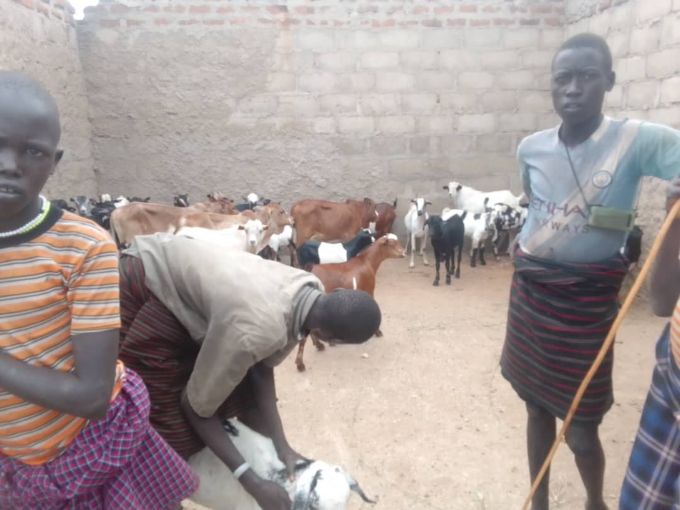
NAKAPIRIPIRIT, July 14, 2026 — A new government proposal to introduce mandatory paid vaccinations against the highly infectious Foot-and-Mouth Disease [FMD] has sparked strong resistance among a section of livestock farmers in Nakapiripirit district, with herders describing the policy shift as an unjust burden on an already struggling sector in the district.
The district, which is part of the Karamoja Sub-region, continues to grapple with a prolonged drought that has resulted in the deaths of livestock, while also destroying crops. The region has also reported human deaths as a result of famine caused the prolonged drought.
Under the FMD vaccination programme spearheaded by the Ministry of Agriculture, Animal Industry and Fisheries [MAAIF], livestock farmers across Uganda are required to pay Shs 8,000 for every cow or pig vaccinated and Shs 4,000 for every goat or sheep. For large-scale pastoralists, the costs could be substantial. A farmer with a herd of 1,000 cattle, for example, would pay Shs 8 million.
The policy has attracted fierce criticism from stakeholders in Nakapiripirit district, who argue that controlling livestock diseases is a public responsibility that should be funded through taxpayers’ money.
Vitalis Bradley Lokol, a vocal member of a local stakeholders’ group, questioned both the timing and justification for the charges.
“Vaccines should be free. Why now? We already pay taxes that should cover basic public services. This feels like theft by trickery,” Lokol said.
The opposition is driven largely by economic hardship. With the region experiencing a severe dry spell that has devastated grazing land and significantly reduced household incomes, many farmers say they simply cannot afford to pay for compulsory government vaccinations.
Another resident, Eric Ojao Lomongin, drew comparisons with the government’s COVID-19 vaccination campaign.
“Did we pay for the COVID-19 vaccine? That was a deadly virus, yet it was provided free of charge. Why should we pay for vaccines that the government purchases using taxpayers’ money?” he asked.
Tensions have been heightened by the government’s directive that only vaccinated animals will be eligible for movement permits and access to livestock markets. Many farmers view the requirement as coercive.
Lomongin warned the authorities against escalating public frustration.
“The government should not create more reasons for public anger. Do not interfere with our livelihoods. We are not against the government; we simply want to protect our means of survival,” he said.
In an effort to ease tensions, Nakapiripirit Deputy Resident District Commissioner Steven Komakech explained that the charges are intended as a cost-recovery measure rather than a revenue-generating exercise.
He said the Shs 8,000 fee covers only the cost of the vaccine, while the government continues to subsidise veterinary personnel, fuel and cold-chain logistics.
“If we cannot sell our animals, how do we buy food or pay school fees? Let us not lock our own ‘bank’,” Komakech said, urging farmers to support the vaccination exercise. “It is far cheaper to vaccinate than to lose a cow worth Shs 2 million.”
Supporting the government’s position, Moses Moru Akol said the Shs 8,000 charge is the lowest market price for an FMD vaccine anywhere in East Africa.
Despite these assurances, many farmers remain unconvinced. Several respondents dismissed the government’s cost-recovery explanation, arguing that it masks poor accountability and could open the door to corruption.
As the debate continues, the standoff highlights the challenges facing the planned vaccination campaign. Unless the government improves public engagement, increases transparency or provides additional financial support, the exercise risks being undermined by widespread resistance from farmers unwilling to pay for what they believe should be a publicly funded animal health service.
According to the 2021 Livestock Census Report by the Uganda Bureau of Statistics [UBOS], Karamoja had the largest cattle population in Uganda, with 2.4 million head, representing 16.7 percent of the national herd. The sub-region also recorded the highest number of goats, estimated at 2.6 million [15.2 percent of the national total], and sheep, with 1.8 million [40.4 per cent].
However, Karamoja had the lowest pig population, with only 82,000 pigs, accounting for 1.2 percent of the national total. The census further reported that 235,765 households in Karamoja kept livestock, while 12,832 households in Nakapiripirit district were engaged in livestock keeping.
Buy your copy of thecooperator magazine from one of our country-wide vending points or an e-copy on emag.thecooperator.news


