
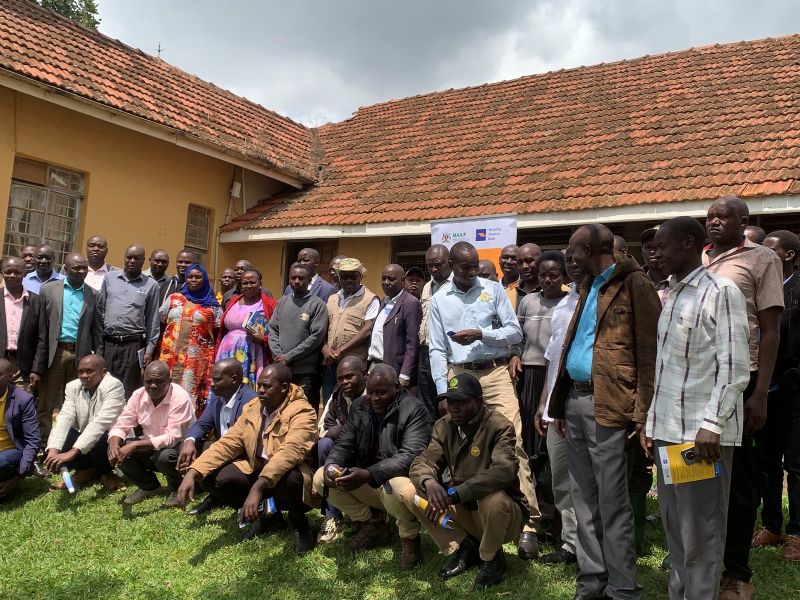
KAPCHORWA, June 25, 2026 — The Ministry of Agriculture, Animal Industry and Fisheries [MAAIF] has engaged leaders and technical officers in Kapchorwa district in a sensitisation meeting on the implementation of the Smart Livestock Vaccination Programme aimed at controlling and eventually eradicating Foot-and-Mouth Disease [FMD].
The engagement organised recently brought together district and subcounty leaders, technical staff, and such as extension workers to discuss strategies for ensuring successful livestock vaccination across the district noted for its production of high-quality Arabica coffee, grown on the fertile volcanic soils of Mount Elgon’s slopes.
Speaking during the meeting, Emmanuel Isingoma, a Veterinary Agricultural Officer from MAAIF, emphasised the importance of the vaccination campaign in protecting livestock and improving household incomes through effective disease control.
According to Isingoma, the Smart Livestock Vaccination Programme is a government intervention designed to strengthen livestock disease surveillance and ensure comprehensive vaccination coverage of susceptible animals, including cattle, goats, sheep and pigs.
“The major objective of this programme is to control and eradicate Foot-and-Mouth Disease, which continues to affect livestock production and trade in many parts of the country,” Isingoma said.
He explained that achieving herd immunity requires comprehensive vaccination coverage of all susceptible livestock. To achieve this, adequate quantities of vaccines must be procured and administered consistently throughout the year.
He noted that under the programme, farmers will be required to vaccinate their animals twice annually to ensure effective protection against the disease.
“For the vaccination exercise to succeed, farmers will be expected to contribute towards the cost of the vaccines. Government will subsidise the larger portion of the cost, while farmers will pay only a small amount,” he explained.
Under the cost-sharing arrangement, cattle farmers will contribute Shs 8,000 per animal, while owners of goats, sheep and pigs will pay Shs 4,000 per animal per vaccination cycle. Government will cover the remaining costs required for procurement, distribution and administration of the vaccines.
He urged local leaders and extension workers to intensify awareness campaigns in their respective areas so that farmers understand the benefits of vaccination and participate actively in the programme.
The Kapchorwa District Veterinary Officer Dr Jackson Chelangat welcomed the initiative, describing it as a timely intervention that will help address recurring outbreaks of FMD in the district.
He noted that livestock farming remains a major source of livelihood for many households in Kapchorwa and that disease outbreaks often result in significant economic losses for farmers.
“The success of this programme will depend on cooperation between farmers, veterinary personnel and local leaders. We need to ensure that every farmer understands the importance of vaccinating their animals and adheres to the vaccination schedules,” the District Veterinary Officer added.
He further called upon extension workers and veterinary officers at sub-county level to provide continuous guidance to farmers and ensure proper record-keeping during the vaccination exercise.
The District Production Officer, Felix Sabila, also commended the ministry for involving local stakeholders in the planning and implementation process.
Sabila said the sensitisation meeting had equipped leaders with the knowledge required to mobilise communities and support the vaccination programme.
“Livestock production contributes significantly to household income and food security in Kapchorwa. When diseases such as Foot-and-Mouth Disease occur, farmers suffer losses through reduced productivity and restrictions on animal movement and trade,” he said.
He encouraged farmers to embrace the programme and view the vaccination fees as an investment in protecting their animals and improving production.
Sabila also appealed to local leaders to work closely with technical officers to ensure that information reaches all livestock keepers across the district.
The meeting also provided an opportunity for participants to discuss challenges affecting livestock production and identify practical solutions to strengthen disease control measures.
In his closing remarks, Deputy RDC Kapchorwa district, Martin Sakajja urged all stakeholders to support government initiatives and ensure that the programme achieves its intended objectives.
He emphasised that controlling Foot-and-Mouth Disease requires collective responsibility among government agencies, local leaders, technical officers and farmers.
“This programme is not for government alone. It requires commitment from every stakeholder. Farmers must appreciate that vaccination is essential for protecting their animals and improving their livelihoods,” Sakaja said.
He called on sub-county leaders, LCIII chairpersons and extension workers to lead community mobilisation efforts and ensure farmers are adequately informed before the vaccination exercise begins.
Sakajja further urged technical teams to maintain transparency and accountability throughout implementation to build confidence among livestock farmers.
The stakeholder engagement concluded with a commitment from district leaders and technical officers to support the rollout of the Smart Livestock Vaccination Programme and strengthen efforts aimed at eliminating FMD in Kapchorwa district.
Participants expressed optimism that, with adequate sensitisation, government support and farmer participation, the programme will significantly reduce disease outbreaks, improve livestock productivity and enhance household incomes across the district.
Livestock rearing complements crop farming, with goats and cattle being prominent, often integrated into mixed farming systems for milk, meat, and manure. According to Uganda Bureau of Statistics data, Kapchorwa maintains approximately 95,564 head of cattle and 75,073 goats, alongside smaller numbers of sheep, pigs, and poultry, providing additional income and nutritional diversity.
https://thecooperator.news/kitgum-to-vaccinate-110000-livestock-under-national-fmd-drive/
Buy your copy of thecooperator magazine from one of our country-wide vending points or an e-copy on emag.thecooperator.news


