
MBARARA CITY, August 25, 2026 — Rapid urbanisation, prolonged dry spells and livestock disease quarantines have caused a sharp decline in milk production across Mbarara City and the wider Ankole Sub-region.
The shortage has left local bulk milk collection centres empty, pushed up consumer prices and severely affected dairy processors.
Urbanisation and changing demographics hit production
Dr Moses Amanyire, Mbarara City Production Officer and City Veterinary Officer, confirmed that milk volumes at both farm level and collection centres have fallen dramatically.
“Concerning milk production, the current status is that we have had a huge reduction in production, and this is evident both at farm level and even when you move around the different bulk milk collection centres,” Dr Amanyire said.
“When you move to, especially, Bukaka Cooperative here in Mbarara along Ibanda Road, you realise that what they used to collect from farmers a few months ago compared to now — there’s quite a big gap, to the extent that by 11am or midday their cooler is already empty.”
Amanyire attributed a significant part of the decline to Mbarara’s elevation to city status in 2020, which accelerated urbanisation and led to the conversion of traditional farmland into residential estates and other real estate developments.
“For Mbarara City, you realise there is an issue of urbanisation,” Amanyire explained. “We used to have farms around town areas like Biharwe, Nyakayojo and Kakika — all these are traditionally farmlands, but we have seen quite a number of estates coming up.
“Go along Ibanda Road; there are farms that have just been turned into estates. What does this mean? A reduction in farm activities.”
He also highlighted rural-to-urban migration among young people, leaving agricultural activities largely in the hands of an ageing population that may struggle to adopt modern farming technologies.
“The challenge here is that production is reducing at a time when the population is growing,” Amanyire said. “When you look at who is in the farming business right now, the majority are old people. The young ones are not joining the farming business.
“Our parents in the farming business, the majority of them cannot cope with modern technologies, while others have already developed health problems because of age.”
Regional livestock disease outbreaks, including Foot-and-Mouth Disease (FMD) and anthrax scares, have compounded the problem, with quarantines restricting the movement of livestock and animal products from neighbouring districts.
“If we have an outbreak in these neighbouring districts, like there’s an ongoing quarantine in some of our neighbours, especially with the scare of anthrax, it means animal products are not coming from such districts,” Amanyire added.
Severe production deficit sends prices soaring
The decline in milk supplies across Mbarara is substantial. While the city typically receives up to 20,000 litres of milk per day during periods of optimal production, the current daily supply has fallen to less than 5,000 litres.
As a result, retail milk prices in Mbarara City have more than doubled, rising from between Shs1,200 and Shs1,500 per litre to between Shs2,500 and Shs3,000.
Drought conditions have also strained municipal water supplies, pushing the price of a 20-litre jerrycan of water to between Shs2,000 and Shs5,000 in areas such as Biharwe, Nyamitanga and Katete, as water levels in the River Rwizi fall to critical levels.
“At the end user in town, a litre goes right now for between Shs 2,000 and Shs 2,500 [or up to Shs3,000],” Amanyire said. “But at farm level, you find there are those even selling at Shs600 per litre, though there are those selling above Shs 1,000.”
To address price exploitation by middlemen and reduce the cost of inputs such as acaricides, Amanyire urged farmers to join dairy cooperatives.
“The bargaining power cannot be the same for an individual,” he emphasised. “These middlemen are exploiting the fact that there are still some farmers who do not want to join those groups. When they are together, even the inputs become cheaper.”
Dairy processors squeezed by low supply and adulteration
The milk shortage is also severely affecting major regional dairy processors.
Wamala Segirima, a quality assurer at Lakeside Dairy Ltd, said the company’s daily milk intake had fallen by as much as 100,000 litres.
“We are supposed to be receiving 200,000 litres per day, but now we are receiving 120,000 litres or 100,000 litres per day,” Segirima said. “So you can see that lowers the production that we tend to have every day.”
Segirima said the drought had contributed to widespread milk adulteration, as desperate suppliers attempt to stretch limited quantities by adding water. This has forced processors to reject large quantities of milk because of poor fat and density levels.
“Because the milk quantity is low, farmers or transporters tend to adulterate the milk by adding water,” Segirima explained. “We are experiencing challenges in fat and density. We are rejecting more milk that is brought to us due to quality.”
Cooperatives feel the impact across south-western Uganda
The severe dry spell across cattle corridor districts, including Kiruhura, Isingiro, Lyantonde and Ibanda, has forced cattle to travel long distances in search of water and pasture. The resulting heat stress has contributed to significantly lower milk yields.
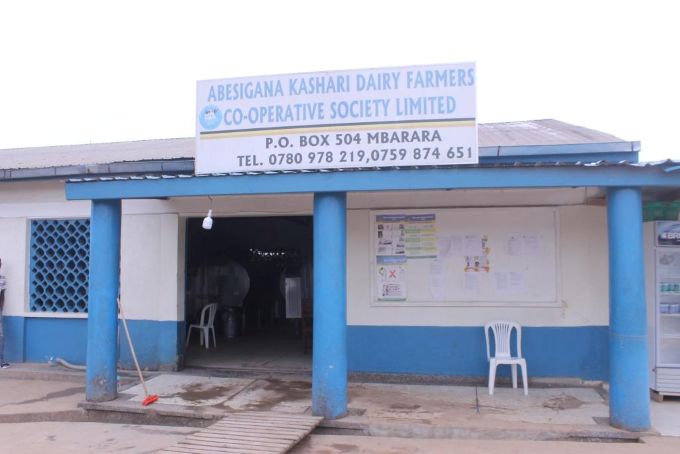
Atushemeza Agaba, General Manager of Abetsigana Kashari Dairy Cooperative in Biharwe, said the effects of water scarcity and inadequate feed were being felt directly by farmers.
“Since milk is 87 per cent water, production drops sharply,” Agaba said. “At the same time, many farmers face high costs of buying animal feeds such as hay, dairy meal and concentrates, and some are even forced to sell their cows.”
Similar declines have been recorded at Nyamisindo Dairy Cooperative in Isingiro, where daily milk collections have fallen to 2,500 litres from 6,500 litres collected from its 312 members.
Karham Kamuntu, Manager of the Uganda Crane Creameries Cooperative Union [UCCCU], which represents 140 primary cooperatives across 10 district unions in south-western Uganda, said milk production across its network falls sharply during the dry season.
“We produce around 1.2 million litres during the rainy season per day and 350,000 litres per day during the dry season, which is less than half,” Kamuntu said.
“By 10am, cows are under the trees to get shade and are not eating until around 4pm. So that also limits production.”
Kamuntu warned that low milk volumes significantly increase operating costs for cooperatives and processors, while delayed collection can compromise milk quality.
“The cooler that can chill 3,000 litres now has only 800, but still it will take the same time to chill, the same fuel, the same power and the same staff,” Kamuntu explained.
“Instead of sending a truck daily, milk stays for two days in the cooler, reducing the quality because it’s not picked every day.”
Climate-smart agriculture needed
To address increasingly extreme weather patterns, sector leaders are calling for a shift away from open grazing towards semi-zero grazing, pasture conservation and wetland protection.
“Climate change is here to stay,” Kamuntu stressed. “In mitigation, we have to restore our wetlands and plant more trees. In adaptation, we need to grow pastures — especially Napier grass, maize, Chloris and Brachiaria — to make hay and silage for the dry season.”
Amanyire similarly urged farmers to move away from reliance on traditional rainfall patterns and adopt modern technologies.
“With the current weather, we cannot use only traditional ways,” Amanyire advised. “Every 15th of August we used to be sure that it would rain, but this is not happening.
“If I was milking 10 cows giving me 50 litres, we need to think of owning two or three cows that give us 50 or more litres through improved production technologies.”
Kamuntu called on government to establish demonstration dairy farms and seed multiplication centres to make planting materials for fodder production more accessible to farmers.
“Establishment of demonstration farms and centres and also seed multiplication centres, because you cannot tell farmers to plant Napier and then they don’t have the source where to get the Napier,” Kamuntu said.
“Farmers can get the planting materials, and also the sensitisation of farmers to know the importance of dry-season feeding.”
Buy your copy of thecooperator magazine from one of our country-wide vending points or an e-copy on emag.thecooperator.news
-

-

-

-


