
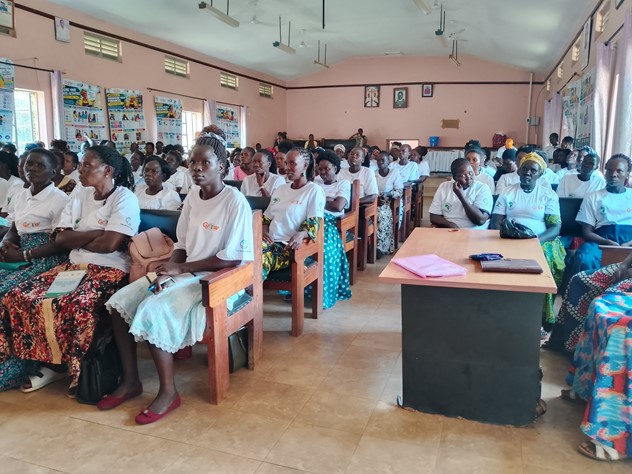
GULU CITY, November 24, 2026 – Businesswomen in Gulu have been urged to formalise their enterprises by registering them with the Uganda Registration Services Bureau [URSB] to enjoy the benefits of operating under legally recognised business names.
Brayan Ochora, a project officer at the URSB Regional Office in Gulu City, said many people avoid registering their businesses for fear of taxation, thereby missing out on opportunities such as commercial bank loans and government grants and loans under initiatives such as the Generating Growth Opportunities and Productivity for Women Enterprises [GROW] project.
“People think business formalisation is all about tax. But there are many benefits a business enjoys when it is formalised. You can compete better when you have a formalised business, and people can easily locate and do business with you,” Ochora said.
He compared informal businesses to street hawkers, whose whereabouts can be difficult to establish when customers want to seek redress over defective products.
“If you buy something from a hawker moving on the street and find a defect in the item, how will you go back and claim that you bought it from that person? Even when you go to court, there is no evidence that you bought it from that person. But if you transact with a business person who is formalised, you gain trust because you know you can follow up in case of anything,” he said.
Ochora was speaking on Thursday during a five-day essential skills training programme for 106 women entrepreneurs in Gulu district under the GROW project.
URSB, the government agency mandated to register businesses, charges Shs 35,000 to reserve a business name and Shs 55,000 to register it.
Launched in March 2023, the GROW project is a US$ 217 million Government of Uganda initiative funded by the World Bank and implemented by the Ministry of Gender, Labour and Social Development in partnership with the Private Sector Foundation Uganda.
The project aims to support women-owned enterprises to grow from micro to small-scale businesses and from small to medium-sized enterprises in targeted areas, including refugee-hosting districts.
During the five-day training, the women were also equipped with skills in 10 other thematic areas, including personal development, developing an entrepreneurial mindset, managing business activities and ensuring business sustainability.
Monica Akello, a salon operator in Bukur, Omel Subcounty, Gulu district, said the training had helped her appreciate the importance of proper financial management.
“I have learnt the importance of not taking multiple loans. Sometimes women are tempted to take several loans because microfinance institutions and moneylenders are willing to lend them money.
“Personally, I was not managing my business properly because I would take out a loan and spend the money on buying new clothes, eating nice food and make-up instead of investing it in the business. This is why my business has been struggling for the last 10 years, but this will now change,” Akello said.
Pauline Ajok, a hardware shop owner in Cwero, Paicho Subcounty, said the training had opened her eyes to the importance of formalising her business.
“I am going to register my business so that I am ready to benefit from any opportunities offered by the Government and other customers,” she said.
Piloya Jackie, the GROW project Focal Person, who also serves as the district labour officer, said the women had been equipped with information on how to access loans and grants under the project.
However, she noted that many rural women were unlikely to benefit from the GROW project loan facility because it targets enterprises operating in traditionally male-dominated sectors.
“The percentage of women who will benefit from the GROW project loan is going to be small because they are advocating that the women participating should be in male-dominated sectors such as construction, value addition, ICT and agro-processing. Most of our rural women are in traditional businesses that women have always engaged in,” Piloya said.
The GROW project loans are being disbursed through six commercial banks: Centenary Bank, DFCU Bank, Equity Bank, Finance Trust Bank, Pearl Bank and Stanbic Bank. The banks are charging interest rates ranging from 8.5 to 10 percent.
The Government of Uganda has committed Shs 120 billion to the initiative, of which Shs 50bln has been disbursed to the participating banks.
Women entrepreneurs can access loans ranging from Shs 4 million to Shs 200mln through the commercial banks at an annual interest rate of 10 percent.
On November 17, 2026, government launched a new funding round opening applications for non-repayable business grants of up to Shs 111mln for eligible women-owned enterprises through December 11, 2026.
Phoebe Ayoo, the Gulu District Woman Member of Parliament, urged the women to work hard and grow their businesses to enable them to contribute to meeting their families’ needs.
“Women are an important pillar in a family. Let us not be stingy with our money. It is sad when you hear that a child has been sent away from school because of school fees when the mother can afford to support them,” she said.
Buy your copy of thecooperator magazine from one of our country-wide vending points or an e-copy on emag.thecooperator.news


