
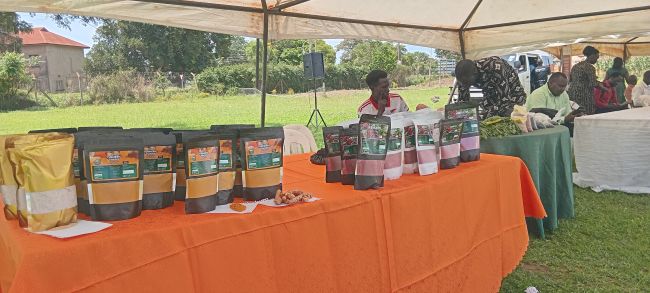
SOROTI CITY, October 16, 2026 — Farmers in Teso Subregion have been urged to move beyond producing food for household consumption and embrace commercial agroecology to improve their household incomes, protect their health and conserve the environment.
The call was made during the National Agroecology Festival being held at Soroti City Museum from October 15 to 16, 2026, bringing together farmers from Amuru, Lango, Sebei, Teso, Buganda and other parts of Uganda to showcase organic foods, indigenous seeds and traditional farming innovations.
The farmers are exhibiting organically produced foods, including vegetables, as part of efforts to promote sustainable farming practices and demonstrate the benefits of agroecology, a farming approach which support climate resilience, environmental stewardship, economic sustainability, food sovereignty, health equity, and more..
Nancy Mugimba, the National Coordinator of the Eastern and Southern Africa Small Scale Farmers Forum [ESAFF] Uganda, said farmers should shift from producing only enough food for their families to adopting commercial agroecological practices that can improve their livelihoods.
Mugimba said agroecology goes beyond food security, as it also focuses on income generation, healthy living, soil conservation and the preservation of indigenous seeds.
She urged farmers to recognise agriculture as a source of income while adopting farming practices that protect the environment and sustain food production.
Margret Masudio, the vice chairperson of ESAFF Uganda, said many farmers in Uganda concentrate on producing enough food for their families but overlook the wider economic and environmental benefits of agroecology.
Masudio said agroecological farming can help farmers access better market prices while producing healthy food, preserving indigenous seeds and protecting the environment.
She added that the approach discourages the use of artificial chemicals and can create opportunities for farmers to earn more through organic markets, both locally and internationally.
Farmers who spoke to The Cooperator news said training in agroecology has helped them adopt farming practices that improve soil fertility, reduce seed wastage and enhance their livelihoods.
Juventine Ochom, a farmer from Kyere Farmers Seed School, said the training has equipped them with knowledge about using organic fertilisers to improve soil fertility.
“After they trained us, we learnt to embrace organic fertilisers, which are rich in soil nutrients,” Ochom said.
Moses Opio, a farmer from Bugondo Sub-county in Serere district, said farmers had faced several challenges before adopting organic farming practices, but their livelihoods had since improved as their crop yields increased.
“These days, farming has become economical, and a lot of seed is not wasted because we plant in rows and columns, which has saved a lot of seeds from being wasted,” Opio said.
Irene Nakijova, a farmer from the Buganda region, thanked ESAFF Uganda for equipping farmers with knowledge about agroecology, saying the skills had helped them improve the performance of their crops.
Nakijova said their coffee, bananas and pineapples were doing well after they embraced organic farming practices based on the knowledge they had acquired.
Her experience highlights how agroecology training can support farmers in different regions to improve crop production while adopting environmentally friendly farming methods.
The two-day festival provides a platform for small-scale farmers from different regions to exchange knowledge, showcase indigenous seeds and organic produce, and promote farming practices intended to improve livelihoods while conserving the environment.
Buy your copy of thecooperator magazine from one of our country-wide vending points or an e-copy on emag.thecooperator.news
-

-

-

-


