
SERERE, October 15, 2026 — The National Agricultural Research Organisation [NARO] has intensified cassava multiplication efforts to ensure farmers in the Karamoja Subregion have access to quality planting materials to help them cope with recurring drought and food insecurity.
Through the Uganda Climate-Smart Agricultural Transformation Project [UCSATP], NARO is promoting drought-resilient and early-maturing crops to help communities withstand prolonged dry spells that often result in hunger.
One of the major crops being promoted is cassava, which researchers say has the potential to provide a reliable source of food in Karamoja because of its resilience and ability to remain in the soil for extended periods.
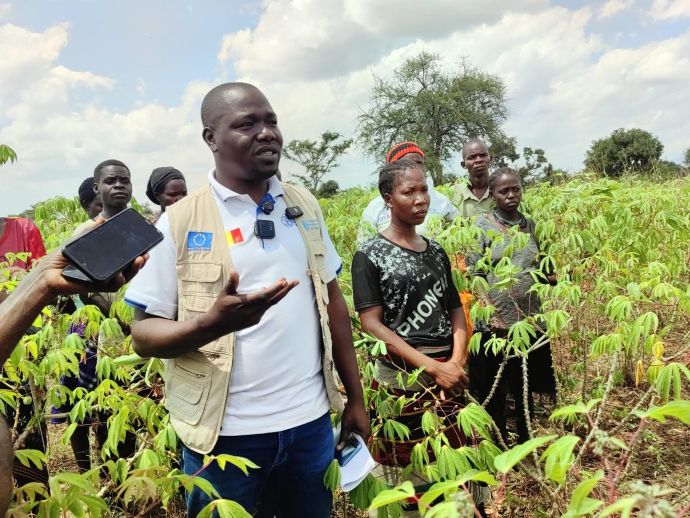
The campaign is being implemented at the Nabuin Zonal Agricultural Research and Development Institute [Nabuin ZARDI], where a 200-acre cassava multiplication and demonstration facility has been established under UCSATP to ensure farmers have access to quality planting materials while also demonstrating improved cassava production technologies.
The Director of Research at Nabuin ZARDI, Dr Walter Odongo, said the intervention is aimed at increasing cassava productivity and improving the livelihoods of people in the region.
“The intention here is two-fold: one, to increase access to quality planting material, but also to demonstrate cassava production technology to the farmers,” Odongo said.
Cassava is particularly relevant to Karamoja because of the region’s exposure to extreme climate variability and prolonged dry spells.
“Cassava has proven to be a very resilient crop for the farmers. So, once this technology is adopted, the cassava varieties we are promoting, for instance NAROCAS 1, are very well adapted to the region,” he said.
Thousands of farmers across the region are expected to access planting materials from the multiplication facility.
The Coordinator of UCSATP at NARO, Dr Damalie Akwango, said Nabuin ZARDI is working with about 200 farmer groups through the cassava demonstration initiative.
Speaking to theCooperator News in a brief interview, Akwango said the 200-acre block is expected to provide planting materials for about 6,000 individual farmers across the region.
“This is a good move towards the achievement of what is planned in the project. Once our target of 6,000 farmers is reached, that will be so impactful,” Akwango said.
The intervention forms part of UCSATP’s broader efforts to increase access to improved agricultural planting and breeding materials among organised farmer groups as part of measures to address food insecurity.
NARO is currently promoting three cassava varieties at the demonstration site: NASE 14, NASE 19 and NAROCAS 1.
Dr Anthony Raphael Ijara, a Senior Research Officer at NARO, said the varieties were selected for their desirable characteristics, including adaptability, high yields and relatively early maturity.
“NASE 14 is easily adaptable to the soil and it is high yielding and quick maturing. NASE 19 equally has high-yielding traits and has the capacity to survive in the soils longer,” Ijara said.
He said NAROCAS 1, which has performed well in different parts of Uganda, is also being promoted because of its high yield potential and longer shelf life.
The researchers believe the crop could help change the perception of cassava among communities in Karamoja, where it has traditionally been regarded as a crop that grows largely on its own.
Traditionally, cassava was perceived in Karamoja as a wild crop that required little cultivation. Many communities did not consider it a normal food crop, particularly during periods of adequate food availability. However, the effects of climate change and recurring food shortages have increasingly forced households to rely on cassava as a survival food.
Farmers also traditionally relied on local cassava varieties that were often hard, thin and slow to mature.
The demonstration site at Nabuin therefore serves not only as a source of improved planting materials but also as a practical learning centre where farmers can observe recommended cassava production practices.
Ijara noted that one of cassava’s biggest advantages in Karamoja is its flexibility as a food crop.
“Cassava can ensure food availability throughout the year because it can be harvested piecemeal and is always available when needed, as opposed to other crops that are harvested at a particular time,” he said.
For a region regularly exposed to prolonged dry spells, researchers say the ability of the improved cassava varieties to remain in the soil for longer periods could provide an additional buffer against hunger.
The 200-acre NARO site is being developed as a strategic “nuclear farm” from which cassava planting materials and production skills can be extended to communities across Karamoja and beyond the border into Turkana, Kenya.
One of the host farmers in Napak district, Patrick Lugel, said farmers who have received training from NARO are increasingly appreciating the improved cassava varieties.
“These cassava varieties are very good. Farmers are very happy about them. My call to the farmers in Karamoja is that they should continue planting cassava to fight hunger. We want cassava as a staple food,” he said.
Karamoja weather outlook
The Karamoja region has one main rainy season, with rainfall generally expected between March and August each year. However, in 2026, the rains stopped earlier than usual, resulting in a prolonged dry spell and a rainfall deficit of between 100 and 200 millimetres below normal, according to the IGAD Climate Predictions and Applications Centre [ICPAC].
ICPAC has also warned of El Niño conditions and the possibility of above-normal rainfall and flooding in the wider region.
The contrasting weather conditions pose a challenge to farmers who have already experienced below-average rainfall, low harvests, crop failure and plant stress.
The agency has projected a 63 per cent chance of above-normal rainfall and flooding across the entire cluster, which could result in crop losses estimated at between 50 and 70 per cent for crops including sorghum, maize, beans and groundnuts.
Buy your copy of thecooperator magazine from one of our country-wide vending points or an e-copy on emag.thecooperator.news


