
SOROTI, October 9, 2026 — Farmers in the Teso Sub-region have been encouraged to embrace coffee growing to boost household incomes and improve livelihoods.
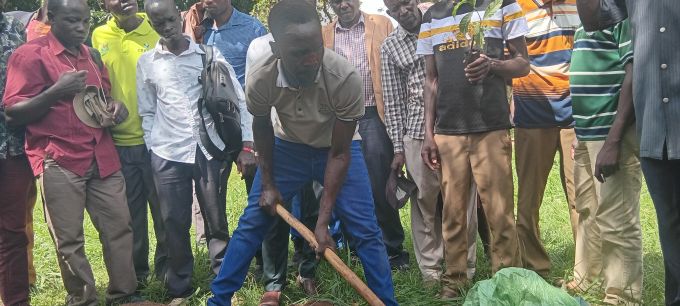
The call was made during a recent coffee establishment training attended by about 500 farmers, each of whom is expected to receive 100 coffee seedlings for planting.
Grace Apolot, a regional coffee trainer under the Ministry of Agriculture, Animal Industry and Fisheries [MAAIF], said farmers in Teso should take advantage of the region’s suitability for Robusta coffee and establish gardens using proper agronomic practices.
She urged farmers not to be discouraged by the belief that they had started growing coffee too late, saying those with existing fruit trees could plant coffee alongside them instead of cutting down the trees.
“Let people not think they have delayed. At least they are better off than those who have not heard,” Apolot said.
She advised farmers to plant coffee at a spacing of three metres by three metres, with planting holes measuring two feet by two feet.
Apolot said farmers should separate the topsoil from the subsoil when digging the holes, mix the topsoil with at least one basin of manure per hole and use the mixture to refill the holes before planting.
She also cautioned farmers against planting coffee in swampy areas, saying excessive water could affect the growth of the seedlings.
“The key thing in coffee growing is the size of the hole which, if not done appropriately, affects production,” she said.
Abraham Ariko, the director of agriculture at the Iteso Cultural Union [ICU], said the initiative was aimed at helping farmers adopt coffee as an additional income-generating activity.
He said each district would receive 5,000 seedlings for 50 farmers, except Katakwi district.
“Teso has faced a big challenge of irrigation schemes, but we have a plan to lobby the Government. People should first improvise in the meantime,” Ariko said.
He urged farmers to properly manage the seedlings to ensure they develop into productive coffee gardens capable of generating income and contributing to poverty reduction.
Andrew Ocole, the Prime Minister of the ICU, cautioned farmers against taking seedlings if they were not prepared to manage them.
He said farmers would be monitored to ensure the seedlings were properly cared for.
Doreen Angiro, one of the farmers who attended the training, said the programme had challenged the long-held belief that Teso’s soils were unsuitable for coffee growing.
Tom Odeke, another farmer, said the training had improved his knowledge of coffee production and expressed hope that the crop would improve farmers’ livelihoods.
The initiative is expected to encourage more farmers in Teso to take up coffee growing as an additional source of income, with proper management of the seedlings key to ensuring the programme achieves its intended benefits.
MAAIF is encouraging coffee farmers across Uganda to register their farms, adopt climate-smart agricultural practices and use certified, disease-resistant planting materials.
https://thecooperator.news/climate-smart-project-to-improve-animal-husbandry-in-teso-karamoja/
Buy your copy of thecooperator magazine from one of our country-wide vending points or an e-copy on emag.thecooperator.news


