
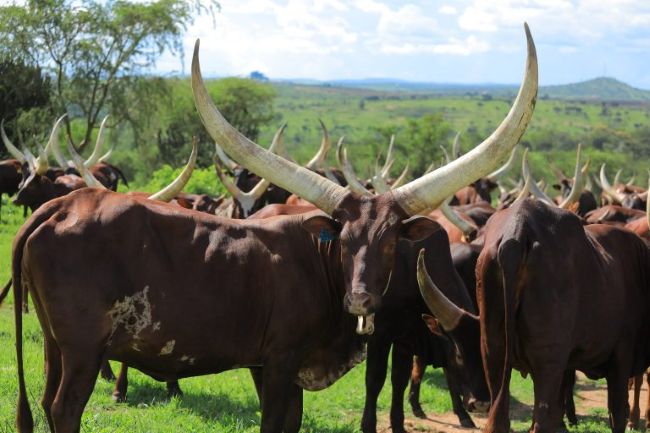
KARUHURA, October 6, 2026 — The National Agricultural Research Organisation [NARO] is implementing a structured breeding programme at Nshaara Conservation Ranch in Kiruhura district aimed at increasing milk productivity in traditional Ankole longhorn cattle without compromising the breed’s genetic identity and adaptability.
The National Animal Genetic Resources Centre and Data Bank [NAGRC&DB] is conducting the programme based on the proposition that the dairy potential of Ankole cattle can be progressively enhanced without crossbreeding.
The researchers have established that the breed’s milk-producing potential can be improved through selective breeding while retaining its genetic characteristics and adaptability.
The programme, which started three years ago, involves identifying superior milk-producing animals within the pure Ankole population and multiplying their genetics through controlled breeding.
The process includes incorporating selected Ankole genetics from recognised sources, including the Kisozi Ankole Longhorn conservation and improvement herd.
The approach combines genetic selection with pedigree management, performance recording and improved nutrition.
“We are not trying to turn the Ankole into an exotic dairy cow. We are identifying superior dairy traits that already exist within the pure Ankole population and systematically selecting and multiplying those genetics,” said Dr Innocent Tuwangye, Manager of Nshaara Conservation Ranch.
The distinction is important because, unlike crossbreeding with exotic dairy breeds to increase milk output, the programme seeks to improve the productive performance of the Ankole cow while retaining its genetic characteristics.
Researchers at NAGRC&DB recently told theCooperator News that milk yield is the principal selection trait, followed by lactation length, udder conformation and calving interval.
According to them [researchers], this is intended to ensure that increased milk production does not come at the expense of reproductive performance or other functional characteristics.
Replacement heifers are evaluated using information from their dams, including milk production, growth and fertility records, as well as physical assessments of body structure, udder development and temperament.
The genetic contribution of bulls to the milk-producing potential of future generations is also considered important in the breeding process.
Candidate bulls are therefore assessed partly on the milk-production performance of their dams, alongside their own growth, body size, maturity, reproductive soundness, testicular development, libido and temperament.
The approach is intended to create a cumulative improvement process in which the best-performing animals contribute disproportionately to subsequent generations.
Rising productivity
At Nshaara, the results suggest that the strategy is translating into higher productivity.
In 2023, average milk production stood at at least 5.2 litres per cow per day. Annual records showed total production of 56,040 litres from 35 active milking cows.
Records for 2024 indicate that average productivity rose to 7.0 litres per cow per day, while annual milk production from 47 cows nearly doubled to approximately 106,358 litres by December.
By 2025, average productivity had reached 8.6 litres per cow per day, with annual recorded production rising to approximately 168,285 litres from at least 60 dairy cows.
Over the three-year period, average productivity increased by about 65.4 percent, although the increase in the number of milking cows also contributed to the growth in total annual production.
Tuwangye said total milk output alone does not demonstrate genetic improvement.
“A larger milking herd will naturally produce more milk. The rise in average production per active cow provides a more relevant indicator of changing performance,” he said.
He cautioned that establishing the precise contribution of genetics requires longer-term records and appropriate comparisons.
Tuwangye also urged dairy farmers and cooperatives to give the breeding process time to generate scientifically validated improvements while maintaining the breed’s adaptability and supporting business sustainability.
The Executive Director of NAGRC&DB, Dr Peter Beine, said breeding and nutrition must work together to realise the animals’ productive potential.
“Selection identifies the animal with superior genetic potential, but nutrition determines how effectively that potential is expressed,” Beine said.
At Nshaara, record-keeping systems covering animal performance and reproductive information are maintained through physical farm records and NAGRC&DB’s Integrated Livestock Management Information System [ILMIS]. The system enables breeders to track individual animals, maternal lines and milk production across successive lactations.
Buy your copy of thecooperator magazine from one of our country-wide vending points or an e-copy on emag.thecooperator.news


