
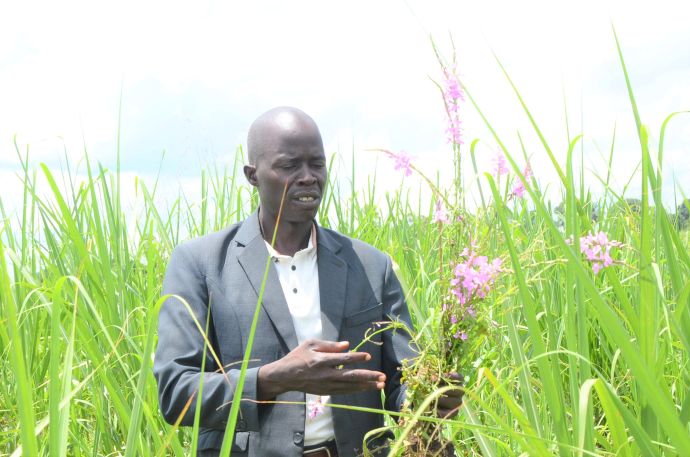
MASINDI, November 15, 2026 – Striga weed, also known as witchweed, has emerged as a major food security threat in Masindi District, forcing farmers to abandon maize growing following its spread across parts of the district over the past four years.
Farmers in four sub-counties – Pakanyi, Labongo, Miirya and Kiruli – in Buruli County, traditionally known for maize production, are among the worst affected by the parasitic weed.
The farmers have expressed frustration over what they describe as government’s failure to provide a lasting solution to the problem, saying the infestation has severely affected their livelihoods and economic well-being.
Striga mainly attacks cereal crops, including maize, sorghum, millet and rice, as well as sugarcane. Farmers say efforts to control it using herbicides have been largely unsuccessful.
Presenting her report at a recent district budget conference held at Country Inn Hotel, Masindi District Production and Marketing Officer Fred Ssebuguzi warned that the district could face severe food shortages as farmers increasingly abandon maize growing in favour of crops less susceptible to the weed.
“The sub-counties which are known for maize growing are the most affected, and we haven’t got any lasting solution to this weed. What we are telling farmers is to practise crop rotation, which is also not effective,” Ssebuguzi said.
She added that she had presented the matter to Parliament’s Committee on Agriculture, but no lasting intervention had been secured.
Speaking at the same meeting, Kanaginagi Ateenyi, a prominent maize farmer in Labongo Subcounty, questioned why the Government had failed to find a lasting solution to the problem despite successfully tackling other challenges, including pandemics.
He called on government research institutions to develop an effective herbicide to combat the weed, warning that continued inaction could worsen food insecurity.
“You grow an acre of maize and get only one bag, yet previously you would get 10 bags and above. Government, through its research institutions, should come out with an herbicide because, if nothing is done, there is going to be a growing food insecurity threat. Because of Government’s failure to address the issue, we are doing away with maize growing,” Ateenyi said.
James Balikungi, a farmer and LCIII Chairperson of Labongo Subcounty, said the weed causes crops to become stunted once it invades maize or sugarcane plantations.
“Due to Striga weed, I lost about Shs 12 million which I expected to earn from my two hectares of maize,” he said, adding that nearly a third of his subcounty had been affected.
Balikungi said the infestation intensified after the weed was first reported in Kijumbura village, Labongo Subcounty, in 2023.
“This weed is parasitic, dangerous and resistant to herbicides. There is no approved chemical that we can use to combat it. We, the farmers and extension workers, are just guessing which chemicals to use. The people involved in maize growing in this area have all made losses,” he said.
Asked how he was controlling the weed, Balikungi said he had resorted to rudimentary methods such as uprooting it, although he described the approach as ineffective and impractical.
“Schools will not have food because maize is the most affected crop, yet it is the source of livelihood for people here. Our economy is also going to be affected. Our extension officers have not helped us because they are also ignorant about it. People are using all sorts of chemicals and, in the end, they make losses,” he added.
Hassim Asiimwe, a farmer from Kidwera Village in Labongo Subcounty, said Striga had also devastated his one-acre maize garden, from which he had expected to harvest more than 10 bags.
“I got only one bag because, immediately after the weed invaded the garden, the maize plants became stunted. We are mostly worried about hunger and where to get money for school fees. I tried using different herbicides, which are also expensive, but in vain. When I asked our extension officers for guidance, they only told me to uproot it,” Asiimwe said.
Livingston Kyotamanya, the LCIII chairperson of Miirya Subcounty, said farmers had increasingly abandoned cereal production in favour of legumes since the weed invaded the area, raising fears of future food shortages.
“All my 20 villages have been invaded by this weed, and there will be no production of maize and other cereals,” he said.
Nature and impact of Striga weed
Edida Kamuregeya, an agricultural officer overseeing Labongo and Pakanyi sub-counties, said there are two types of Striga weed, one characterised by a red colour and the other by a purple colour.
She said the infestation had become severe, causing farmers to lose nearly 40 per cent of their expected yields.
Kamuregeya explained that Striga is a parasitic weed that attaches itself to the roots of other crops and draws nutrients from them, causing stunted growth and reduced productivity.
Affected crops include sugarcane, maize, sorghum, millet and rice, among other cereals.
How Striga weed spreads
According to Kamuregeya, the weed can spread from one location to another through wind, contaminated farm tools, livestock, farm-saved seeds intended for planting in subsequent seasons and flowing water.
How to control Striga weed
Kamuregeya advised farmers to adopt early planting, crop rotation and intercropping with legumes as some of the measures that can help control the weed.
The Masindi farmers are, however, calling for more practical interventions, including research into effective control methods and increased technical support from agricultural extension workers.
The district budget conference was held under the theme: “Full Monetisation of Uganda’s Economy through Commercialisation of Agriculture, Industrialisation, Broadening and Expanding Services, Digital Transformation and Market Access.”
Buy your copy of thecooperator magazine from one of our country-wide vending points or an e-copy on emag.thecooperator.news


