
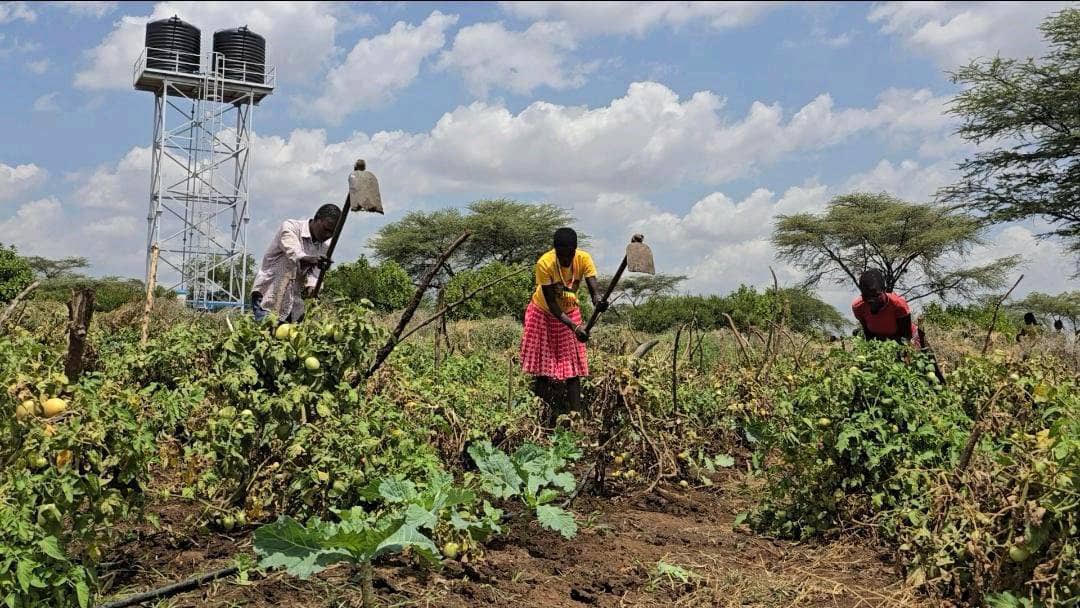
MOROTO — Farmers in Lokitumo Village, Lotisan Subcounty, Moroto district, have started harvesting vegetables throughout the year after benefiting from a solar-powered irrigation system established by the Ministry of Water and Environment.
The irrigation system has enabled farmers to grow crops such as sukuma wiki, onions and tomatoes despite prolonged dry conditions affecting much of the Karamoja Subregion.
The project is being implemented to promote irrigated agriculture and demonstrate how communities in dry areas can increase food production through reliable water sources.
During a farmer field day held at the irrigation site, farmers displayed their produce and shared how the project has improved their livelihoods.
Josephine Tengori, one of the beneficiaries, said the project had improved nutrition in her household.
“Our children are now healthy because they eat fresh vegetables, and this is helping us reduce malnutrition in our home,” Tengori said.
Ronald Kato Kayizzi, Assistant Commissioner for Multipurpose and Bulk Water Development at the Ministry of Water and Environment, said the irrigation site was established as a demonstration centre where farmers can learn modern farming practices.
“The solar-powered water supply system focuses on establishing a minimum of two and a maximum of five acres of land per site as a centre of excellence where people are trained in irrigated agronomy,” Kayizzi said.
He added that the Moroto site had been successful and could be considered for expansion.
Moroto District Senior Agricultural Engineer Geoffrey Wanamama said the project had demonstrated that agriculture can succeed in Karamoja when farmers have access to sustainable water sources.
“This project proves that agriculture is possible in Karamoja as long as there is sustainable water. As a district, our role has been to train farmers and carry out routine monitoring of the project,” Wanamama said.
Assistant Resident District Commissioner Aol Mark Musoke called for the expansion of the irrigation project to other parts of the region facing food insecurity.
“This project is successful and should be scaled up. In times of hunger like this, such a project becomes a lifeline for the region,” Musoke said.
Besides supporting vegetable production, the solar-powered water system also provides water for livestock and domestic use by nearby residents.
Alice Okwakol, another beneficiary, said the project had also helped women improve their savings through a Village Savings and Loan Association [VSLA].
“Our group members are able to save money in the VSLA after selling vegetables,” Okwakol said.
Farmers, however, said they need additional support in accessing quality seeds, farm inputs and markets to sustain vegetable production.
They are now urging the Government and development partners to expand irrigation support to more communities across Karamoja, where drought continues to affect food production.
The Lokitumo project comes at a time when the region continues to face food insecurity challenges caused by prolonged dry spells and heavy dependence on rain-fed agriculture.
Meanwhile, Parliament has unanimously backed a motion calling for urgent government intervention to address the worsening drought and hunger crisis affecting Northern Uganda.
The motion, moved on Thursday by Kilak North County Member of Parliament [MP] Anthony Akol, seeks a resolution directing the Government to immediately scale up humanitarian assistance while investing in long-term climate resilience measures.
Akol called on the Government to urgently deliver relief food and agricultural inputs to households whose crops have failed due to the prolonged drought.
“Government should expedite the delivery of food items to support drought-affected households, as well as seedlings and planting materials for affected people to plant immediately in the forthcoming planting season,” he said.
He further called on the Government to strengthen climate resilience by investing in early warning systems capable of providing timely weather information to farmers and local governments.
The motion also urges the Executive to fast-track the utilisation of US$38 million earmarked under the Northern Uganda Social Action Fund IV [NUSAF IV] Disaster Risk Financing Facility to respond to the severe drought affecting West Nile, Acholi, Lango, Karamoja, Teso, Bukedi, Bunyoro and the Elgon sub-region.
Akol warned that the drought had evolved beyond an agricultural challenge into a humanitarian emergency.
“People have started dying of acute hunger, including children, the elderly and pregnant mothers. It is important that the country takes action now to avert a crisis,” he said.
Legislators rallied behind the motion, agreeing that the prolonged dry spell had exposed Uganda’s vulnerability to climate change.
Tochi County MP Peter Okot said many farmers had invested heavily in planting before the unexpected dry spell destroyed their crops.
“Unless the people of Greater Northern Uganda are urgently supported, many lives will be lost,” Okot warned.
Meanwhile, Omoro County MP Andrew Ojok proposed amending the motion to include crop insurance, arguing that Parliament repeatedly debates similar relief measures every year without addressing farmers’ vulnerability.
“If we help farmers insure their crops, we shall go a long way in protecting livelihoods,” Ojok said.
Simon Peter Longoli, Chekwii County MP, said the Karamoja region had received virtually no meaningful rainfall since April.
Longoli observed that more than 1.15 million acres of crops had been destroyed, while at least 20 people had reportedly died from hunger-related causes, although the Government has officially confirmed 16 deaths.
He acknowledged the Government’s recent allocation of Shs4 billion for emergency relief and rehabilitation of water facilities but argued that the response remained inadequate compared with the scale of need.
Longoli proposed three additional interventions: sustained food relief covering the six-month period before the next harvest; distribution of drought-tolerant seeds by the Ministry of Agriculture, Animal Industry and Fisheries [MAAIF]; and targeted nutritional support for an estimated 120,000 malnourished children in Karamoja.
Prime Minister Robinah Nabbanja assured legislators that the Government had already activated emergency interventions.
She disclosed that Cabinet had earlier considered a paper on the hunger crisis and that President Yoweri Museveni had directed the Office of the Prime Minister [OPM] to coordinate emergency food distribution with the army.
Food stocks, the Prime Minister added, had already been positioned in Kigumba, Kiryandongo District, while the National Enterprise Corporation had been contracted to transport relief supplies to the worst-affected districts in Karamoja.
“The President has instructed OPM to use the army to supply food relief to the most affected areas. Distribution is expected to commence on Friday, and MPs from affected districts should mobilise communities to receive the assistance,” Nabbanja told Parliament.
Additional reporting by agencies
Buy your copy of thecooperator magazine from one of our country-wide vending points or an e-copy on emag.thecooperator.news
-

-

-

-


