
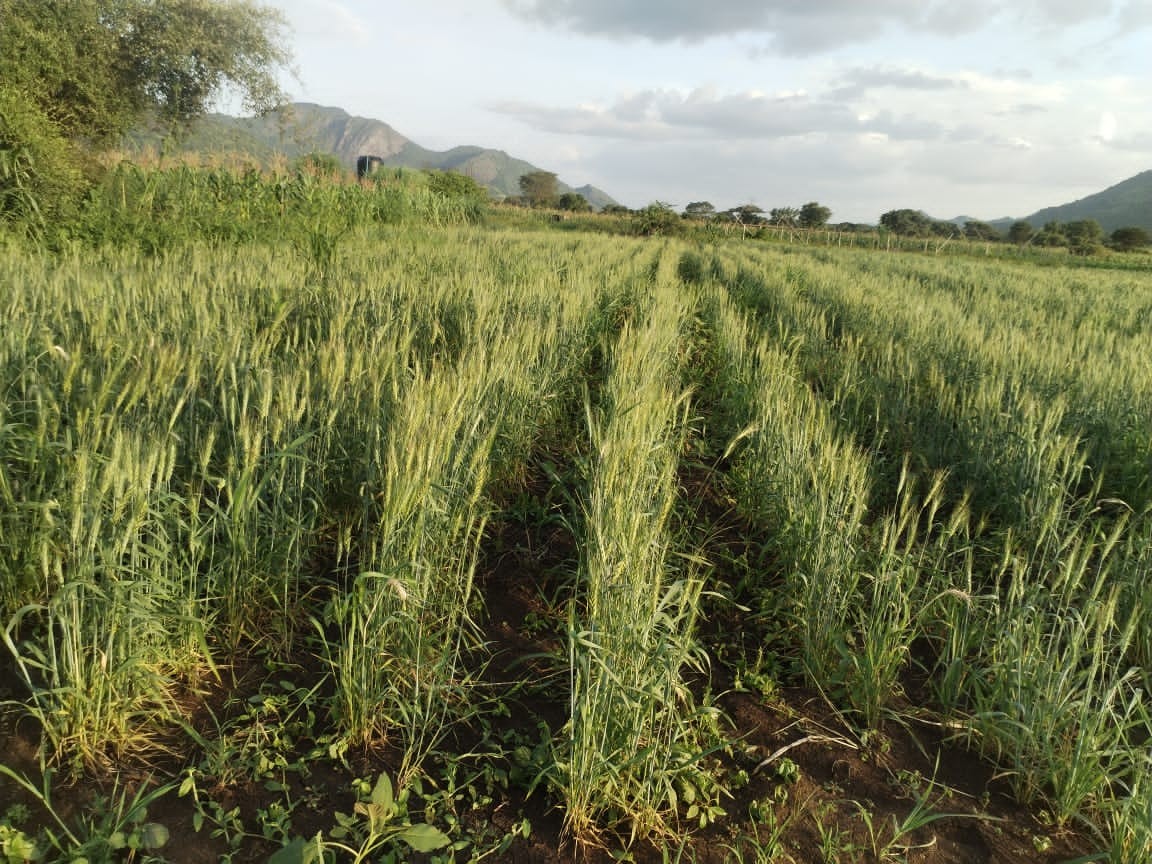
MOROTO, May 29, 2026 — Farmers across the Karamoja sub-region have appealed to the government for urgent intervention through the provision of subsidised irrigation equipment, as erratic weather patterns threaten the success of the newly launched wheat multiplication programme in the region traditionally known for nomadic pastoralism.
Despite the region’s potential for large-scale wheat production, a looming dry spell has left many growers in districts such as Abim and Moroto facing the prospect of total crop failure.
The wheat multiplication initiative, a collaborative effort between local farmers and the Ugandan government, was designed to establish a self-sustaining seed supply chain within three years.
This season, the programme allocated eight metric tonnes of wheat seed for rain-fed cultivation. However, the anticipated rainfall has failed to materialise in several areas, forcing farmers to confront the limitations of traditional rain-fed agriculture amid increasing climate volatility.
According to local weather forecasts, the dry season is expected to intensify from June through to September, a development that has heightened concerns among farmers who planted within the past six weeks.
Charles Alir, one of the early planters, expressed uncertainty about the survival of his crop. Although he took advantage of the early rains, he fears his wheat may not reach full maturity before the soil moisture is exhausted by the harsh June heat.
The situation is even more severe for farmers who planted later. Daniel Aleper said he sowed his seeds only two weeks ago, just as the rains stopped.
“The dry season set in, and almost all the wheat dried up,” Aleper said.
He added that the losses could have been prevented with better infrastructure, noting that an irrigation scheme would have helped sustain the crop.
In Abim District, the outlook remains equally bleak. John Paul Omugetum said the area has not received any rainfall since he planted his wheat, leaving the seeds struggling to germinate in the dry soil.
Meanwhile, Christine Kamubona observed that the lack of moisture has created additional challenges, as the hardened ground has made weeding significantly more difficult, further affecting the growth of the surviving crops.
The physiological effects of the prolonged heat and water stress are already evident in some fields. Bradford Ochieng reported that his wheat had begun “selective flowering”, a premature and uneven development caused by heat stress and insufficient moisture.
The development has raised serious concerns about yields, as flowering under stress often results in shrivelled grains and poor harvest quality.
Responding to the farmers’ concerns, Mark Abuku, Chairperson of the Karamoja Farmers’ Cooperative Association, also known as the Karamoja Farmers’ Cooperative Society, urged farmers not to lose hope.
He advised growers to adopt immediate moisture-retention measures, including mulching, to help preserve the limited soil moisture available.
Abuku noted that the current crisis should serve as a critical lesson for future agricultural planning in the region.
He encouraged farmers with the financial capacity to explore the Uganda Intergovernmental Fiscal Transfers [UgIFT] programme, a government-supported irrigation initiative that operates on a 25–75 cost-sharing arrangement, under which the government covers the larger share of installation costs.
However, many small-scale farmers in Karamoja say even the required 25 per cent contribution remains unaffordable, prompting renewed calls for fully subsidised or more heavily supported irrigation infrastructure.
As the region seeks to transition towards food self-sufficiency and establish a robust wheat value chain, the current dry spell has underscored the urgent need to move beyond reliance on unpredictable rainfall.
Farmers warn that without a reliable water management system, Karamoja’s ambitions of becoming a major wheat-producing hub will remain vulnerable to the effects of climate change.
Buy your copy of thecooperator magazine from one of our country-wide vending points or an e-copy on emag.thecooperator.news


