
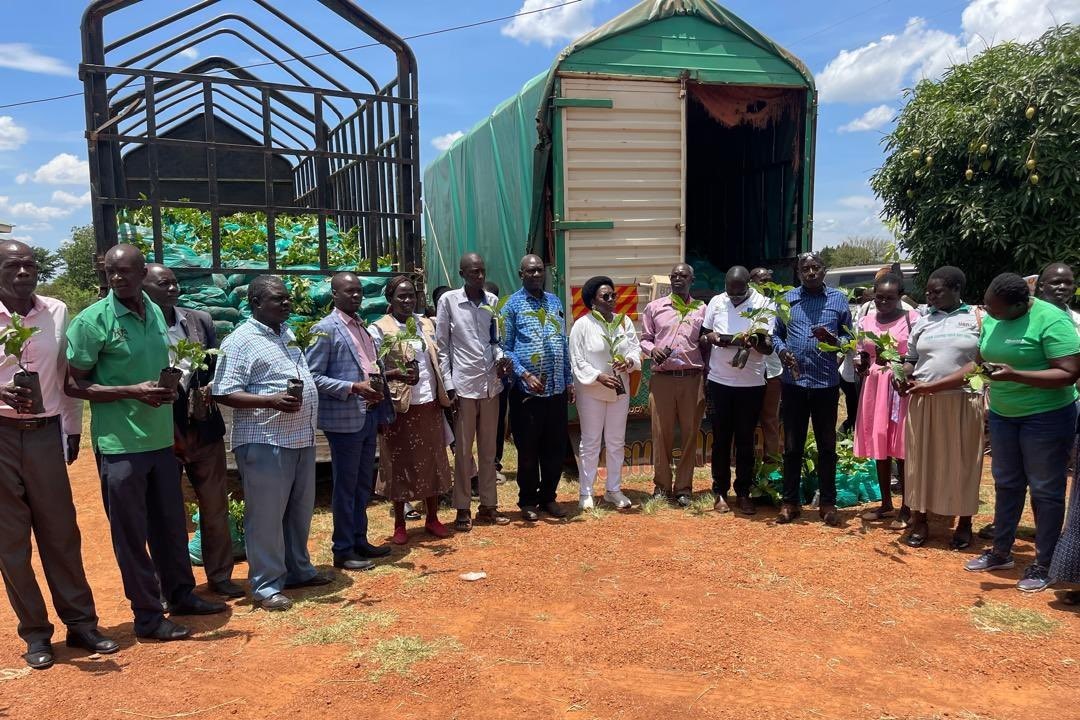
OYAM, April 20, 2026 — Oyam district has received 660,000 coffee seedlings from the Office of Operation Wealth Creation [OWC] as part of government’s broader initiative to transform the district and the wider Lango Sub-region into a major coffee-growing area.
The KR1–KR10 coffee seedlings were handed over on Friday by Sylvia Damalie Owori, Director of Operations at OWC, and will be distributed among farmers across 11 sub-counties and five town councils in the district.
Owori said OWC forms part of the government’s strategy to promote high-value perennial crops and improve rural livelihoods by actively involving religious leaders, stakeholders and farmers in discussions on a wealth-creation mindset.
“Through these engagements, it was discovered that one of the key reasons many farmers remained poor was their heavy reliance on short-term crops that take only about three months to mature. While such crops provide quick harvests, they fail to deliver sustainable income, unlike perennial crops, which provide long-term and reliable earnings,” Owori said.
She added that extension workers must ensure farmers who have expressed interest in coffee seedlings meet all the requirements.
“To the technical teams supplying coffee seedlings to farmers, ensure that every farmer receiving seedlings is fully prepared. They must have already prepared their gardens, undergone training, and continue to receive follow-up support to guarantee proper planting and care,” she advised.
Addressing farmers, Owori said coffee presented a pathway into the money economy.
“This is your opportunity to move into the money economy and get out of poverty. We believe coffee is what will lift you out of poverty,” she said.
Chris Ongom, the Oyam district LCV Vice Chairperson, cautioned against misuse of the seedlings, warning that they should not be left on verandas or under trees.
“We do not want a situation where people keep seedlings under trees or on verandas. Technical teams in sub-counties must continue training farmers to ensure that only those who are ready receive them,” he said.
The Oyam District Production Officer, Albino Cox Ogwal, said coffee had shown strong potential in Lango and urged farmers to work closely with extension workers.
“Consult with extension staff on how to plant and manage coffee, because it is a relatively new enterprise in our region,” he said, cautioning that poor management could result in low or no returns despite the availability of markets.
Assistant Resident District Commissioner Patrick Ocen Ebong said the government had identified Northern Uganda, traditionally known for growing cassava, cotton, sorghum and millet, as a key area to help the country meet its target of producing 20 million bags of coffee annually by 2030, as outlined in the Coffee Roadmap launched in 2017.
Ocen tasked leaders at all levels to carry out community sensitisation to encourage citizens to embrace coffee farming as a new opportunity for income and development.
According to a 2024 report from the now-rationalised Uganda Coffee Development Authority [UCDA], 127,184 households were engaged in coffee growing in the region, producing up to 962,278 60-kilogramme bags of coffee beans annually.
John Okullo, a beneficiary from Oyam Town Council, welcomed the initiative, describing it as timely in the fight against poverty.
“I am very impressed. I will make sure I put this into action,” Okullo said.
The KR1–KR10 coffee varieties were developed by Uganda’s National Coffee Research Institute [NaCORI] to provide high-yielding, resilient planting material.
Scientific research and field tests across Uganda’s diverse growing conditions show that the KR clones offer strong resistance to Coffee Wilt Disease [CWD] and Coffee Leaf Rust, as well as tolerance to Root Borer Disease [RBD]. These traits help reduce crop losses and lower chemical input costs. Their early maturity enables faster returns on investment, while producing large, premium-quality beans that meet international market standards and command competitive prices.
Farmers were advised to dig planting holes two feet deep and wide, maintain spacing of about three metres between plants, and mix topsoil with manure. They were also urged to remove polythene covers before planting and to plant at the onset of rains.
The Monthly Coffee Report for February 2026 released by the Ministry of Agriculture shows that Uganda’s coffee exports for the period March 2025 to February 2026 totalled 8.8 million bags, valued at US$ 2.5 billion [about Shs 9 trillion]. This marks a significant increase from 6.3mln bags worth US$ 1.6bln [Shs 6trn] recorded in the previous year. The figures represent a 41 per cent rise in export volumes and a 61 per cent increase in value, underlining strong international demand and improved earnings.
Buy your copy of thecooperator magazine from one of our country-wide vending points or an e-copy on emag.thecooperator.news
-

-

-

-


