
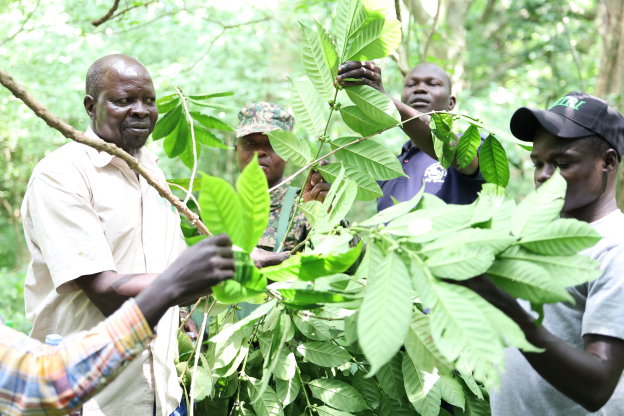
ADJUMANI, June 4, 2026 –Deep inside the thick tropical canopy of the Zoka Central Forest Reserve, where towering trees shield wildlife and streams snake through dense vegetation, grows a rare wild coffee that conservationists in West Nile believe could hold significance far beyond the region.
For generations, the indigenous Ma’adi community has lived alongside the forest, quietly aware of the wild coffee growing beneath its canopy. But now, after years of conservation struggles and advocacy, the coffee has officially received a name that ties it directly to its ancestral home — ZOKA COFFEE.
The decision by the Adjumani District Council to formally recognise the rare coffee variety marks more than a symbolic act. Environmentalists and researchers say it could elevate the global scientific importance of the forest while strengthening conservation efforts in one of Uganda’s most threatened ecological reserves.
The resolution, passed during an ordinary council meeting on May 7, 2026, followed a petition by Friends of Zoka, a local conservation organisation that has spent nearly a decade campaigning to protect the forest from destruction caused by illegal logging, charcoal burning, and agricultural encroachment.
“Zoka Forest has sheltered this coffee for millennia. Its name now dignifies its location and the heritage of the Ma’adi community. This is long overdue,” said Angelo Izama, the Board Chairman of Friends of Zoka.
A forest under pressure
Located in Adjumani District in northern Uganda, the Zoka Central Forest Reserve is one of the last remaining tropical forests in the West Nile sub-region. The reserve is home to diverse plant and animal species and has long been regarded by environmentalists as ecologically sensitive.
Yet for years, the forest has faced increasing threats from human activity. Residents and conservation groups have repeatedly raised concerns over illegal timber harvesting, land encroachment, and commercial charcoal production that continue to degrade the reserve.
Friends of Zoka emerged in 2016 as one of the leading voices defending the forest. Through advocacy campaigns, community engagement, and partnerships with government institutions and cultural leaders, the organisation has sought to draw national attention to the destruction unfolding in the reserve.
Now, the naming of ZOKA COFFEE is being viewed as a strategic breakthrough in that campaign.
“Naming Zoka Coffee focuses scientific attention on the forest, creates an identity that conservation can rally around, and gives local communities a direct stake in protecting what grows there. The Council’s resolution turns a conservation argument into public policy,” said Amanzuru William Leslie, Team Leader of Friends of Zoka
World take interest in wild coffee species
Globally, scientists are increasingly turning their attention to wild coffee species as climate change threatens commercial coffee production.
The global coffee industry, valued at more than US$ 460 billion, largely depends on Arabica and Robusta varieties. But rising temperatures, unpredictable rainfall, pests, and diseases are placing those crops under growing pressure.
Researchers believe wild coffee species may contain critical genetic traits such as drought tolerance, disease resistance, and unique flavour characteristics that could help secure the future of coffee production worldwide.
Institutions, including the Royal Botanic Gardens, Kew, have identified the protection and documentation of wild African coffee as a global conservation priority.
Conservationists say the newly named ZOKA COFFEE could eventually attract international botanical research and scientific classification.
The Adjumani District Council resolution directs technical departments, through the Office of the Chief Administrative Officer, to engage national authorities, the National Agricultural Research Organisation, and civil society groups to formalise the naming according to national and international scientific standards.
Hope for communities around Zoka Forest
Beyond science and conservation, local leaders believe the recognition of ZOKA COFFEE could create economic opportunities for communities surrounding the forest.
Environmental advocates argue that formal recognition may open doors for eco-tourism, geographical indication protections, sustainable coffee branding, and conservation-linked livelihoods that could benefit residents while discouraging forest destruction.
For the Ma’adi community, whose ancestral territory includes the forest, the naming also carries cultural significance.
The press release notes that the recognition formally connects the coffee’s identity to the indigenous heritage and stewardship of the Ma’adi people, who have protected the forest for generations.
As the world searches for solutions to climate change and biodiversity loss, conservationists in Adjumani hope the story of a wild coffee hidden for centuries beneath the Zoka forest canopy could become a powerful reason to save one of Uganda’s disappearing forests.
For Friends of Zoka, the naming of ZOKA COFFEE is not merely about branding a rare plant species.
It is about ensuring that the forest — and the communities connected to it — are no longer overlooked.
Zoka Coffee as an indigenous, disease-resistant variety
The Adjumani District Agriculture Officer, Charles Lagu, has described Zoka Coffee as a unique indigenous coffee variety with great potential for both conservation and commercial production if deliberate efforts are made to domesticate and promote it.
Speaking about the coffee species found in the Zoka Forest, Lagu explained that the forest is one of the few tropical rainforests in northern Uganda, comparable to Budongo Forest and Mabira Forest.
He said the tropical rainforest receives high rainfall throughout the year, creating a suitable natural habitat for the indigenous coffee variety commonly referred to as “wild coffee.”
Lagu noted that the coffee has existed naturally in the forest for many years but has largely remained underutilized because of the forest’s dense canopy cover, which limits sunlight penetration to the ground.
According to him, coffee requires partial sunlight for proper flowering and fruiting, which explains why the wild coffee in Zoka rarely flowers consistently under the closed forest canopy.
“When the canopy opens, and sunlight reaches the ground, the coffee starts flowering and fruiting,” he explained, adding that this has limited its commercial exploitation and consumption over the years.
The district agriculture officer further revealed that the coffee species found in Zoka is mainly a resistant Robusta variety that has attracted interest from researchers and breeders.
He said scientists often collect specimens from the indigenous coffee plants to crossbreed with domesticated varieties that are more vulnerable to diseases and harsh weather conditions.
“The domesticated varieties are susceptible to diseases, but this natural variety is resistant. Researchers are using it to improve the resilience of cultivated coffee,” Lagu said.
He added that the coffee has long been documented in research databases and remains an important genetic resource for coffee improvement programmes.
Lagu also disclosed that seedlings taken directly from Zoka Forest can be planted successfully outside the forest and are capable of producing good yields.
He described the coffee as indigenous, pure, and naturally resistant, saying it has the potential to become one of the best coffee varieties to promote globally.
He welcomed the decision by local leaders to brand the variety as “Zoka Coffee,” saying the name reflects the identity of the forest, which is widely recognised across the West Nile sub-region and northern Uganda.
“I appreciate the council’s decision to name it Zoka Coffee because Zoka is known as our major forested area in West Nile and Northern Uganda,” he said.
However, he stressed the need for deliberate efforts to domesticate and promote the original indigenous variety instead of relying entirely on cloned or modified seedlings developed through research.
Lagu explained that some of the coffee seedlings currently distributed to farmers already contain elements of Zoka Coffee because scions from the forest have been used in breeding programmes to improve resistance.
He warned that continuous scientific modification could eventually alter the original characteristics and taste of the indigenous coffee.
“If the indigenous variety is deliberately grown and preserved by households without mixing it with other varieties, then people will experience the real taste and identity of Zoka Coffee,” he said.
He called for increased promotion, conservation, and utilisation of the coffee as part of efforts to preserve the unique natural heritage of Zoka Forest while creating economic opportunities for local communities.
Locals around the Zoka Forest speak about the Zoka coffee
Alex Edema Ogege, who is a forest guard and lives around the Zoka forest, says he knew the Zoka coffee in 1979, saying he did not pick interest at the time, but five years later, in 1984, after being told what coffee is, he collected close to one kilogram of the coffee in the forest.
“In 2022, I went to the forest to bring about 9seedlings and planted them around my home, and they have all survived. The other one is fruiting very well, and it’s very promising,” Edema noted.
He promises to take more of the seedlings to plant, saying it might be a game-changer for the region in terms of economic transformation.
William Iranya, a youth in Itirikwa sub-county who also lives near the forest, says that, as a youth, he is interested in planning the Zoka coffee, which, according to him, carries the Madi heritage found in Madi land.
https://thecooperator.news/bobi-wine-vows-to-restore-zoka-forest-expand-youth-skills-training/
Buy your copy of thecooperator magazine from one of our country-wide vending points or an e-copy on emag.thecooperator.news


