
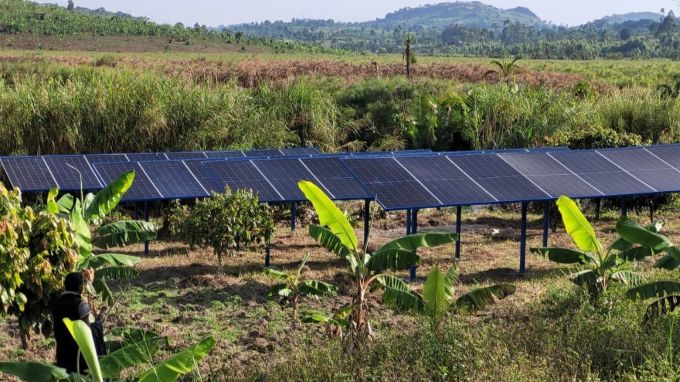
KALIRO, July 20, 2026 – Nawampiti village is located about 82 kilometres away from Kaliro Town in Bukamba Sub-county, Kaliro district. Here, the cold breeze from Lake Nakuwa once carried the familiar smell of fish drying outside homes. Today, however, it carries a different sound—the gentle hiss of sprinklers watering lush green fields.
Nawampiti, home to the Nawampiti Fishermen and Fish Traders SACCO, is also hosts the Lugonyola Solar-Powered Irrigation Scheme, a project that is steadily redefining the identity of this once-impoverished fishing community.
For decades, fishing was virtually the only source of livelihood. Families endured unpredictable incomes, dwindling fish stocks and chronic poverty, with little hope that tomorrow would be any better than today.
Today, that story is changing.
A community transformed
The irrigation scheme was introduced after Kaliro district leaders identified overdependence on fishing as the root cause of persistent poverty in the area. As fish stocks in Lake Nakuwa declined, the need for an alternative and more sustainable source of income became increasingly urgent.
The project was designed to help fishermen become farmers by providing reliable irrigation, enabling them to cultivate crops throughout the year instead of depending solely on rainfall and the uncertain fortunes of the lake.
Implemented by the Ministry of Water and Environment [MWE] with support from development partners from the United Kingdom, the scheme uses solar-powered pumps installed by green energy company Nexus Green Limited to draw water from Lake Nakuwa and distribute it across previously dry farmland.
The project began with 38 fishermen-turned-farmers who owned sizeable pieces of land. By its third planting season, however, it had expanded beyond Nawampiti village to at least four neighbouring parishes in Kaliro district.
Harvesting hope
For many years, households in Lugonyola survived on cassava, finger millet and maize grown mainly for subsistence. With only one rainy season to rely on, farming was uncertain, while fishing became the only fallback during periods of food shortage.
Many men took to fishing not because they wanted to, but because they had few other options to support their families.
The irrigation scheme has changed that reality.
Farmers can now grow crops throughout the year, significantly increasing production and household incomes.
“We now plant up to four seasons a year. Where farmers used to earn about Shs 500,000 from an acre, they now earn more than Shs 2 million. That kind of money transforms a household,” one of the project leaders says.
The benefits extend beyond higher incomes.
The community has witnessed a decline in domestic violence and child abuse as more residents spend their time productively on their farms.
“Domestic violence has gone down. When people are busy and earning, they don’t quarrel the way they used to,” says Misaki Magemeso, the LC I Chairperson of Nawampiti Village.
The success of the project has attracted people from neighbouring sub-counties, many of whom are buying or leasing land in Bukamba in the hope of replicating the area’s agricultural success.
From surviving to thriving
Among those whose lives have changed is Robert Musana.
In the past, poverty prevented him from seeking medical treatment whenever he fell ill. Instead, he relied on traditional remedies, including mango leaves and herbal concoctions.
After joining the irrigation project, Musana gradually reduced his dependence on fishing and ventured into growing cassava and sweet potatoes. Profits from his harvests enabled him to buy three piglets, which have since multiplied into a piggery with 18 pigs.
“This project has helped me a lot. After only three seasons of growing cassava, I can now afford to go to hospital whenever I am sick,” he says.
“For me, mango leaves and lemon water were all I knew as medicine. Before the irrigation scheme came, we never imagined growing crops for income. We only thought about fishing,” Musana adds with a smile.
A SACCO searching for a new identity
Ironically, the success of the irrigation project now poses a challenge for the Nawampiti Fishermen and Fish Traders SACCO. Its chairperson, Jethro Magombe, says the majority of members have either shifted to crop farming or left the lakeshore altogether as fish stocks continued to decline.
“We no longer know what our future is. Many members now earn more money from farming under irrigation than from fishing,” Magombe says.
According to Magombe, attendance at SACCO meetings has declined because many members no longer identify themselves as fishermen.
“We are even considering changing the SACCO’s name because most of our members are now farmers. Some have already joined other financial institutions.”
Changing lives beyond the farm
Robert Ibanda, the Secretary for Production at Kaliro District Council, says the irrigation scheme has transformed livelihoods in Bukamba Subcounty.
“When the project was introduced, many people doubted it would succeed. Today we are happy because household incomes have increased and families can now afford better healthcare,” Ibanda says during a visit to the irrigation scheme.
The project’s success has been strengthened by continuous extension services.
Nicholas Kayongo, the irrigation scheme operator, regularly visits farmers to monitor crop performance, advise on production practices and ensure efficient use of the irrigation system.
“We guide farmers on enterprise selection, recommend crops with reliable markets and assess which crops are suitable for different soils,” Kayongo explains.
His technical support has helped farmers avoid counterfeit seed, follow proper planting calendars, implement crop rotation and use water efficiently.
“We mainly encourage hybrid seed varieties and organic fertilisers such as cow dung because they help maintain soil health,” he says.
“The project has transformed this area from a community of struggling fishermen into one of promising commercial farmers.”
Women sharing in the benefits
The transformation has also empowered women.
Betty Salaama, the Woman Councillor for Bukamba Subcounty and Secretary for Gender at Kaliro District, says the irrigation scheme has enabled women and girls to participate more actively in agricultural production.
“The irrigation scheme has enabled women to grow food crops such as beans, carrots, groundnuts and vegetables, which they sell to earn an income,” she says.
She explains that, through community groups, women received training in producing quick-maturing crops including cucumbers, green vegetables and aubergines, while also learning simple value-addition techniques to improve their earnings.
“This has improved household incomes and reduced dependence on selling dried fish and mukene as the only source of livelihood,” she adds.
A new future
Today, much of Bukamba Subcounty is dotted with solar panels glistening under the tropical sun, a quiet but powerful symbol of transformation.
The lake that once sustained the community almost exclusively through fishing now also feeds flourishing farms through solar-powered irrigation. Acres of bananas, cassava, sweet potatoes, beans, carrots, cucumbers, vegetables and even coffee are replacing fishing nets as the main source of household income.
Women who once survived by selling small quantities of dried fish, cassava and vegetables are now cultivating acres of crops for commercial markets.
In Nawampiti, the story is no longer about dwindling fish catches. It is about how the power of the sun, combined with water from Lake Nakuwa, has given an entire community the confidence to exchange uncertainty for opportunity, and to harvest not only crops, but hope.
Buy your copy of thecooperator magazine from one of our country-wide vending points or an e-copy on emag.thecooperator.news


