
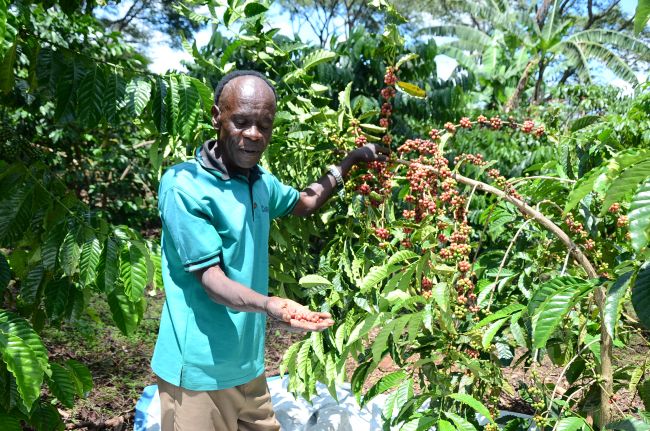
MASINDI, October 22, 2026 — Masindi District Agricultural Department has deployed community volunteers to curb harvesting and post-harvest practices that compromise coffee quality.
The initiative follows a recent stakeholders’ meeting aimed at developing strategies to address poor harvesting practices as the coffee harvesting season approaches.
District Agricultural Officer Job Byaruhanga said the volunteers, deployed across the district, will ensure farmers do not harvest immature coffee cherries or dry coffee on the ground, practices that undermine the quality of the crop.
“The volunteers are authorised to arrest farmers found engaging in these practices and hand them over to the police, together with the coffee, which may be used as evidence in court,” Byaruhanga said.
He said two people had so far been arrested and their cases were before the courts.
Byaruhanga attributed the harvesting of immature coffee partly to traders who hire workers to fill as many bags as possible, as well as those who pay farmers in advance.
He explained that some farmers subsequently harvest and sell their coffee to other buyers, sometimes before the cherries have matured.
The agricultural officer urged farmers to adhere to recommended harvesting and post-harvest practices to produce high-quality coffee and enhance Uganda’s competitiveness on the global market.
During the distribution of 50,000 improved coffee seedlings to farmers in Bwijanga Sub-county in April, Francis Rwothomio, the Regional Agricultural Officer for Kiryandongo, Masindi and Buliisa districts under the Ministry of Agriculture, Animal Industry and Fisheries [MAAIF], also expressed concern about declining coffee quality in the region.
Rwothomio warned that premature harvesting was undermining coffee quality and said authorities would enforce the law against offenders.
“It is unacceptable to harvest coffee by stripping or picking unripe cherries. Some farmers are drying immature coffee in sugarcane plantations. We will enforce the law,” Rwothomio cautioned.
He reminded farmers that the Coffee Act provides for the arrest and prosecution of offenders, with penalties including imprisonment of between two and four years or fines of about Shs 2.4 million or more.
Rwothomio said the ministry was intensifying farmer education through community training sessions, radio programmes and farm visits to improve compliance and coffee quality.
Ssensaga Bendicto, Chairperson of Bwijanga Coffee Farmers Cooperative, welcomed the initiative, saying it was already helping farmers improve their harvesting practices.
“Right now, we are no longer harvesting unripe coffee haphazardly. We welcomed the idea very well because it is helping improve the quality of coffee. We even attended the training with them and agreed on the type of coffee to always harvest,” he said.
Ssensaga acknowledged that farmers contribute to declining coffee quality through poor harvesting practices but also blamed some buyers for employing people to harvest coffee on their behalf.
“The biggest problem is the buyers who are deploying people to harvest coffee on their behalf. Another challenge is impatient coffee farmers,” he said.
He added that some farmers sell coffee before it is ready for harvesting to meet immediate financial needs, a practice that seriously compromises quality.
Ssensaga also cited theft as another challenge, saying thieves sometimes harvest coffee at night, breaking branches and stripping coffee bushes.
Coffee revival
Coffee production in Masindi District is experiencing a resurgence, driven by high global coffee prices, growing cooperative movements and government interventions aimed at increasing production.
Once heavily dominated by sugarcane production, the district is increasingly being encouraged to shift towards coffee, which agricultural authorities consider a potentially more profitable crop for smallholder farmers.
The revival is being supported by increased distribution of improved planting materials and efforts to scale up production.
MAAIF recently distributed 50,000 Coffee Wilt Disease Resistant [CWDR] seedlings across the district. Bujenje County received 25,000 seedlings, Buruli County 15,000, while Masindi Municipality received 10,000.
Local agricultural extension officers say demand for coffee seedlings among farmers far exceeds government supply, signalling strong interest in expanding coffee production.
The growth of the sector is also being supported by organised farmer cooperatives, which aggregate production, provide technical knowledge and help farmers reduce their reliance on middlemen.
https://thecooperator.news/masindi-food-processors-warned-against-compromising-quality-standards/
Buy your copy of thecooperator magazine from one of our country-wide vending points or an e-copy on emag.thecooperator.news


