
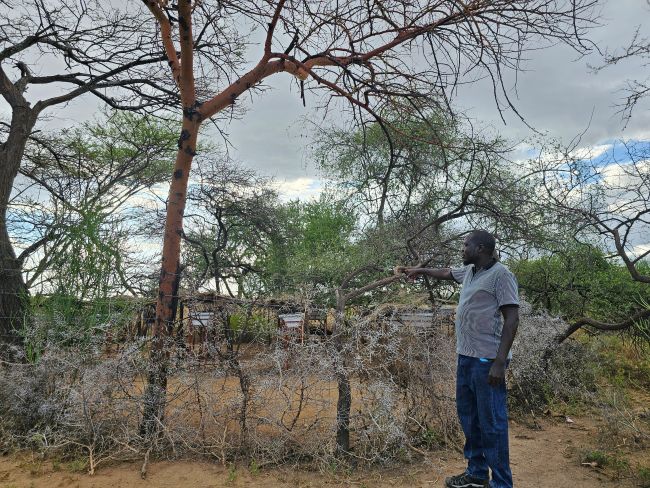
KOTIDO, October 20, 2026 — In the arid plains of Kotido district, where unpredictable weather and prolonged droughts frequently undermine traditional crop farming, an enterprising farmer is turning beekeeping into a viable source of income and a potential buffer against climate shocks.
Joshua Ngorok, an enterprising bee farmer from Losilang and owner of Muchekem Honey Enterprises Limited, has transformed what he once regarded as a traditional activity into a commercial enterprise producing up to 1,500 kilogrammes of honey per season.
Ngorok’s success has also positioned him as a mentor to hundreds of farmers in Karamoja Subregion and neighbouring regions, demonstrating how diversification into beekeeping can help rural households withstand the effects of unreliable rainfall and prolonged dry spells.
The Kotido District Production Department is encouraging farmers to embrace beekeeping as an alternative or complementary enterprise to crop farming.
Dr Michael Erichu, the Kotido District Production Officer, said beekeeping presents fewer risks than conventional crop production in an area where weather conditions are increasingly unpredictable.
“Beekeeping is significantly less risky than traditional crop cultivation because of the volatile and unpredictable weather patterns experienced in the region,” Erichu said.
The district production department is also seeking to strengthen market linkages for farmers by helping them access reliable buyers and commercial markets.
“Our focus is not only on encouraging farmers to take up beekeeping, but also on ensuring that their honey can reach profitable markets and provide a steady household income,” Erichu said.
For Ngorok, the transformation began after he partnered with the Sasakawa Africa Association [SAA], which introduced him to modern apiary management, financial literacy and marketing.
Before the intervention, Ngorok kept bees using traditional methods, producing little honey and viewing the activity largely as a household practice rather than a business.
“At first, it was not like a business; we took it as something traditional,” Ngorok said.
“When Sasakawa trained us, they opened our minds. We started doing beekeeping as a business, branded our products as Muchekem, and learned how to market them,” he added.
Through the support, Ngorok also established financial linkages, including access to credit through Centenary Bank. The financing enabled him to purchase hives in bulk and increase his processing capacity from about 400–500 kilogrammes to 1,500 kilogrammes of honey per season.
“The financial support and training helped us to move from keeping a few hives to thinking about beekeeping as a serious commercial enterprise,” Ngorok said.
He is now encouraging farmers who depend heavily on maize and sorghum to diversify their sources of income by taking up beekeeping.
According to Ngorok, bees require relatively little land and depend largely on naturally occurring vegetation, making the enterprise suitable for dryland communities where crop production is often constrained by drought.
A traditional hive can produce up to 30 kilogrammes of honey in a season, providing farmers with an additional source of income.
Muchekem Honey Enterprises has also moved beyond selling raw honey by adding value to other bee products. The enterprise processes propolis into propolis tincture and uses beeswax to make products such as jelly, creating additional revenue streams.
Ngorok’s enterprise has grown into a network of about 900 bee farmers across Kotido, Abim and Kaabong districts. The farmers supply honey, propolis and beeswax to the Muchekem processing unit.
The network is supported by Commercial Community-Based Facilitators [CCBFs] trained by SAA to provide farmers with training in good agricultural practices, post-harvest handling and business management.
[“We are not only producing honey for ourselves; we are building a network where other farmers can also benefit by supplying honey and other bee products,”] Ngorok said.The income generated from beekeeping has helped some households meet essential needs, including paying school fees, buying livestock and improving their homes.
For farmers facing increasingly unreliable harvests, Ngorok believes beekeeping offers an opportunity to build a more resilient livelihood.
“Farmers should not depend only on seasonal crops because when drought comes, they can lose everything. Beekeeping gives them another source of income,” he said.
Despite challenges, including pests that affect traditional hives, inadequate processing equipment and scepticism among some community members about handling bees, Ngorok continues to expand his enterprise.
He is reinvesting profits in new hives, strengthening his farmer network and training more community members in modern beekeeping practices.
With continued support from the Kotido District Production Department and market-linkage initiatives, beekeeping is emerging as a promising enterprise for farmers in the region.
Ngorok’s experience demonstrates that, with appropriate training, financing and access to markets, an activity once regarded as a traditional practice can become a commercially viable enterprise.
For farmers in Uganda’s drylands struggling with the effects of climate change, the message from Muchekem Honey Enterprises is straightforward: diversifying into beekeeping could help turn climate-related challenges into an opportunity for sustainable household income.
https://thecooperator.news/primary-school-in-lira-embraces-beekeeping-to-keep-learners-in-school/
Buy your copy of thecooperator magazine from one of our country-wide vending points or an e-copy on emag.thecooperator.news
-

-

-

-


