
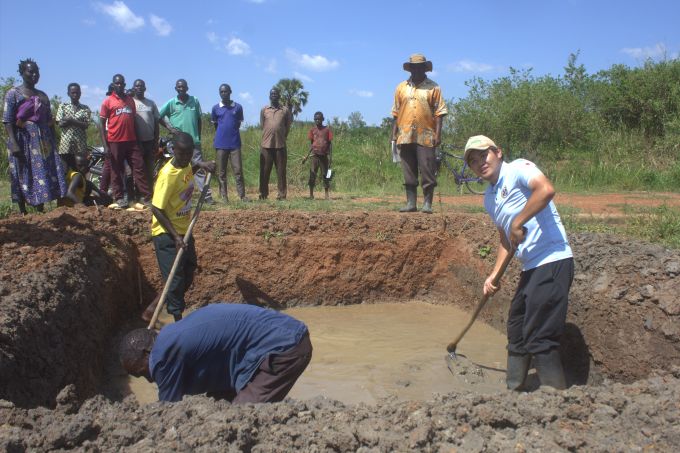
LIRA, November 1, 2026 — More than 1,500 members of Itek Okile Rice Growers Multipurpose Cooperative Society Limited in Lira district are working with the Embassy of Japan in Uganda to tackle challenges affecting rice production and improve farmers’ incomes.
The Japanese Government is supporting the initiative through agricultural expertise, field demonstrations and improved farming practices aimed at increasing rice productivity and strengthening farmers’ livelihoods.
As part of the partnership, the Embassy of Japan deployed Mikio Kasahara, a Japan Overseas Cooperation Volunteer [JOCV] specialising in agriculture, to work with the cooperative.
Kasahara is helping farmers identify rice varieties suited to local conditions while promoting improved cultivation, water management and post-harvest handling practices.
His work was showcased during a recent press tour organised by the Embassy of Japan at the cooperative’s demonstration fields in Itek Subcounty, Lira District.
Field trials identify suitable rice varieties
Since arriving in Uganda in February 2026, Kasahara has been conducting field trials to compare rice varieties and establish which perform best under local conditions.
He records data on crop growth, pests, diseases, water management and yields to help farmers make informed decisions about the varieties and farming practices they adopt.
He is also exploring other income-generating activities, including growing tomatoes in unused spaces around farms, in response to farmers’ concerns about the rising cost of fertilisers and pesticides.
“I am comparing rice varieties because farmers do not know much. I am trying compost manure to improve rice yields because many farmers do not apply manure,” Kasahara said.
The initiative is intended to increase rice production while helping farmers diversify their incomes and reduce some of the financial pressures associated with farming.
Farmers welcome new approaches
Spearson Ocen Muno, a rice farmer who has grown the crop in the area for 26 years, said Kasahara’s work was helping farmers improve water management and assess the suitability of different rice varieties.
Muno identified water management, weeds, pests and diseases as some of the major challenges affecting rice production in the area.
He said Kasahara had introduced improved field layouts, including bunds and waterways, to control the movement of water between plots.
“Now, when you look at these areas, you can see that water is not flowing across the plots uncontrollably. When we want water, we can allow it in, and when we do not need it, we can close it or drain it out,” Muno said.
He added that the trials were giving farmers an opportunity to exchange knowledge with the Japanese volunteer and learn practical techniques that they could share with other growers.
Muzee John Odero, who has grown rice for nearly 35 years, said Kasahara had identified gaps in local farming practices and was helping farmers address them.
Odero said many farmers had traditionally broadcast rice seeds directly into their fields, but Kasahara was encouraging them to consider line planting and transplanting.
“The new approach showed promising results during the first season, although inadequate water management affected performance. I am optimistic that the current trials will yield better results following improvements in water control,” he said.
He added that the volunteer was encouraging farmers to consider rice varieties that could better withstand pests and diseases, potentially reducing their reliance on costly agricultural chemicals.
Improving post-harvest handling
Post-harvest handling is another area receiving attention under the initiative.
Odero said some farmers traditionally threshed rice by beating it with sticks, a practice the team hopes to improve through the introduction of a simple manual thresher.
“The proposed equipment would use a wooden frame to help farmers separate rice grains while minimising damage and keeping costs affordable,” he said.
Farmers are working with cooperative staff and local agricultural extension personnel to test the new methods and assess which practices could be adopted more widely.
Japan has deployed 846 volunteers in Uganda
Masanobu Yonemitsu, Head of Economic Cooperation at the Embassy of Japan, said the volunteer programme was one of the ways Japan supported Uganda beyond major infrastructure projects.
He said Japan currently had 37 volunteers working across Uganda, including Kasahara, who is working directly with farmers in Lira district.
Over the past 25 years, Japan has sent a total of 846 volunteers to Uganda to share professional knowledge and skills while working alongside local communities.
“When people hear about Japanese assistance to Uganda, many think of major infrastructure projects such as the Kampala Flyover and the Jinja Bridge. We also support the health sector, but one of the programmes that may receive less attention is our volunteer programme,” Yonemitsu said.
He said the volunteers work at community level, sharing expertise and helping local institutions address practical development challenges.
Yonemitsu said Japan was interested in improving agricultural productivity because higher yields could help rural households increase their incomes and improve their living standards.
“One of our objectives is to increase the living standards of local people. By improving agricultural productivity and rice production, we want to help local communities increase their incomes,” he said.
Japan’s support for Uganda is delivered through its Official Development Assistance programme, which includes infrastructure development, health-sector support and community-based initiatives.
Through Kasahara’s work at Itek Okile, the initiative is focused on practical agricultural improvements that farmers can test and adapt to their own fields.
The Itek-Okile Rice Scheme is a major irrigation project located in Itek and Bar sub-counties in Lira district, within the Lango Sub-region.
The scheme was originally managed by Itek-Okile Growers Multipurpose Cooperative Society Limited, but its administration was later taken over by the Lira District Department of Agriculture following past cooperative management and infrastructure challenges.
The scheme covers approximately 600 to 800 hectares of rice-growing land and supports more than 2,500 smallholder farmers, according to data obtained from the Lira District Department of Agriculture.
https://thecooperator.news/itek-okile-rice-cooperative-readying-for-first-planting-season/
Buy your copy of thecooperator magazine from one of our country-wide vending points or an e-copy on emag.thecooperator.news
-

-

-

-


