
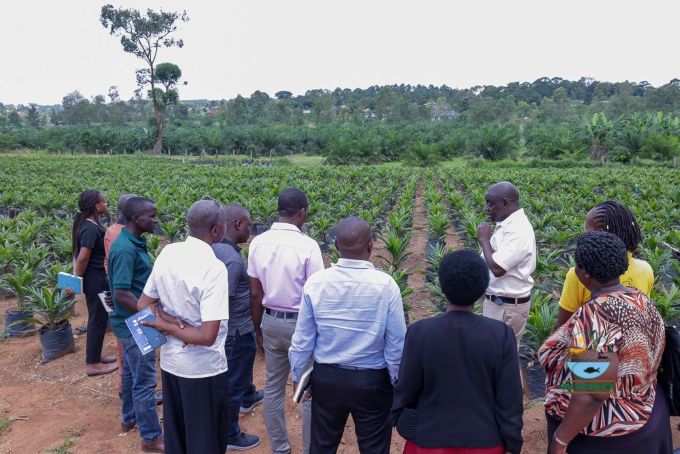
WAKISO, October 29, 2026 – The National Crops Resources Research Institute [NaCRRI], in collaboration with the Ministry of Agriculture, Animal Industry and Fisheries [MAAIF], has developed stringent oil palm seed production standards aimed at improving the quality of planting materials, increasing yields and boosting domestic production.
The initiative seeks to strengthen Uganda’s oil palm seed production system, reduce dependence on imported planting materials and ensure that farmers have access to high-quality, disease-free seedlings suited to local growing conditions.
During a recent strategic technical meeting held at NaCRRI in Wakiso district, researchers and officials from MAAIF agreed to strengthen seed production systems, intensify monitoring of oil palm nurseries and enhance inspections through the ministry’s Department of Crop Inspection and Certification [DCIC].
The meeting also focused on harmonising national oil palm seed initiatives, advancing local breeding programmes and enforcing strict nursery management and quality assurance standards to support the sustainable growth of Uganda’s oil palm sub-sector.
Dr Gabriel Ddamulira, the Oil Palm Research Programme Lead at NaCRRI, said the institute had adopted a comprehensive approach to establishing a sustainable national oil palm seed production system.
He explained that the strategy centres on a dedicated oil palm breeding and germplasm evaluation programme aimed at developing high-yielding varieties adapted to Uganda’s agro-ecological conditions.
“Establishing a robust, localised oil palm seed system is critical for securing farmer livelihoods and expanding domestic production,” Ddamulira said.
“Through scientific research and strict regulatory collaboration with MAAIF and DCIC, we are ensuring that Ugandan farmers receive high-quality, high-yielding planting materials,” he added.
According to Ddamulira, the research programme will involve optimising breeding crosses, monitoring flowering patterns and evaluating fruit maturity after pollination to improve the production of quality oil palm seeds.
He said the interventions are expected to increase the domestic availability of certified planting materials while significantly reducing Uganda’s reliance on imported pre-germinated oil palm seeds.
NaCRRI also emphasised the need to strengthen regulatory controls governing the importation of oil palm seeds to safeguard the country against pests and diseases while maintaining the genetic integrity of planting materials.
Under the proposed standards, the sourcing and importation of certified Tenera hybrid seeds will require verification of disease resistance, acquisition of relevant regulatory permits, compliance with quarantine requirements and adherence to specialised handling procedures to minimise seed mortality.
The institute further outlined strict nursery management requirements, including appropriate planting techniques, controlled irrigation, balanced nutrient application and integrated pest and disease management.
Nursery operators will also be required to transplant seedlings into larger polybags at appropriate growth stages, maintain adequate spacing and conduct routine monitoring to promote healthy root development and canopy growth.
Strict seedling inspection standards
To strengthen quality assurance, NaCRRI has introduced a three-tier seedling inspection and culling system designed to identify and eliminate weak, stunted, deformed and diseased seedlings at different stages of growth.
The system is expected to ensure that only healthy, vigorous and high-quality seedlings are distributed to farmers for establishment in oil palm plantations.
Researchers believe that enforcing these standards will help minimise losses associated with poor-quality planting materials, improve plantation productivity and strengthen farmers’ confidence in locally produced seedlings.
Oil palm cultivation in Uganda is largely concentrated in the island districts of Kalangala and Buvuma, where the crop has become an important source of household income and raw materials for the country’s edible oil industry.
In Kalangala, the oil palm industry includes a nucleus estate covering approximately 6,500 hectares and an estimated 5,000 out-growers.
The total area under oil palm cultivation in the district is reported to exceed 11,000 hectares, mainly on Bugala Island, which covers approximately 27,000 hectares.
Oil palm is a perennial crop that generally begins producing fruit about four years after planting. Once mature, the crop can be harvested at intervals of approximately 10 days and may remain productive for up to 30 years under proper management.
In Kalangala, farmers reportedly earn at least Shs870 per kilogramme of harvested oil palm fresh fruit bunches, with some bunches weighing up to 90 kilogrammes.
The crop has become a major commercial agricultural enterprise in the district, supporting thousands of smallholder farmers and creating opportunities along the palm oil value chain.
In 2018, oil palm out-growers in Kalangala organised themselves under the Ssese Oil Palm Growers Cooperative Society Limited to strengthen their collective bargaining power, improve market access and maximise returns from their produce.
The cooperative arrangement was also intended to give farmers a stronger voice in negotiations with buyers and other industry stakeholders.
With the introduction of stricter seed production and nursery management standards, NaCRRI and MAAIF hope to strengthen Uganda’s capacity to produce reliable planting materials locally, support the expansion of oil palm cultivation and improve productivity across the sub-sector.
Buy your copy of thecooperator magazine from one of our country-wide vending points or an e-copy on emag.thecooperator.news


