
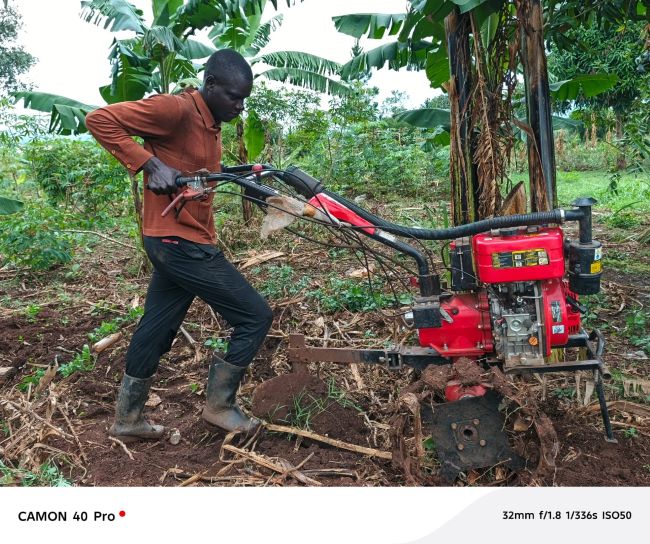
KIRYANDONGO, August 5, 2026 — Kiryandongo district, a major food basket for Uganda and its neighbours, is experiencing a quiet agricultural revolution as farmers embrace mechanisation to boost production.
Since 2018, the increased use of low-cost on-farm mechanisation, particularly walk-behind tractors or walking tractors, has transformed farming practices, leading to increased yields, improved incomes and greater food security for smallholder farmers.
Kiryandongo district currently supplies an estimated 160 million kilogrammes of maize annually, along with other staple crops.
This impressive output is largely attributed to a significant shift in production patterns, driven by changing rainfall patterns, prolonged dry spells and intermittent flooding and waterlogging, which continue to affect farmers.
“Behind this impressive success is a major shift in planting seasons driven by environmental factors, including rainfall and prolonged dry spells, interspersed with acute floods or waterlogging, which drastically affect farmers,” explains Issa Hassan Byenkya, the Kiryandongo District Agriculture Officer.
Faced with erratic rainfall and the challenges posed by climate change, farmers have embraced walk-behind tractors, also known as two-wheeled tractors or power tillers, instead of traditional hand hoes and ox-ploughs.
These versatile machines, ranging from 50 to 75 horsepower, can plough up to two acres a day and perform various tasks, including mowing, planting, weeding and transporting crops.
Moro Sedrack, Director of Togole Super Spares Services Ltd, the company introducing the tractors, said the machines were introduced in response to the needs of smallholder farmers.
“We were compelled to introduce the walk-behind tractors in response to the needs of smallholder farmers who faced intense pressure to produce adequate food for their families amidst erratic rainfall,” he said.
Sedrack highlighted the tractors’ lightweight design, which minimises soil compaction and protects plant root systems, providing an important environmental benefit.
Patrick Sebowa, a farmer in Kiryandongo Subcounty, has seen his maize yields increase from between four and seven bags per acre to 13 bags, equivalent to about 2,000 kilogrammes.
“The yields are better because I can now plant early and afford better-quality seeds and fertilisers,” he said.
His production records show a significant increase from five tonnes in 2023 to 15 tonnes in 2025, allowing him to expand the land under cultivation and significantly improve his household income.
The tractors are also proving beneficial to women farmers, including Nabukenya Florence and Concy Achayo.
Florence, a single mother, used a village savings loan to hire a tractor and has since seen her crop production increase beyond household needs, enabling her to save Shs 800,000 annually.
Achayo praised the environmental benefits of the machines, noting that they can navigate areas with trees, reducing the need for complete land clearing.
To further improve access to the technology, the Climate Smart Jobs [CSJ] project is subsidising the cost of the tractors.
Togole Super Spares Services Ltd has sold 128 walk-behind tractors since 2018 through a cost-sharing arrangement, with farmers securing financing through bank loans.
The company also provides free training in operation and maintenance to ensure farmers can maximise their investment.
According to Byenkya, the district’s Production and Marketing Officer, adoption of the technology needs to accelerate to help tackle household poverty.
He said the walk-behind tractor was demonstrating that minimum soil compaction could deliver maximum productivity while helping farmers secure food and incomes and respond more effectively to climate change.
The Climate Smart Jobs project is a UK-funded initiative in Uganda that creates sustainable on-farm and off-farm employment, boosts incomes and strengthens climate resilience among smallholder farmers, women and refugees.
Buy your copy of thecooperator magazine from one of our country-wide vending points or an e-copy on emag.thecooperator.news
-

-

-

-


