
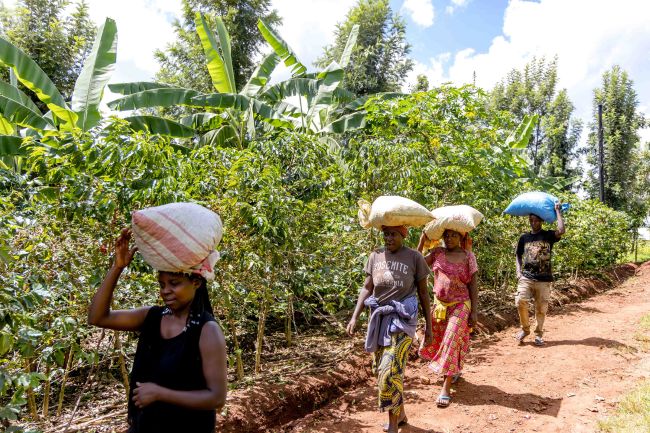
KIGALI, October 4, 2026 — In Rwanda’s southern Huye region, when coffee cherries have turned red and ripe, trained farmers harvest the fruits at just the right moment. The harvesters work methodically, moving from the shade of one coffee tree into the harsh sunlight before moving on to the next. The silence of the work is punctuated only by birdsong and the ping of ripe cherries hitting the plastic buckets.
The selected cherries are quickly transferred to workstations. These stations, set in wide, open spaces, are tucked between the region’s rolling hills. Men and women stand alongside long tables, working in silence as they carefully select only the highest-quality cherries.
The selected cherries are then taken to the washing station. Unlike the harvesting and sorting processes, which are undertaken in silence, the washing station, closer to the processing facilities, is filled with relentless movement and noise.
Aphrodis Twagirayezu, an agronomist and manager of the Kyarumba Coffee Washing Station, explains: “Once the workers have carefully selected the coffee cherries, removing those that are too ripe, we get them into the floating tank to remove those that float.”
Aphrodis explains that damaged, underripe or dried-out cherries can be identified through a flotation test.
“It all depends on the density. High-quality coffee displays higher density in water — they’re the sinkers — while lower-quality coffee floats to the top. We remove those lower-quality cherries before moving forward with the processing.”
This step at the washing station is key to identifying only the best cherries destined for specialty coffees. The selected cherries then proceed to further processing, including de-pulping, fermentation, washing and drying.
The proliferation of coffee washing stations — along with training for farmers, sorters and coffee-washing station workers — has been crucial in transforming Rwanda’s coffee harvests into specialty coffees that fetch higher prices in niche markets abroad.
Meanwhile, in Kenya, another country renowned for its coffee, a coffee cooperative in Baringo County has revived itself by adopting new leadership and implementing a series of reforms to improve governance and business management, in response to low production and rapidly declining membership.
A much larger producer of coffee than Rwanda, Kenya is equally well known for its high-quality Arabica beans. Coffee is grown in 33 of the country’s 47 counties, providing important employment and livelihoods for millions of rural Kenyans.
As in Rwanda, Kenyan small-scale coffee production relies heavily on cooperatives, which provide coffee farmers with access to finance and markets, improved processing facilities and opportunities to have a say in decisions that affect their businesses.


Both countries partner with the Food and Agriculture Organization of the United Nations [FAO]to prioritise coffee production and consistently work to improve productivity and increase earnings for their many smallholder farmers.
Rwanda has chosen coffee as the national priority under FAO’s Hand-in-Hand Initiative, which aims to further develop and invest in the country’s coffee value chains. Through this prioritisation under the FAO programme, Rwanda aims to leverage public-private partnerships and innovative business models to engage young people and incorporate agri-tech solutions into coffee production.
In Kenya, Baringo County cooperatives partnered with FAO’s Forest and Farm Facility, which supported the cooperative’s reforms with a USD 30,000 grant under its Small Grants Programme. The transformation in less than three years has been impressive. Membership has increased from 756 to almost 1,200 farmers, while the proportion of women and young people among cooperative members has risen from around 10 per cent to 40 per cent.
“Our members are involved in each and every activity right from the planning stage,” said Jackson Lenge, chairman of Tenges Farmers’ Cooperative Society Ltd in Baringo. “We conducted training on coffee value chain analysis and development, where we addressed issues on coffee establishment, right from land preparation, crop management, fertiliser application, pruning and other management aspects.”
Though different in scale, coffee is central to rural employment, livelihoods and national economies in Kenya, Rwanda and several other African countries. The African continent accounts for 17 per cent of global coffee production and 12 per cent of global coffee exports. These exports also generate foreign-exchange earnings and establish important trade relations with markets around the world.
On this first International Coffee Day, we celebrate the coffee crop that supports employment and rural livelihoods, as well as the coffee farmers in Rwanda, Kenya and around the world who are constantly innovating and improving production to provide a premium export product to coffee consumers worldwide.
Source: FAO
Buy your copy of thecooperator magazine from one of our country-wide vending points or an e-copy on emag.thecooperator.news


