
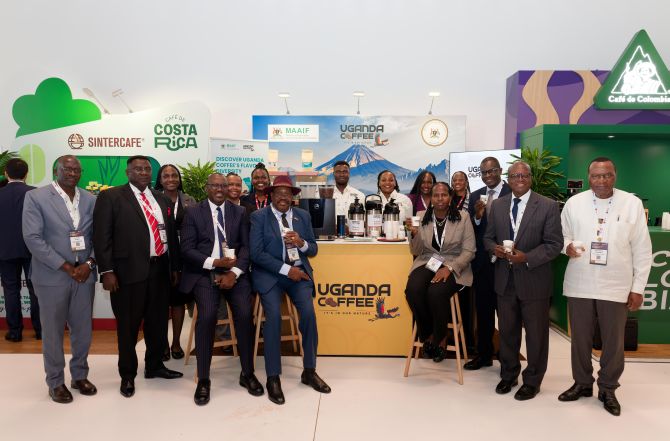
MONTREUX, October 4, 2026 –Uganda has showcased the transformation of its coffee sector, highlighting rising exports, traceability, sustainability and value addition as the country seeks to strengthen its position in the global coffee market.
The country made its inaugural participation in the 17th Swiss Coffee Trade Association [SCTA] Forum and Dinner held in Montreux, Switzerland, on Friday, bringing together government officials and private sector players to engage international coffee traders, investors and other industry stakeholders.
The Ugandan delegation was led by the Minister of State for Agriculture, Desire Muhooza, Permanent Secretary in the Ministry of Agriculture, Animal Industry and Fisheries [MAAIF], Rtd. Maj. Gen. David Kasura-Kyomukama, and Permanent Secretary in the Ministry of Foreign Affairs, Vincent Bagiire Waiswa.
Uganda’s participation was held under the theme, “Brewing Trust: Traceability, Sustainability and Value Addition in Uganda’s Coffee Journey,” with the delegation using the forum to present the country’s progress in coffee production and its plans to meet changing international market requirements.
Opening Uganda’s engagement, Muhooza said coffee remains a major part of the country’s economy and a source of livelihood for millions of households.
“Coffee is not simply a crop for Uganda. It is deeply embedded in our economy, our history, our culture and the livelihoods of millions of households. It represents a national commitment and a long-term ambition to produce more, produce better and share Uganda’s coffee excellence with the world,” she said.
Uganda’s coffee exports have increased from approximately 3.6 million bags in 2017 to more than 8.3 million bags in 2025, according to MAAIF.
Muhooza attributed the growth to government interventions aimed at increasing production and productivity, improving quality and expanding market opportunities for farmers.
“This transformation is not merely a story of increased volumes. It reflects Uganda’s emergence as a dependable and significant coffee origin in the international market, driven by deliberate government investments in farmer support, productivity improvement, quality enhancement and market development,” she said.
She said government programmes including the distribution of free coffee seedlings, farmer training, subsidised fertilisers, extension services, rehabilitation and replanting programmes have contributed to the expansion and modernisation of the coffee sector.
The government is also seeking to expand coffee production beyond Uganda’s traditional coffee-growing areas, particularly into parts of northern and eastern Uganda.
“Our goal is to ensure that more Ugandans participate in and benefit from the coffee economy. By expanding production into Northern and Eastern Uganda, we are broadening opportunities for farmers while strengthening the country’s production base for future growth,” Muhooza said.
The government is also placing greater emphasis on traceability as Uganda works to meet international requirements governing the sourcing and production of agricultural commodities.
Kasura-Kyomukama told the forum that Uganda’s coffee sector, which is largely supported by smallholder farmers, requires robust systems that can establish the origin and production history of coffee destined for international markets.
“Uganda’s coffee industry is built on the efforts of millions of smallholder farmers. Building traceability at this scale is a significant undertaking, but it is essential for developing a modern, transparent and competitive coffee sector,” he said.
Uganda is implementing systems aimed at supporting traceability and compliance with international requirements, including the European Union Deforestation Regulation [EUDR], which places requirements on commodities entering the European market to demonstrate that they are not linked to deforestation.
Kasura-Kyomukama said Uganda’s traceability efforts are also intended to strengthen the credibility and competitiveness of the country’s coffee rather than simply respond to external market requirements.
“We are not pursuing traceability solely because international markets require it. We are doing so because transparency, sustainability and accountability are fundamental to the future competitiveness of Uganda’s coffee sector. Trust begins with knowing where our coffee comes from and being able to demonstrate how it is produced,” he said.
The government also presented its efforts to improve coffee quality through better processing, grading, inspection and quality assurance, while encouraging greater value addition along the coffee value chain.
Uganda wants international buyers to associate its coffee with specific origins, quality characteristics and verifiable sustainability standards.
“We want buyers to say: this is Ugandan coffee; this is the region it came from; this is the farmer or cooperative network behind it; this is the cup profile; and this is the verified sustainability and traceability story behind the lot,” the ministry said.
The country also used the forum to promote its different coffee origins, including Fine Robusta varieties known for chocolate, caramel, nutty and spicy flavour profiles.
Uganda’s specialty Arabica coffees from Bugisu, Mount Elgon and the Rwenzori Highlands were also showcased to international participants at the Uganda booth alongside coffee-producing countries including Costa Rica and Colombia.
Beyond production and exports, Uganda used the forum to promote investment opportunities in coffee processing, manufacturing, branding and export development.
Joseph Enyimu, Commissioner in the Ministry of Finance, Planning and Economic Development, said coffee forms part of Uganda’s wider strategy to expand industrialisation, create jobs and increase the value generated from agricultural commodities.
“Uganda’s coffee transformation is part of a wider national strategy to accelerate economic growth, industrialisation and job creation. Coffee presents significant opportunities not only in production but across processing, manufacturing, branding and export development,” Enyimu said.
He said Uganda is seeking to retain more value from its coffee by encouraging investment beyond the export of raw commodities.
“Our objective is to move beyond exporting raw commodities and create more value across the entire coffee value chain. This presents attractive opportunities for investors looking to partner in Uganda’s growing coffee industry,” he said.
The engagement was also presented as part of Uganda’s economic and commercial diplomacy efforts, with Foreign Affairs Permanent Secretary Bagiire Waiswa stressing the importance of collaboration between government agencies and private sector actors in promoting Ugandan products internationally.
The Swiss Coffee Trade Association represents more than 40 companies involved in green coffee trading and, according to the Ugandan delegation, its members account for more than half of global coffee export volumes.
The association provides a platform for interaction among major players in the international coffee industry, including traders and other stakeholders involved in sustainability, responsible sourcing and international coffee trade.
Uganda’s participation therefore provided an opportunity for the country to strengthen engagement with major coffee buyers and investors while presenting its efforts to improve production, quality, traceability and sustainability.
The government said the long-term objective is to build a coffee sector capable of producing higher volumes and quality, meeting international standards, increasing value addition and improving the livelihoods of the millions of smallholder farmers who form the backbone of the industry.
Buy your copy of thecooperator magazine from one of our country-wide vending points or an e-copy on emag.thecooperator.news


