
KAMPALA, June 11, 2026 — The Ugandan Government has so far invested close to Shs 11 trillion in wealth-creation programmes, according to Henry Musasizi, the Minister of Finance, Planning and Economic Development.
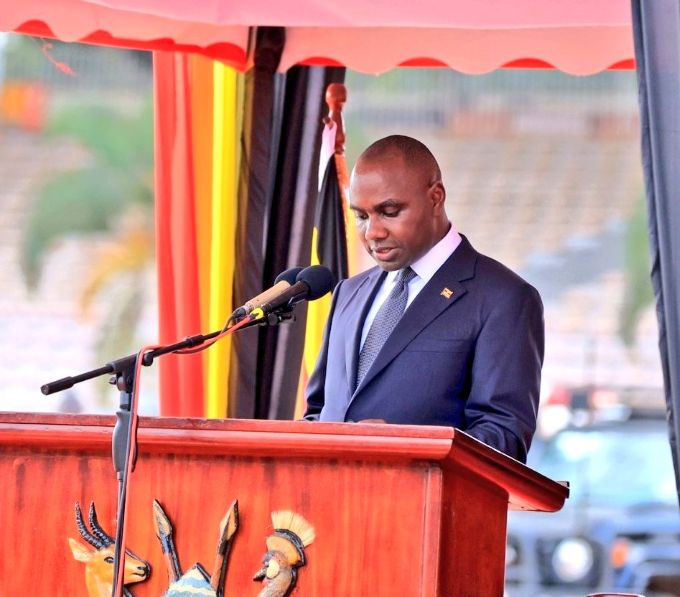
Musasizi revealed this today at Kololo Ceremonial Grounds in Kampala while presenting Uganda’s 2026/2027 national budget to Parliament, emphasising the need for every Ugandan to participate in the money economy.
“Mr Speaker, the foundation of Uganda’s economic transformation is ensuring that every Ugandan participates in the money economy. Government, therefore, has continued to invest in programmes that expand access to affordable capital, strengthen enterprise development and increase household incomes,” Musasizi who was reading the national budget for the first time, as Finance Minister, said.
He noted that government has invested the money directly into wealth-creation initiatives targeting households engaged in subsistence livelihoods, farmers, youth, women and businesses.
According to the Minister, these interventions are reducing barriers to economic participation while expanding opportunities across the country.
Parish Development Model
Musasizi said the Parish Development Model [PDM], launched in February 2022, remains government’s flagship intervention for eliminating subsistence living and expanding participation in the money economy.
“I wish to thank His Excellency the President for his vision and unwavering commitment to this programme. PDM is not merely a financing programme. It is a structural transformation programme,” he said.
He explained that the programme seeks to move households from subsistence to commercial production, from survival to enterprise, and from poverty to prosperity.
Over the past five years, government has transferred Shs 4.4 trillion in revolving capital to all 10,589 parishes nationwide.
Musasizi said Ugandans previously outside the money economy are now participating in income-generating activities.
“By the end of this month, PDM funds will have reached more than four million beneficiaries. The PDM is raising household incomes, improving food security and creating local economic opportunities for Ugandans who previously relied on subsistence production,” he said.
Next phase of PDM
The Minister said the next phase of PDM will focus on increasing productivity, strengthening value addition and improving market access for beneficiaries.
“My Ministry will seek policy guidance to ensure that underserved and densely populated parishes, particularly in urban areas, receive adequate funding. Equally important, we will begin a gradual and deliberate transition from government transfers to a self-sustaining financial ecosystem — ultimately a PDM Bank — underpinned by strong repayment performance, governance and value-chain development,” he stated.
Other wealth-creation programmes
In addition to PDM, the Minister said government has continued supporting enterprise development through several other wealth funds.
Emyooga
Musasizi said government has capitalised the programme with Shs 760 billion in revolving funds.
“To date, 7,148 Emyooga SACCOs have been established, with more than 2.48 million members and cumulative savings of Shs 95.3 billion. An additional Shs 100 billion has been allocated in FY 2026/27,” he said.
Katale Loan Facility
Government, through the Microfinance Support Centre [MSC], introduced the facility to expand access to affordable working capital for market vendors and informal urban operators. “It is currently being piloted in six major markets within the Greater Kampala Metropolitan Area and will be rolled out nationwide in FY 2026/27,” he said.
The pilot markets include St Balikuddembe [Owino], Nakawa, Kalerwe, Busega, Nakasero and Ggaba. The facility offers working capital loans at an annual interest rate of 8 per cent.
Small Business Fund
Formerly known as the Small Business Recovery Fund, the initiative was established in 2021 to support small businesses affected by COVID-19.
Musasizi said the fund has disbursed more than Shs 82.1 billion to over 4,031 small and medium enterprises [SMEs].
The fund provides financing of up to Shs 500 million at an interest rate of 10 per cent to formal enterprises employing at least two people.
Agricultural Credit Facility
Government has invested Shs 371.7 billion in the facility through co-financing arrangements with participating financial institutions.
The programme has cumulatively disbursed Shs 1.35 trillion to more than 14,000 beneficiaries. “An additional Shs 47.68 billion has been allocated in FY 2026/27,” stated the Minister.
Large-Scale Commercial Farmers Financing Scheme
Musasizi said Shs 41 billion was provided in FY 2025/26 to cover interest payments for large-scale farmers cultivating more than 50 acres of grains and animal feed.
So far, the Minister said, the support has enabled 186 farmers to access Shs 169.1 billion from government-owned commercial banks.
“Farmers repay the principal while government meets the interest costs. Another Shs 41 billion has been allocated for FY 2026/27,” he said.
Uganda Development Bank
Government has cumulatively capitalised the Uganda Development Bank [UDB] with Shs 1.6 trillion to provide long-term patient capital to strategic sectors.
“The bank has extended more than Shs 2.45 trillion in financing to over 600 businesses across agriculture, manufacturing, tourism, construction and services. An additional Shs 442.2 billion has been allocated in FY 2026/27,” said the Minister.
GROW and other women-focused funds
Through the World Bank-financed GROW Project, government has extended Shs 133.14 billion in soft loans to 6,584 women-owned businesses in the country to support their transition from informality.
“This complements Shs 153.5 billion previously disbursed under the Uganda Women Entrepreneurship Programme [UWEP], benefiting 244,805 women,” said the Minister.
Youth empowerment programmes
Musasizi said the Youth Livelihood Programme [YLP] has financed 24,859 projects, benefiting 275,034 young people at a cost of Shs 195.4 billion. In addition, 57,849 youth have benefited from the Youth Venture Capital Fund.
Revolving fund for creatives
Government has provided Shs 33 billion to establish a revolving fund for musicians and other creatives in the country to support enterprise growth and job creation in the new FY.
Support to teachers’ SACCOs
Budget estimates show government released Shs 20 billion during the year to private teachers’ SACCOs to strengthen teachers’ welfare through improved access to affordable credit. This is in addition to an earlier Shs 25 billion provided to Walimu SACCO umbrella structures.
Minister Musasizi said the wealth-creation interventions have expanded access to affordable capital, strengthened enterprise growth and created jobs.
“In FY 2026/27, Government has allocated an additional Shs 2.49 trillion to wealth-creation programmes to accelerate monetisation of the economy and expand wealth creation,” he said.
The new FY in Uganda kicks off on July 1,2026, with government expected to get money from domestic revenue, grants, and borrowing to fund its programmes.
Details: Budget Speech FY2026-2027
https://thecooperator.news/here-is-the-background-to-the-fy2026-2027-national-budget/
Buy your copy of thecooperator magazine from one of our country-wide vending points or an e-copy on emag.thecooperator.news


