
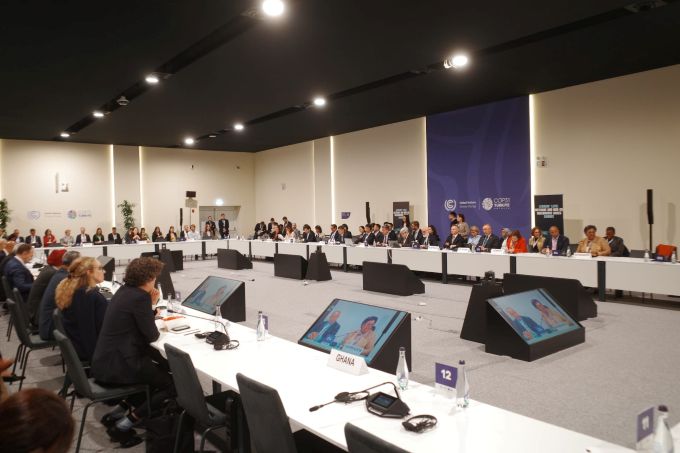
ANTALYA, November 13, 2026 – More than US$ 480 million in new philanthropic funding has been announced at the COP31 Leaders’ Summit to accelerate efforts to reduce methane and other non-CO₂ greenhouse gas emissions.
The funding, announced by philanthropic partners, will support emission reduction initiatives across the energy, agriculture and waste sectors, as well as efforts targeting black carbon, clean cooking, transport and cooling.
The announcement was made during the Leaders’ Level Methane and Other Non-CO₂ Greenhouse Gases Summit, co-hosted by Brazil, China and the United Kingdom, alongside the COP31 Presidency. The meeting was chaired by UK Secretary of State for Energy Security and Net Zero Ed Miliband.
The summit brought together government leaders, ministers, international organisations and climate finance partners to discuss ways of translating commitments to reduce methane and other greenhouse gases into measurable action.
The latest funding builds on US$ 300mln pledged by philanthropies when the Global Methane Pledge was launched in 2021. Since then, philanthropic partners have provided more than US$ 530mln to support implementation efforts.
“This new commitment will accelerate practical solutions across energy, agriculture, waste, clean air and cooling,” said Christie Ulman, president of the Sequoia Climate Foundation.
“Philanthropy can help catalyse action, but government leadership and private investment are essential to delivering change at scale,” she added.
Opening the summit, Barbados Prime Minister Mia Amor Mottley called for stronger action to reduce methane emissions from fossil fuels, agriculture and waste, saying the transition presented significant economic opportunities.
However, she cautioned against placing the financial burden of reducing agricultural emissions on farmers.
“No one can reasonably expect farmers to bear the cost of adjustment for methane emissions, either in livestock farming or rice paddy farming,” Mottley said.
She called for financing from national governments, the international community and philanthropic organisations, urging countries to move beyond voluntary commitments towards stronger international cooperation and regulation.
Australia also announced its endorsement of the UK-led Statement on Drastically Reducing Methane Emissions in the Global Fossil Fuel Sector.
COP31 President and Australia’s Minister for Climate Change and Energy Chris Bowen said capturing methane that would otherwise be wasted offered economic opportunities, while emphasising the need for improved emissions measurement and international cooperation.
International Energy Agency [IEA] Executive Director Fatih Birol said at least 75 per cent of methane emissions from fossil fuel operations could be eliminated using existing technologies.
He noted that more than 60 per cent of the potential reductions could be achieved at no net cost, strengthening the economic case for immediate action.
World Bank Group president Ajay Banga said methane reduction programmes were already delivering economic and development benefits across agriculture, waste management and energy.
He said the World Bank was supporting methane reduction programmes in 45 countries, three times the number committed at COP28, with the initiatives expected to cut 11mln tonnes of methane emissions and benefit more than 160 million people.
In Brazil, Banga cited results from a programme in which small family dairy farms increased milk yields by 10 per cent while reducing emissions by six per cent in one year.
He also highlighted a US $1 billion rice programme in India supporting more than 300,000 farmers, saying the initiative demonstrated that reducing methane emissions could go hand in hand with improved agricultural productivity and livelihoods.
China’s Minister of Ecology and Environment Huang Runqiu outlined his country’s efforts to reduce methane and other non-CO₂ greenhouse gases, including plans to incorporate the pollutants into its economy-wide emissions control target for 2035.
He said China’s latest Five-Year Plan prioritised non-CO₂ emission reductions, with a target of establishing 30 million tonnes of CO₂-equivalent abatement capacity by 2030.
China is also pursuing measures to control methane emissions in the energy, agriculture and waste sectors, alongside efforts to reduce industrial nitrous oxide and fluorinated gas emissions.
Huang called for greater international cooperation through knowledge sharing, technology development and transfer, as well as market-based incentives to attract investment in emissions reduction initiatives.
Meanwhile, United Nations Framework Convention on Climate Change (UNFCCC) Executive Secretary Simon Stiell called for stronger policies, increased investment and practical support to help countries overcome barriers to implementing proven emission reduction solutions.
He cited the Climate and Clean Air Coalition’s [CCAC] Super Pollutant Country Action Accelerator as an initiative helping countries translate their climate commitments into practical action.
Speaking on behalf of the CCAC partnership, UK Climate Minister Katie White announced an additional US$ 25mln to expand the programme to seven more countries: Côte d’Ivoire, Ethiopia, Fiji, Morocco, Pakistan, the Philippines and Uzbekistan.
The seven countries will join Brazil, Cambodia, Indonesia, Kazakhstan, Mexico, Nigeria and South Africa, which were selected during COP30.
Launched with an initial US$ 25mln commitment, the Accelerator now has US$ 50mln in announced funding and aims to support 30 developing countries by 2030.
The programme provides dedicated national teams, technical assistance and support to develop investment-ready projects targeting methane and other super pollutant emissions.
COP30 Chief Executive Officer Ana Toni said methane reduction had become a permanent priority in the COP process and was essential to limiting the magnitude and duration of global temperature overshoot.
She highlighted Brazil’s initiatives under the COP30 Action Agenda, including the launch of the Super Pollutant Country Action Accelerator and the No Organic Waste initiative.
Toni also cited measures to reduce non-CO₂ emissions in Brazil’s national climate plan and plans to introduce an integrated air quality and climate action plan.
She stressed that efforts to reduce methane must complement, rather than replace, deep cuts in carbon dioxide emissions, describing methane reduction as an “emergency brake that buys us time”.
Germany also called for stronger international action to address sulphur hexafluoride [SF₆], one of the most potent greenhouse gases.
Heike Henn, State Secretary at Germany’s Federal Ministry for the Environment, Climate Action, Nature Conservation and Nuclear Safety, highlighted the German-led Global SF₆ Pledge, launched at COP31.
The United Kingdom and European Commission also announced their support for the initiative, strengthening international cooperation to reduce emissions from electricity networks.
The summit builds on similar high-level engagements at COP28, COP29 and COP30, with participants emphasising the need to mobilise financing, strengthen policies and build institutional capacity to scale up available methane and other non-CO₂ emission reduction technologies.
Methane is a potent greenhouse gas, and reducing its emissions is considered an important measure for slowing global warming in the near term.
Participants said accelerating action on methane and other non-CO₂ pollutants would help limit global temperature overshoot while delivering economic, environmental and public health benefits.
https://thecooperator.news/cop31-leaders-push-global-electrification-drive-to-35-percent-by-2035/
Buy your copy of thecooperator magazine from one of our country-wide vending points or an e-copy on emag.thecooperator.news


