
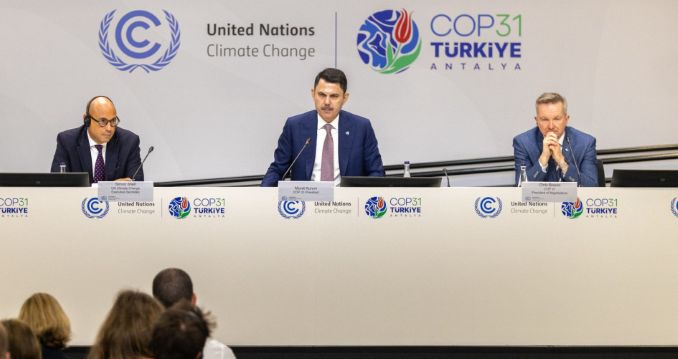
ANTALYA, November 12, 2026 – Leaders of the 31st United Nations Climate Change Conference [COP31] have called for accelerated global electrification, setting a target of increasing electricity’s share of global final energy consumption from the current 23 percent to 35 percent by 2035.
The target, under the 35-by-35 Global Electrification Pledge launched by the COP31 Presidency, is intended to reduce dependence on imported fossil fuels, strengthen energy security and accelerate the transition to cleaner energy.
Speaking at a joint COP31 Presidency press conference in Antalya, Türkiye, on Tuesday, COP31 President Murat Kurum said the global energy crisis had exposed the vulnerability of countries dependent on imported fuels, particularly to price fluctuations and supply disruptions.
Kurum said fuel-importing countries incurred an additional US$ 330 billion in costs between March and August, underscoring the need to accelerate the adoption of electricity-based technologies in transport, buildings and industry.
“As electric technologies become increasingly affordable, they give us an important opportunity to reduce this vulnerability,” Kurum said.
He said Türkiye wanted COP31 to deliver practical outcomes rather than political declarations, adding that the electrification target would be supported by concrete measures and investments.
COP31 President of Negotiations Chris Bowen said achieving the 35 percent target would require a significant acceleration in the rate of global electrification, noting that the current pace of progress was insufficient to meet the climate targets.
“The world has no chance of holding to 1.5 degrees unless we lift that to 35 percent,” Bowen said.
He explained that global electrification had increased from 17 per cent in 2005 to 19 percent in 2015 and 23 percent currently, meaning the world would need to more than quadruple its annual rate of progress to achieve the 2035 target.
Bowen said electrification was part of the solution to the interconnected global challenges of rising living costs, energy insecurity and climate change.
He also emphasised the importance of international cooperation, saying countries working together remained the only effective way of addressing climate change and other global crises.
UN Climate Change Executive Secretary Simon Stiell said COP31 was placing greater emphasis on practical solutions to help countries implement their global climate commitments and national plans through negotiations and the Global Climate Action Agenda.
Stiell said the transition to electricity, powered by clean energy, offered countries an opportunity to reduce pollution, lower household costs and protect their economies from the volatility of fossil fuel markets.
“Clean energy is cheap energy,” he said, citing International Renewable Energy Agency [IRENA] figures showing that 90 per cent of large-scale renewable energy projects were now cheaper than fossil fuel alternatives.
He added that existing technologies could already support the electrification of up to 75 percent of global energy demand, but stressed the need to accelerate their deployment and expand access to electricity, particularly in countries requiring additional support.
Stiell further revealed that 180 companies with combined revenues of nearly US$ 1.7 trillion were urging governments to seize the opportunities presented by electrification.
However, he warned that the global energy transition remained uneven, with many countries requiring greater support to participate fully.
Beyond electrification, the COP31 Presidency said it would prioritise climate adaptation, loss and damage, and efforts to keep global temperature increases within the 1.5 degrees Celsius threshold set under the Paris Agreement.
Kurum warned that even a temporary overshoot of the threshold could result in irreversible loss and damage, calling for urgent action to limit the scale and duration of any overshoot and eventually bring global temperatures back below the threshold.
He cited warnings from the World Food Programme that a strong El Niño event could push an additional 50 million people into acute hunger, illustrating how climate risks were worsening existing global crises.
The Turkish president said a special ministerial meeting on the second Global Stocktake would be held during the summit to examine the implications of exceeding the 1.5 degrees Celsius threshold and guide measures to bring temperatures back below it.
Kurum also welcomed a declaration by former COP presidents, from COP21 to COP31, expressing support for the current Presidency’s Action Agenda, describing the endorsement as a first in COP history.
He said the Turkish and Australian teams were working as one to deliver an inclusive conference that takes into account the priorities and circumstances of all participating countries.
Bowen, meanwhile, praised the partnership between Türkiye and Australia, saying their teams had been fully integrated to coordinate the conference.
The three leaders said COP31 should be judged by the practical changes it delivers, particularly in improving energy security, expanding clean transport and supporting lower-emission industrial production.
Kurum said the Presidency wanted delegates to leave Antalya confident that the conference had achieved tangible results and translated its commitments into improvements in people’s lives.
Buy your copy of thecooperator magazine from one of our country-wide vending points or an e-copy on emag.thecooperator.news


