
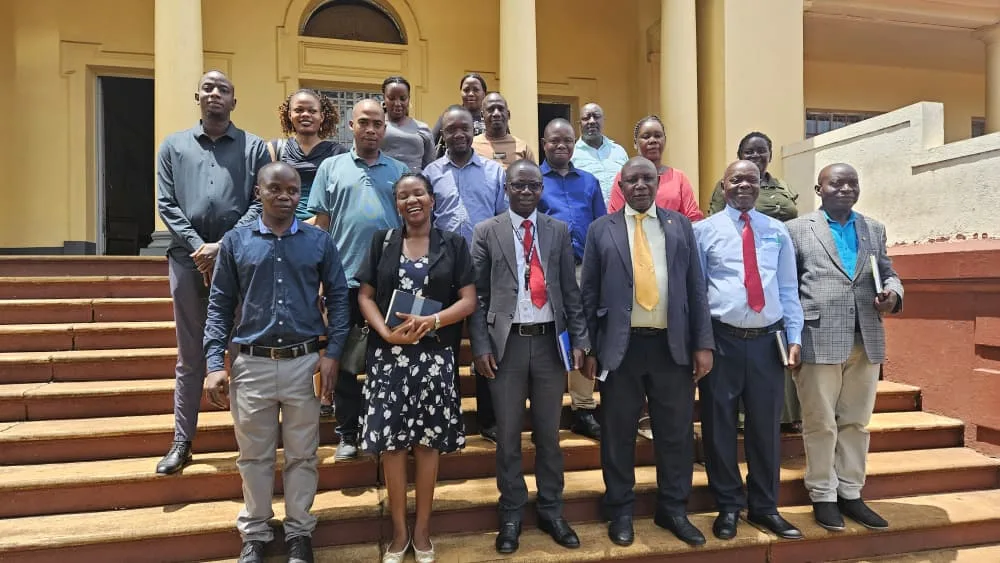
JINJA CITY, October 30, 2026 — Jinja district leaders and officials in Butagaya Subcounty have pledged their support for a Ministry of Water and Environment [MWE] exercise to reopen and demarcate the boundaries of the Nile Bank Central Forest Reserve to curb encroachment, restore degraded ecosystems and protect the River Nile’s fragile buffer zones.
The exercise is being implemented under the Kalagala and Itanda Falls Conservation and Protection Project, which seeks to strengthen the protection of forest reserves bordering the River Nile and promote sustainable management of the riverine environment.
The leaders made the commitment during a consultative meeting held recently with MWE officials at the Jinja district headquarters in Jinja City.
Jinja Resident District Commissioner Ahmed Katerega pledged the support of the district’s political leadership, saying local authorities would mobilise communities to participate in the boundary demarcation exercise.
“The district embraces the project, and will always mobilise our communities to support the demarcation exercise,” Katerega said.
He added that district leaders would work closely with the Ministry throughout the implementation of the exercise in Butagaya Subcounty.
The demarcation and restoration activities are being spearheaded by the Ministry’s Department of Environment Sector Support Services [DESS].
District Internal Security Officer [DISO] Andrew Kanywani also backed the initiative, citing persistent sand mining along the River Nile and the shores of Lake Victoria as a growing environmental concern.
“Unregulated extractive activities can accelerate environmental degradation,” Kanywani warned.
He called for stronger enforcement of environmental regulations and greater community participation in protecting natural resources.
Representing the district’s technical leadership, Deputy Chief Administrative Officer Hussein Malunda called on technical officers to work closely with the Ministry throughout the demarcation exercise.
The meeting was attended by officials from the District Women’s Council, District Forestry Office and District Land Board, as well as officials from Buwenge Town Council.
Protecting the Nile ecosystem
The head of the Ministry delegation, William Mawenu, said the success of the exercise would depend on effective collaboration among district political leaders, technical officers, local councils and communities.
He said reopening the boundaries of forest reserves bordering the River Nile was a key component of the Kalagala and Itanda Falls Conservation and Protection Project.
“These reserves are very important because they form part of the broader River Nile ecosystem, and any unregulated activities cause siltation of the river,” Mawenu said.
Forest reserves and riverbank buffer zones play a critical role in protecting water quality, stabilising riverbanks, reducing soil erosion and trapping sediment before it enters the river. They also provide habitats for wildlife, support biodiversity and help maintain the ecological balance of the River Nile.
Mawenu said clear demarcation of forest boundaries was essential to preventing illegal occupation, strengthening forest management and ensuring that activities within and around the reserves comply with environmental laws.
The project will also support restoration of degraded areas along the river through the planting of tree seedlings, including bamboo, Maesopsis eminii [Musizi] and Milicia excelsa [Mvule].
Mawenu encouraged communities to participate in tree growing and adopt alternative livelihoods to reduce pressure on forest resources.
“Community participation is critical to ensuring that conservation efforts are sustainable and that communities benefit from protecting natural resources,” he said.
He said the approach was intended to promote community ownership of conservation efforts while providing residents with sustainable economic opportunities.
Mawenu further said the Ministry had established a Grievance Redress Mechanism Committee comprising parish chiefs, local and district leaders to address concerns raised by community members during implementation of the project.
He added that an Environment and Social Safeguards Committee would also be established to manage environmental and social risks associated with project activities.
Senior Forest Officer Michael Kusuro emphasised the importance of clearly marking the forest reserve boundaries to prevent encroachment, deforestation and other activities contributing to environmental degradation.
According to the Ministry’s surveyor, Derrick Egunyu, the exercise will cover 606 hectares of land within the Nile Bank area, including a 12-kilometre cut-line along the River Nile.
The process will involve reconnaissance, reopening and marking of the forest boundary with visible pillars.
“The involvement of local communities in these activities is expected to promote ownership of the demarcated boundaries and strengthen collective responsibility for protecting the reserve,” Egunyu said.
Communities mobilised
Following the consultative meeting with district officials, the Ministry delegation proceeded to the Butagaya Sub-county offices, where it met local council leaders who pledged to mobilise residents to participate in the boundary reopening and demarcation exercise.
The meeting was attended by Sub-county Chairperson Waiswa Tanansi and Subcounty Chief Emmanuel Kakaire, alongside other local leaders, representatives and community members.
The Ministry team and local council leaders are engaging communities across the villages of Butagaya Subcounty to raise awareness about the reopening of the forest boundaries and the importance of protecting the reserve.
As the exercise progresses, sustained cooperation between government institutions and local communities will be crucial to ensuring that the demarcated boundaries are respected and restored areas remain protected.
Safeguarding the Nile Bank Central Forest Reserve and the River Nile’s buffer zones will require more than marking boundaries. It will also depend on sustained enforcement, community participation, restoration of degraded ecosystems and the promotion of sustainable livelihoods that reduce pressure on forests and riverbanks.
Through coordinated action, stakeholders can help preserve the River Nile’s ecological integrity, protect vital water resources and secure the environmental and economic benefits of the river for future generations.
https://thecooperator.news/west-nile-farmers-receive-training-on-modern-rice-production/
Buy your copy of thecooperator magazine from one of our country-wide vending points or an e-copy on emag.thecooperator.news


