
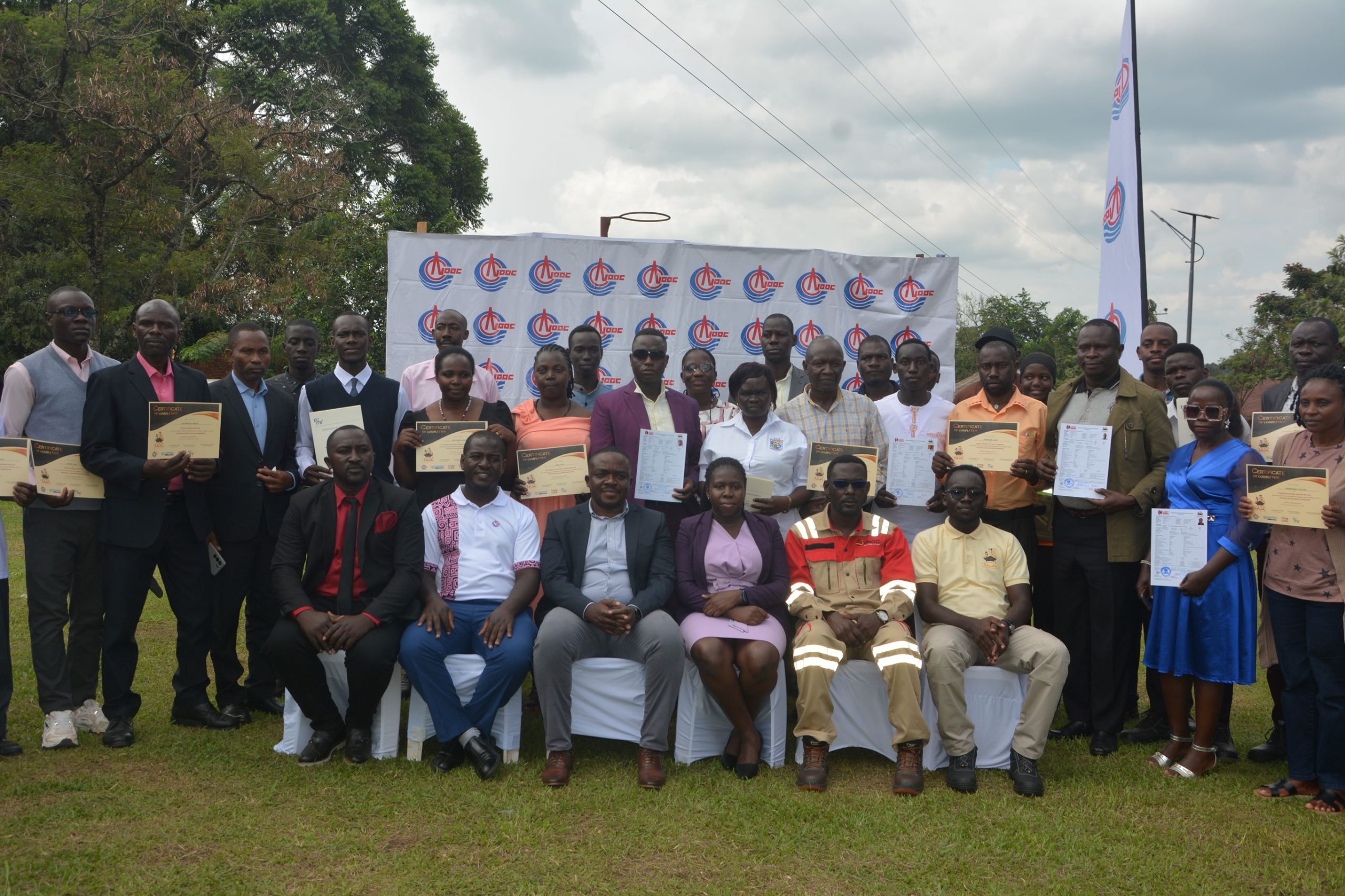
HOIMA, November 25, 2026 – A total of 168 vocational instructors from across Uganda have been awarded internationally recognised certificates following specialised training aimed at developing a skilled workforce for the country’s oil and gas sector ahead of commercial oil production.
The instructors trained in welding and fabrication, scaffolding, mechanical engineering, non-destructive testing, electrical and electronics engineering, and occupational health, safety and environment [HSE], among other disciplines.
They were awarded certificates after completing a two-month training programme sponsored by China National Offshore Oil Corporation [CNOOC] Uganda Limited under its Train-the-Trainer programme.
CNOOC is developing the Kingfisher oilfield in Buhuka parish, Kyangwali Subcounty, Kikuube district, on the shores of Lake Albert shared by Uganda and the Democratic Republic of Congo [DRC].
Speaking at the graduation ceremony held at St Simon Peter’s Vocational Institute in Hoima City recently, Shalyn Nansubuga, a Skills Development Officer at the Petroleum Authority of Uganda [PAU], welcomed the initiative, saying the country’s preparations for oil production and associated infrastructure development were increasing demand for technical expertise.
She said the growing demand covered occupational safety, quality management, maintenance services, fabrication, construction support and engineering skills.
Nansubuga noted that the training was part of a broader effort to develop a highly skilled Ugandan workforce capable of supporting not only the oil and gas industry but also manufacturing, construction, infrastructure development and other strategic sectors of the economy.
She urged vocational training institutions to strengthen partnerships with industry players, regularly update their curricula and align training programmes with emerging labour market requirements.
“The Train-the-Trainer approach is particularly commendable because it creates a multiplier effect. By equipping instructors with industry-relevant knowledge and practical skills, the benefits of this programme will extend far beyond the individuals graduating. Hundreds and eventually thousands of students will gain from the knowledge, experience and improved training methodologies that these instructors will carry back to their institutions,” she said.
She added that the programme was aligned with PAU’s commitment to promoting national participation and sustainable capacity development in Uganda’s petroleum sector.
“A skilled and competent workforce is fundamental to ensuring that Ugandans are able to participate competitively in petroleum activities and in other sectors of the economy,” she said.
Eric Jumba Daniel, CNOOC Uganda Limited’s National Content Manager, said the company had trained 413 vocational instructors since the Train-the-Trainer programme was launched in 2018.
He said CNOOC had contracted Q-Training Assessment and Training Centre [TASC] to conduct the training, with participants selected from vocational institutions across the country, including Uganda Technical College Kichwamba, Uganda Petroleum Institute Kigumba, St Simon Peter’s Vocational Institute and St Joseph’s Vocational Institute in Munteme, among others.
Jumba said the programme was designed to strengthen the capacity of local training institutions to develop a sustainable workforce capable of serving different sectors of Uganda’s economy, including oil and gas.
“Our goal is to ensure that Ugandans are not only participants but leaders in the oil and gas sector. We will continue to invest in skilling Ugandans, enterprise development and support, employment opportunities for nationals, and technology transfer to build sustainable capacity for the future,” he said.
He added that the international skills acquired by the instructors would enable them to compete for employment opportunities both in Uganda and abroad.
Highlighting CNOOC’s contribution to national content development, Jumba said 72 per cent of the company’s workforce at the Kingfisher oilfield comprised Ugandan nationals.
He further revealed that 398 contracts had been awarded to Ugandan companies, while 100 local enterprises had received training in documenting health, safety and environment management systems in line with International Organisation for Standardisation [ISO] standards.
Humphrey Muhumuza, Principal of St Joseph’s Vocational Training Institute in Teco, Munteme, commended CNOOC for investing in the professional development of vocational instructors.
He said the specialised skills acquired through the programme were difficult to obtain from local institutions because of their limited training capacities.
Muhumuza described the training as a major opportunity for the institution, noting that the instructors would pass on the knowledge and practical skills acquired to their students.
He said vocational skills training was increasingly important because it provided practical pathways to employment and self-reliance at a time when competition for formal white-collar jobs was growing.
Speaking on behalf of the beneficiaries, Deogratius Keuber, a welding and fabrication graduate, commended CNOOC for investing in the professional development of vocational instructors.
He said the knowledge and practical skills acquired had strengthened their capacity to deliver quality training and better prepare students for workplace demands.
https://thecooperator.news/ugandas-oil-sector-attracts-shs-50trn-investment-employs-18958-ugandans/
Buy your copy of thecooperator magazine from one of our country-wide vending points or an e-copy on emag.thecooperator.news


