
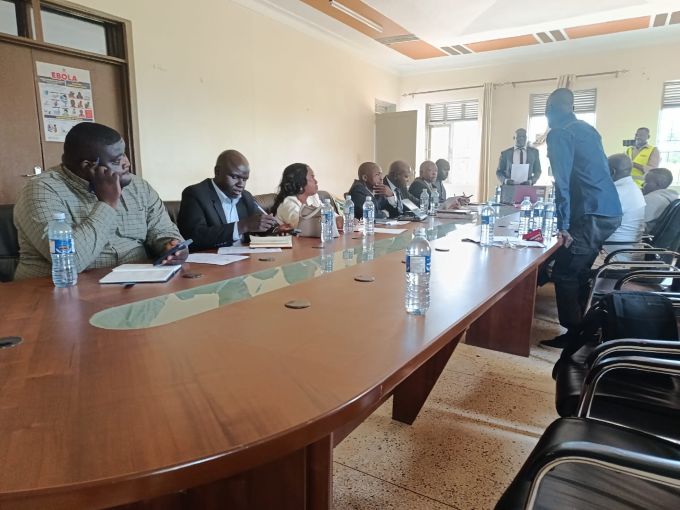
ZOMBO, October 26, 2026 — Zombo District has begun preparations for a major agricultural trade show and coffee conference aimed at showcasing the district’s agricultural potential, promoting value addition and linking farmers to markets and investment opportunities.
The three-day event is scheduled for November 11-13, 2026, at the Kyambogo University-Paidha Campus playground under the theme: “Building Climate Resilient Agriculture for Sustainable Agro-Industrialisation and Market Linkages for Wealth Creation.”
The development was announced to journalists on Wednesday during a press conference held in the boardroom of the district’s Health Department.
Dr Walter Kumakech, the Zombo District Production Officer, said the event would showcase the district’s untapped agricultural potential across value chains for key commodities, including coffee, bananas, Irish potatoes, tea, cassava, honey, horticulture, aquaculture, dairy and small ruminants, among others.
Kumakech said the trade show would also highlight Zombo’s tourism potential and rich cultural diversity, including the traditions of the Alur, Kebu, Lendu and Lugbara communities.
He said the event would provide a platform for direct linkages between farmers, research institutions, academia, agro-input dealers, processors, manufacturers, traders, buyers and investors from beyond the West Nile sub-region and northern Uganda.
Patrick Aneniwu, the Zombo District Agricultural Officer, said the trade show would provide an opportunity for farmers and other stakeholders to share knowledge and experience on modern agricultural technologies, innovations and sustainable farming practices, particularly those suited to the district’s highland agro-ecological system.
During the event, district extension officers, the Ministry of Agriculture, Animal Industry and Fisheries [MAAIF], the National Agricultural Research Organisation [NARO], the National Coffee Research Institute [NaCORI], development partners, civil society organisations, and religious and cultural leaders will participate in discussions on commercial agriculture, agro-processing and value addition.
On sustainable agriculture, district officials said the event would provide a learning platform focused on practical local solutions for climate change adaptation, environmental conservation and integrated farming.
They said the measures would help increase agricultural productivity while improving food and nutrition security and household incomes amid unpredictable weather patterns, soil degradation and increasing land fragmentation.
According to the district authorities, Zombo plans to increase coffee production and exports to approximately 61 metric tonnes annually within the next five years through targeted government interventions.
These interventions will include the distribution of coffee seedlings, fertilisers and other agricultural inputs, alongside continuous provision of quality extension and advisory services aimed at improving farm productivity and coffee quality while reducing post-harvest losses.
“Through the Coffee Conference, we intend to highlight the constraints the local coffee industry is facing along the value chain for redress,” the statement said.
The district authorities said Zombo’s fertile clay-loam soils, which have a high water-retention capacity, provide an advantage for agricultural production, particularly during prolonged dry spells.
“To supplement this, we’re promoting water for production that will enable us to go a long way to curb the challenge of climate variability and heat waves,” the district said.
Zombo has 36 agricultural extension workers serving more than 64,342 farming households, translating into approximately one extension worker for every 1,787 households.
Jovian Kayenyparwoth, the District Tourism Officer, said the event would also give visitors an opportunity to learn about the traditions and cultural practices of communities in Zombo through traditional dances, food and other cultural activities.
“The farmers will want to learn with the quality tools, but the tourists will be interested in seeing our cultural heritage, where it came from and how it started long ago,” she said.
Robert Abenaitwe, the Zombo Chief Administrative Officer, urged residents to change their attitude towards farming and embrace coffee growing as a viable economic activity.
“Coffee is gold. Let’s encourage our people to plant coffee,” Abenaitwe told journalists, calling for greater efforts to popularise coffee growing in the district.
Charles Etoma, the MAAIF West Nile Regional Agricultural Officer, said the ministry fully supported the district’s initiative.
“It is the mandate of MAAIF to promote agriculture, so we’re in full support of the trade show and the conference,” he said.
Zombo District LCV Chairperson James Oruna Oyulu said the district leadership intended to make the agricultural trade show and coffee conference an annual event and provide funding for it in future budgets.
Assistant Resident District Commissioner Isaac Wurochi said the event would help connect farmers to investment opportunities and accelerate the transition from subsistence to commercial agriculture.
He added that the RDC’s office continued to monitor funds under the Parish Development Model [PDM] and Emyooga Programme to ensure they reached the intended beneficiaries.
“This will help us transit from subsistence to commercial farming and eventually into the money economy,” Wurochi said.
Oyulu said the district leadership would prioritise the event in its planning and budgeting.
“As executives and the technical team, we will sit and make sure that we give this event a priority in the budget starting with the upcoming budget conference,” he said.
Buy your copy of thecooperator magazine from one of our country-wide vending points or an e-copy on emag.thecooperator.news
-

-

-

-


