
OUAGADOUGOU, September 26, 2026 — The population of the Sahel is projected to exceed 500 million by 2050, making it one of the world’s fastest-growing regions. The demographic expansion presents significant opportunities for long-term economic growth, particularly in rural areas, where more than two-thirds of the population lives.
But unlocking that potential will require greater investment. Insecurity, population displacement and limited access to productive assets continue to constrain economic opportunities in rural communities, making it harder for people to build sustainable livelihoods.
The Joint Programme for the Sahel in Response to the Challenges of COVID-19, Conflict and Climate Change [SD3C] was established to address some of these challenges. Designed, implemented and financed through a collaboration between the International Fund for Agricultural Development [IFAD], the Food and Agriculture Organization of the United Nations [FAO] and the World Food Programme [WFP], the programme seeks to strengthen resilience and livelihoods for an estimated 854,750 people across the region.
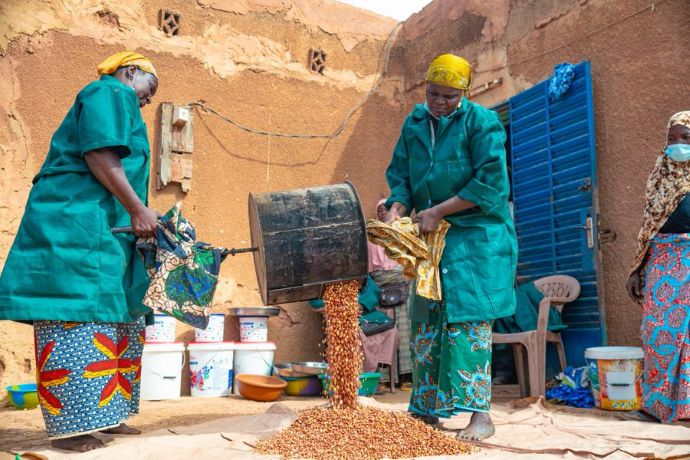
In Burkina Faso, an SD3C-supported women’s cooperative is demonstrating how targeted investment can unlock rural enterprise and create new economic opportunities.
By transforming a small-scale peanut-processing operation into a growing enterprise, SCOOPS RELWENDE, based in Ouahigouya in northern Burkina Faso, is increasing production, raising incomes and strengthening the economic resilience of its members.
From small-scale processing to a growing enterprise
For years, limited equipment and working capital constrained the growth of SCOOPS RELWENDE. Although demand for processed peanut products was strong, cooperative members could work only about one day a week, relying largely on manual shelling or a single machine.
That began to change in 2024, when the cooperative received a XOF 2 million [US$ 3,500] grant through the SD3C programme.
The funding enabled the women to establish a dedicated peanut-processing unit, purchase 10 shelling machines, acquire storage bags for peanut seeds and improve packaging for their peanut paste.
The results were rapid.
Within less than a year, the cooperative increased its processing capacity from seven bags of peanuts a week to nearly 40. The increase in production has translated into higher earnings, with monthly profits rising nearly tenfold to at least XOF 500,000 [US$ 870].
Rather than distributing all of the profits, the cooperative is reinvesting them in the business to support further growth.
Turning peanuts into value
The cooperative’s progress is not simply a result of producing more. It is also adding greater value to its products while making use of what would otherwise become waste.
Non-standard peanuts are processed into peanut butter, with revenue from the product more than doubling from XOF 3.25 million [US$5,688) to XOF 7.6 million [US$13,300].
The cooperative also repurposes peanut shells as organic fertiliser, creating an additional environmental and economic benefit from the processing chain.
This approach allows the women to capture more value from locally produced agricultural commodities while reducing waste.
Expanding access to finance and opportunity
The impact of the enterprise extends beyond production and profits.
For many of the women involved, the cooperative has provided an important pathway to formal financial services, with several members gaining access to credit for the first time.
Greater economic security has also strengthened the women’s confidence and participation in household and community decision-making, giving them a stronger voice in shaping their own futures.
The cooperative has built partnerships with farmers’ organisations, microfinance institutions, technical services of the Ministry of Agriculture, the Chamber of Commerce and traders in both Ouahigouya and Burkina Faso’s capital, Ouagadougou.
These partnerships have helped strengthen supply chains, improve product quality and connect the cooperative to wider markets.
Preparing for the next phase
With demand for its products growing and confidence from financial institutions increasing, SCOOPS RELWENDE is now preparing for its next stage of expansion.
Continued support through the SD3C programme is helping the cooperative expand its network of suppliers and buyers, secure land for a dedicated processing facility, pursue product certification, develop a distinct brand identity and prepare a bankable business plan.
These investments could help move the cooperative from a small-scale processing operation to a more established rural agribusiness.
A model for rural enterprise
The experience of SCOOPS RELWENDE highlights the potential of locally led enterprises across the Sahel.
Many rural businesses already have the skills, local resources and entrepreneurial drive needed to grow. What they often lack is access to finance, appropriate equipment, markets and business development support.
The experience of the women in Ouahigouya shows how relatively modest investment can help remove some of these constraints.
For SCOOPS RELWENDE, the transformation is being measured not only in bags of peanuts processed or profits generated, but also in greater access to finance, stronger market connections and new economic opportunities for women.
As the Sahel faces the combined pressures of population growth, climate change and insecurity, enterprises such as this cooperative demonstrate the potential of rural communities to build resilience by investing in local skills, adding value to agricultural products and creating opportunities from within their own communities.
https://thecooperator.news/agroecology-proves-a-win-for-burkina-faso-farmers-report-finds/
Buy your copy of thecooperator magazine from one of our country-wide vending points or an e-copy on emag.thecooperator.news
-

-

-

-


