
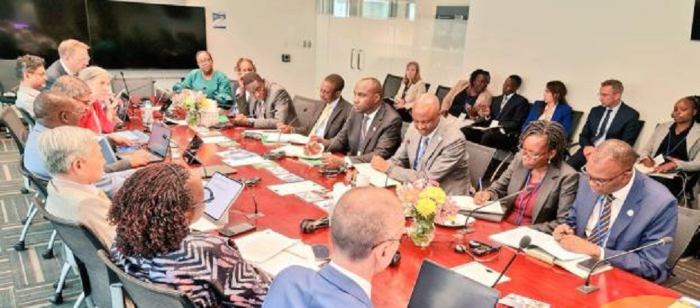
KAMPALA, April 21, 2026 — The World Bank has expressed concern that Uganda’s strong economic growth is not translating into improved livelihoods for its citizens.
The Bank’s Vice-President for Africa, Ndiame Diop, told the Ugandan delegation during talks in Washington, DC, that while the country’s macroeconomic stability appears robust, it has yet to generate sufficient quality jobs or significantly reduce poverty.
Diop noted that economic gains should be matched by tangible improvements in living standards, including reduced income inequality, better housing, and a general decline in poverty levels across communities.
His remarks followed a report by the State Minister for Finance, Henry Musasizi, who said Uganda’s economy had continued to expand despite a challenging global environment.
He added that Gross Domestic Product [GDP] growth currently stands at 6.3 per cent, with projections of between 6.5 and 7 per cent by the end of the financial year.
“This growth trajectory is well aligned with our ambition to expand the economy tenfold by 2040. The World Bank portfolio has grown from US$ 3.9 billion in March 2025 to US$4.74 billion across 18 projects and programmes,” Musasizi told the meeting.
Diop commended Uganda for its solidarity with refugees and expressed the Bank’s readiness to develop a coordinated programme to support refugees and asylum seekers in the country.
Uganda hosts more than two million refugees from countries including Sudan, South Sudan, the Democratic Republic of Congo, Burundi, Somalia, Eritrea, Djibouti and Ethiopia, according to a recent report by the United Nations.
However, several World Bank-funded projects in Uganda have been rated underperforming in various reviews, largely due to inefficiencies in implementation, which have also led to delays in the disbursement of funds.
The meeting reviewed the Investment for Industrial Transformation and Employment [INVITE] project, recommending its restructuring to better meet the needs of intended beneficiaries. The project was established with World Bank support to help the private sector recover from the effects of the COVID-19 pandemic.
Discussions also covered other World Bank-funded initiatives, including those in energy and hydropower, the Standard Gauge Railway, and broader infrastructure development.
Musasizi welcomed the Bank’s approval of the Uganda Cities and Municipal Infrastructure Programme, as well as additional financing for the Integrated Water Management Development Project, and called for further support for electricity and road projects.
“We look forward to the approval of the Uganda–Tanzania Transmission Line project and additional financing for Lot 1 of the North Eastern Road Asset Management Project,” he said.
Projects under the Bank’s portfolio include the Standard Gauge Railway, hydropower generation, urban infrastructure, drainage and waste management, transmission lines and substations—particularly in industrial parks—as well as private sector support, especially access to credit, alongside Development Policy Operations.
The Ugandan delegation to Washington, DC, for the just concluded IMF-World Bank Meetings was led by Musasizi and included Permanent Secretary and Secretary to the Treasury Ramathan Ggoobi, Attorney General Kiryowa Kiwanuka, and Bank of Uganda Governor Michael Atingi-Ego, among others.
https://thecooperator.news/world-bank-imf-and-iea-form-joint-taskforce-over-middle-east-war-shock/
Buy your copy of thecooperator magazine from one of our country-wide vending points or an e-copy on emag.thecooperator.news
-

-

-

-


