
KAMPALA, June 27, 2026 — Uganda’s manufacturing sector has called on government and financial institutions to reform existing financing models and provide funding solutions tailored to different production cycles and investment needs.
The local manufacturers argue that conventional lending structures remain prohibitively expensive, while weak supply chain linkages continue to constrain productivity and sector growth.
They are now advocating for innovative financing models and stronger value chain integration as businesses contend with rising production costs and other persistent barriers to expansion.
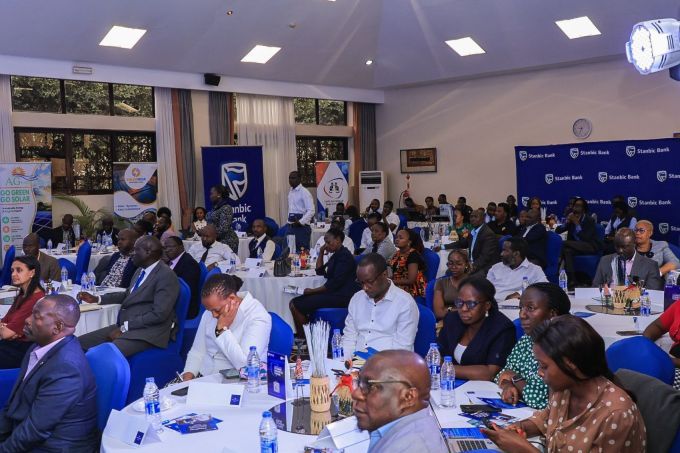
These concerns dominated discussions at Stanbic Bank Uganda’s inaugural Business Forum held recently in Kampala, where manufacturers, agribusiness operators, logistics stakeholders and policymakers examined structural challenges affecting industrial growth.
The Director of Policy and Advocacy at the Uganda Manufacturers’ Association [UMA], Allan Ssenyondwa, called for innovative financing mechanisms, stronger public-private partnerships and policies aimed at reducing operational bottlenecks.
“We can collectively develop reforms in the financial sector after consulting all stakeholders, including those in agribusiness and large-scale commercial farming,” Ssenyondwa said.
The Managing Director of Agrifarm Uganda Ltd, Agnes Mbabazi, said access to affordable and appropriately structured financing remains critical for firms seeking to expand production capacity and invest in value addition.
“Weak connections between producers, processors, distributors and retailers are creating inefficiencies across supply chains, increasing costs and reducing our competitiveness,” she said.
Manufacturers also reported that many firms continue operating under expensive financing arrangements, heavy reliance on imported raw materials and fragmented supply chains, all of which have undermined competitiveness.
Tunde Thorpe, Head of Business and Commercial Banking, noted that with manufacturing contributing at least 16.6 per cent to Uganda’s Gross Domestic Product [GDP], the concerns raised by industry players deserve greater attention.
“These figures remind us that manufacturing is not just another sector; it is central to Uganda’s growth, resilience and competitiveness,” he said.
According to records from the Uganda National Bureau of Statistics, Uganda’s manufacturing sector supports at least one million direct and indirect jobs and contributes more than 30 per cent of total national tax revenue.
Participants observed that while these figures reflect the sector’s importance, they also conceal underlying challenges that continue to limit industrial expansion and value creation from domestic resources. Among the most pressing concerns, they noted, is the mismatch between traditional lending products and the realities of manufacturing operations.
Manufacturers therefore urged financial institutions to design products that support long-term capital investment in production equipment, technology upgrades and business expansion.
The Commissioner for Business Development and Quality Assurance at the Ministry of Trade, Industry and Cooperatives, Patrick Mugisha, said Uganda must increase local processing capacity to strengthen its position in regional and international markets.
“Industrialisation efforts must focus on converting more of Uganda’s agricultural output into finished and semi-processed products rather than exporting raw materials,” he said.
The forum also recognised the growing importance of technology in improving market access, particularly for agribusiness products.
Stanbic Bank’s Head of Agribusiness, Emmanuel Negombye, said digital platforms have become instrumental in connecting farmers, processors and exporters while reducing structural inefficiencies across supply chains.
Meanwhile, Stanbic Bank Uganda Executive Director Paul Muganwa said the forum was intended to shift discussions towards practical interventions that can strengthen local production and position Ugandan businesses for sustainable growth.
“We have seen what is possible when manufacturers scale with ambition and the right support. Roofings Group, for example, has grown from strong local foundations into a major industrial player. Its journey demonstrates the importance of access to the right financing partner, strategic investment and market opportunities,” Muganwa said.
Lending rates
In April 2026, the average weighted lending rate for Shilling denominated credit declined to 18.26
percent, from 18.89 percent in March 2026, says the Performance of the Economy Monthly Report for May, which attributed the decline to a lower risk premium charged by commercial banks, supported by the decline in non-performing loans.
The report further says the weighted average lending rate on foreign currency-denominated credit rose to 7.34 percent in April 2026 from 6.65 percent in March 2026. “This increase was partly driven by
increased uncertainty in global financial markets stemming from geopolitical tensions in the Middle
East, which contributed to higher global risk premiums,” says the report released by the Finance ministry recently.
The report says credit extension to the manufacturing sector increased to Shs 153 billion in April 2026, from, which was Shs 10bln up, from Shs 143bln received by the sector in March.
Meanwhile, participants at the meeting noted that such forums remain important for economic transformation as Uganda seeks to expand industrial output under its broader industrialisation agenda, with policymakers prioritising value addition to drive job creation, export growth and improved household incomes.
https://thecooperator.news/ugandan-manufacturers-call-for-new-cross-border-trade-policies/
Buy your copy of thecooperator magazine from one of our country-wide vending points or an e-copy on emag.thecooperator.news


