
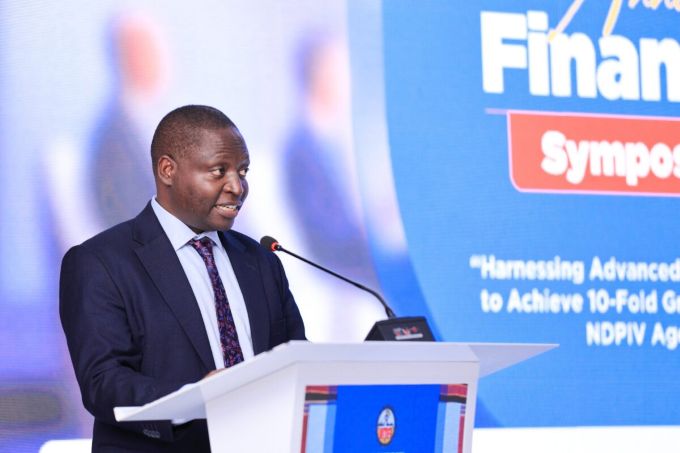
KAMPALA, August 11, 2026 — State Minister for Trade David Bahati has urged commercial banks in Uganda to reduce lending rates for manufacturers to enable the sector to grow.
Bahati said the gap between manufacturers’ rates of return and the cost of borrowing makes it difficult for businesses to expand.
He said manufacturers’ rates of return range between 8 and 12 per cent, compared with commercial lending rates of between 18 and 24 per cent, describing the disparity as one of the key impediments to industrial growth.
“Borrowing money for manufacturers at 18 per cent or 20 per cent and expecting to break even and make profits within five years is almost impossible,” Bahati said while speaking at the Uganda Manufacturers Association [UMA] Financial Symposium in Kampala.
He described the manufacturing sector as “purely bankable” and called on lenders to design financial products tailored to its needs.
Bahati said government is working on measures to widen access to long-term financing, including increased funding for the state-owned Uganda Development Bank [UDB] and reforms such as new regulations allowing Islamic banking.
He also noted that the industrial sector contributes at least 27.4 per cent of the country’s Gross Domestic Product [GDP], reiterating government’s commitment to reducing electricity tariffs for manufacturers to at least US$0.05 per unit to enhance industrial competitiveness.
Bahati called for sustained collaboration and unwavering commitment to Uganda’s 10-fold growth agenda, emphasising that continuity in its implementation is critical to unlocking investment in industrial transformation and promoting inclusive economic growth.
The symposium was organised under the auspices of the Uganda Manufacturers Association [UMA], under the theme “Financing Uganda’s Tenfold Growth Agenda”. The Government’s long-term plan seeks to expand Uganda’s economy from US$50 billion to US$500bln by 2040.
The ambitious agenda, launched in 2023, is anchored on Agro-industrialisation, Tourism, Mineral Development, and Science and Technology [ATMS].
Speaking at the symposium, Diamond Trust Bank Uganda’s Head of Banking, Douglas Ddamba, committed the bank to providing several long-term lending facilities for manufacturers.
He said the bank had developed long-term financing facilities covering equipment and asset financing, trade finance and working capital, stressing that short-term credit alone could not deliver the country’s growth ambitions.
UMA Chairman Agha Sekalaala noted that affordable long-term financing remains one of the biggest barriers to industrial growth.
He called for closer collaboration among manufacturers, banks, government and development partners.
“Our manufacturing sector has the potential to achieve 10-fold growth, but only if finance evolves with it,” he said.
Sekalaala also called for integrity-driven financial reforms, innovative financing solutions and stronger partnerships to unlock Uganda’s industrial potential and accelerate economic growth.
According to the latest Performance of the Economy Monthly Report, released by the Finance ministry, the average weighted lending rates for both shilling and foreign currency denominated credit in May 2026, declined to 18.0 per cent and 7.28 per cent from 18.26 per cent and 7.34 per cent respectively in April 2026. This decline, the report says, was partly attributed to lower risk premiums, coupled with low inflation, exchange rate stability and adequate banking sector liquidity.
On the other hand, the report states the stock of outstanding private sector credit expanded by 1.1 percent to Shs 26.7 trillion in May 2026, up from Shs 26.4trn in April 2026, and largely driven by growth in foreign currency-denominated lending following increased loan disbursements to the manufacturing and trade sectors.
The shilling-denominated credit increased to Shs 18.6trn from 18.4trn in April 2026. Personal and household loans continued to account for the largest share of the stock of outstanding credit at 25.8 percent, followed by building, mortgage, construction and real Estate [18.4 per cent], trade [14.3 per cent], manufacturing [12.6 per cent], and agriculture sector [11.3 per cent].
Buy your copy of thecooperator magazine from one of our country-wide vending points or an e-copy on emag.thecooperator.news
-

-

-

-


