
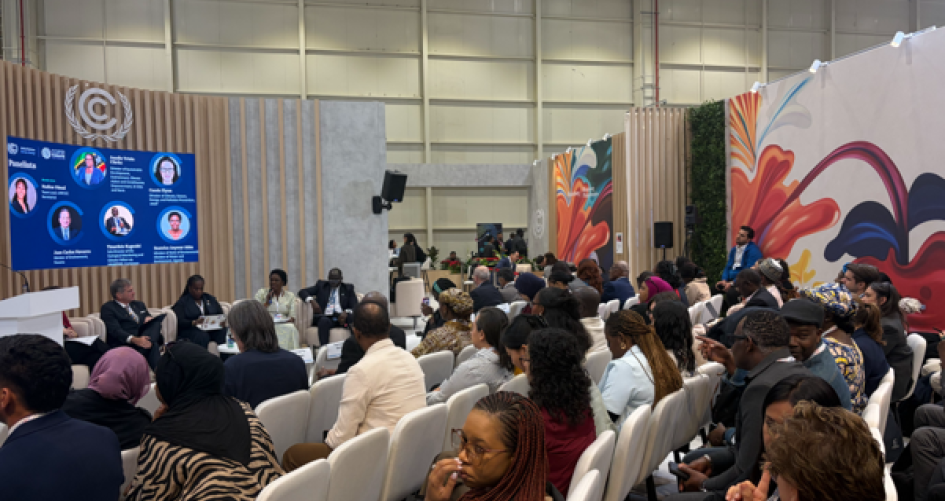
ANTALYA, November 20, 2026 – Uganda and other developing countries have called for increased climate finance, stronger technical assistance and greater international cooperation to help translate national climate commitments into concrete action.
Speaking at COP31 in Antalya, Türkiye, on Wednesday, Uganda’s Minister of State for Environment, Beatrice Anywar Atim, said developing countries faced different challenges in implementing their climate plans and required support tailored to their national circumstances.
“We cannot design a one-size-fits-all approach and expect it to be implemented in all developing countries. What we require are targeted, hands-on and country-defined solutions,” she said.
Anywar Atim also called for increased technical assistance to developing countries and additional funding for the United Nations Framework Convention on Climate Change [UNFCCC] secretariat and its Regional Collaboration Centres [RCCs] to respond to countries’ evolving capacity needs.
Her remarks were made during a session titled Catalysing Support for NDCs, convened by the UNFCCC secretariat and its RCCs. The session brought together representatives from Cameroon, Panama, Saint Kitts and Nevis, Uganda and the UNDP Climate Promise.
Opening the session, James Grabert, Director of the Mitigation Division at the UNFCCC secretariat, said countries needed to move beyond setting climate targets and focus on implementation.
“Countries need to translate their priorities into policies, programmes and investment plans, supported by strong institutions and adequate resources,” he said.
Panama’s Minister of Environment, Juan Carlos Navarro, said technical guidance from the UNFCCC secretariat and the Regional Collaboration Centre for Latin America had supported the development of the country’s Nature Pledge and implementation roadmap.
The framework brings together Panama’s climate, biodiversity and land restoration commitments.
Navarro said political commitment was essential but insufficient without practical measures to deliver on agreed targets.
“But having a commitment is only the beginning. Again, political will. The real challenge is implementation,” he said.
“We do not need more commitments to remain on paper. We need the tools, partnerships and resources to deliver commitments that we have already made.”
In Saint Kitts and Nevis, Minister Joyelle Trizia Clarke highlighted the complexity of implementing national climate commitments, saying even a single target could require coordination across several government ministries and institutions.
She cited electric vehicle adoption as an example, noting that implementation could involve decisions on vehicle imports, taxation and investment in charging infrastructure.
“You can have a climate commitment in your NDC document. It takes up a paragraph or two pages. But what does that mean in the government, in the systems and the institutions that you have to navigate?” she said.
Clarke also highlighted the technical assistance provided by the NDC Partnership in supporting countries to implement their climate commitments.
Cameroon identified climate finance, cross-sectoral coordination and stronger technical and institutional capacity as key requirements for implementing its Nationally Determined Contribution [NDC].
Timothée Kagonbé, Sub-Director of Ecological Monitoring and Climate Follow-up at Cameroon’s Ministry of Environment, Nature Protection and Sustainable Development [MINEPDED], said support from the Regional Collaboration Centre for West and Central Africa and the Central Africa Forest Initiative had contributed to the revision of the country’s NDC.
“The climate ambition of developing countries cannot be fully realised without international support,” he said, highlighting the gap between countries’ climate ambitions and the resources available to implement them.
Linking national priorities to international support
Cassie Flynn of the UNDP said the Climate Promise, working with the RCCs, helped countries access technical assistance, exchange knowledge and strengthen country-led climate action.
“NDCs are not just a document. NDCs can be a pathway towards transformation, a pathway towards investment and a pathway towards collaboration,” she said.
Closing the session, Muhammad Taimur, Manager of Implementation Coordination at the UN Climate Change Secretariat, who also oversees the six Regional Collaboration Centres, said the centres played a key role in connecting countries with the expertise, partnerships and resources needed to implement their climate commitments.
However, he said the centres could not deliver that support alone.
“They connect country priorities with partnerships, expertise and resources needed to move from ambition to implementation. But RCCs cannot and should not do this alone. Partnership is our collective and strategic strength,” he said.
Buy your copy of thecooperator magazine from one of our country-wide vending points or an e-copy on emag.thecooperator.news
-

-

-

-


