
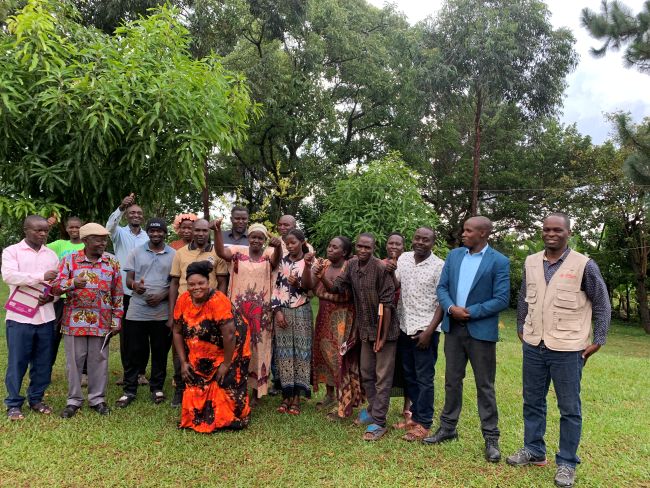
KAPCHORWA, August 21, 2026 — The Uganda Cooperative Alliance [UCA], in partnership with Agriterra and other partners under the Farmers Organisations for Rural Transformation [FORT] programme, has trained members of the Sirimityo Matooke Growers and Poultry Keeping Group in Kapchorwa district in lobbying and advocacy.
The training, held recently in Sirimityo parish, was aimed at equipping farmers with practical skills to identify challenges affecting their livelihoods, engage local leaders and other duty bearers, and collectively advocate for services and interventions that can improve agricultural production and household incomes.
The training is part of the FORT programme, which seeks to strengthen farmer organisations through capacity building in leadership, governance, financial management, lobbying and advocacy, and sustainable economic development.
Speaking during the training, Rosemary Chelangat, Chairperson of the farmers’ group, said the organisation was established in 2021 with only 10 members but has since grown to more than 45 members.
She attributed the growth to members’ commitment, savings and the benefits of working collectively.
“We started as a small group of only 10 members, but today we have more than 45 members. This growth shows what farmers can achieve when they work together and remain committed to a common goal,” Chelangat said.
She explained that when the group was formed, members contributed Shs 35,000 as registration funds, while each member was required to save Shs 5,000 every week. Members also contributed Shs 100,000 each as capital shares.
According to Chelangat, the financial contributions were introduced to promote a culture of saving and provide the group with a foundation for collective investment.
“Our savings have helped us to understand the importance of planning and working together. We want our members to continue saving because it gives the group a stronger financial foundation and creates opportunities for investment,” she said.
The group’s main activities are matooke growing and poultry keeping, enterprises that contribute to household incomes, food security and the general welfare of members.
However, Chelangat said farmers continue to face several challenges that limit their ability to increase production and improve their incomes. These include limited access to agricultural extension services, markets, finance and other opportunities needed to expand their enterprises.
She said the lobbying and advocacy training had helped members understand that they can address some of these challenges by organising themselves and engaging the relevant authorities.
“We have learnt that we should not simply complain about the challenges we face. We need to identify the problem, collect information and approach the responsible leaders and institutions with a clear message,” she said.
Chelangat encouraged members to apply the knowledge gained from the training to improve their enterprises and household welfare.
On his part, Timothy Bisagati, Regional Coordinator for UCA and Project Coordinator for the FORT programme in the Elgon region, said the programme was designed to empower farmer organisations to become stronger and more effective in representing their members.
Bisagati said FORT is being implemented in six districts in the Elgon region, with interventions aimed at strengthening farmer organisations and improving their contribution to economic and community development.
He said improving farmers’ livelihoods requires more than knowledge about agricultural production, noting that farmers also need to understand how to engage government institutions, local leaders and other stakeholders responsible for delivering services.
“Farmers need production skills, but they also need the ability to engage with leaders and institutions that have the responsibility to provide services. Lobbying and advocacy give farmers a collective voice through which they can influence decisions that affect their livelihoods,” Bisagati said.
He urged farmers to move away from simply complaining about the challenges they face and instead organise themselves, gather evidence and present their concerns to the appropriate duty bearers.
“Your concerns are more likely to receive attention when you approach leaders as an organised group, with evidence and clear proposals on what you want addressed,” he said.
Bisagati also encouraged the group to strengthen its internal structures, maintain proper records and promote transparency and accountability in the management of its activities and finances.
He said strong governance is essential for the sustainability of farmer organisations because members need confidence that their contributions are being properly managed.
“A strong farmer organisation must have good leadership, proper records and accountability. Members must know how their money is being used and how decisions are being made. This builds trust and encourages members to remain active,” he said.
The training also focused on helping farmers understand the difference between lobbying and advocacy and how both approaches can be used to influence decisions and improve services in their communities.
Participants were encouraged to identify issues affecting matooke production and poultry keeping, discuss them collectively and determine the relevant institutions and leaders to approach.
Among the issues farmers were encouraged to advocate for were improved agricultural extension services, better access to markets and financial services, infrastructure and other interventions that can support agricultural production and increase household incomes.
The facilitators emphasised the importance of evidence-based advocacy, urging farmers to document their challenges, activities and achievements. Proper records, they said, can provide credible evidence when farmer organisations engage government authorities, development partners and other stakeholders.
The training further highlighted the importance of unity among farmers. Participants were encouraged to use their organisation as a platform for identifying common challenges and developing collective solutions rather than pursuing individual interests.
Bisagati also urged members to remain committed to saving and participating actively in group activities, saying collective action can create opportunities that individual farmers may struggle to access.
Closing the training, Walter Braghai, the LCII Chairman-elect for Sirimityo parish, appreciated UCA, Agriterra and their partners for bringing the training closer to farmers.
Walter encouraged participants to put the knowledge acquired into practice and use their collective voice to address challenges affecting their agricultural activities.
“I appreciate UCA, Agriterra and their partners for bringing this training to our farmers. The knowledge acquired will only be useful if members put it into practice and use it to improve their livelihoods,” Walter said.
He congratulated the group for its growth since its establishment in 2021 and urged members to continue mobilising other farmers to join the organisation.
Braghai said strong farmer organisations can contribute significantly to community development when members remain united and committed to shared objectives. He also encouraged members to maintain their savings culture, strengthen the organisation through active participation and promote responsible leadership.
The training ended with a call for farmers to use lobbying and advocacy as tools for constructive engagement with leaders, government institutions and other stakeholders.
For the Sirimityo Matooke Growers and Poultry Keeping Group, the training is expected to strengthen members’ capacity to identify their priorities, communicate their concerns effectively and participate more actively in local development processes.
With the group now having more than 45 members, its continued growth, coupled with the skills acquired through the FORT programme, provides a stronger foundation for improving matooke production, poultry keeping, savings and collective action.
Buy your copy of thecooperator magazine from one of our country-wide vending points or an e-copy on emag.thecooperator.news
-

-

-

-


