
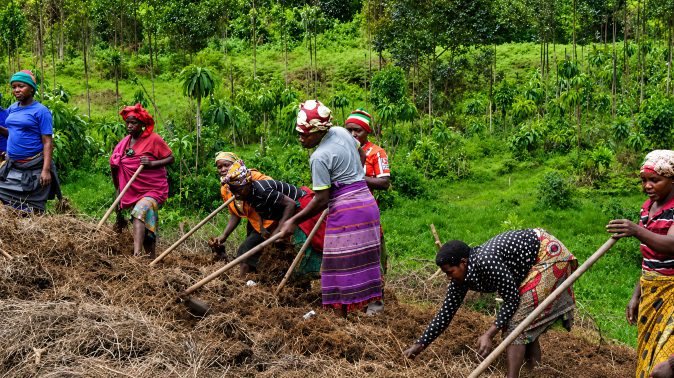
RUKIGA, July 16, 2026 — Smallholder farmers in Rukiga district, southwestern Uganda, have partnered with researchers, environmental experts and development organisations under a new initiative aimed at strengthening resilience to climate change by turning scientific research into practical farming solutions.
The initiative, implemented under the Strengthening Smallholder Farmer Resilience to Climate Change [SFR2CC] Project, seeks to bridge the long-standing gap between agricultural research and everyday farming practices by fostering direct collaboration between scientists and rural communities.
The project is jointly implemented by Kabale University and Kigezi Women in Development [KWID] in the Kigezi Highlands, alongside Mountains of the Moon University and Joint Effort to Save the Environment [JESE] in the Rwenzori region.
The latest engagement brought together members of Catchment Management Committees, Water User Groups, women and youth representatives, farmers, and local leaders for a one-day training on water and soil conservation organised recently at All Saints Church in Kamwezi Subcounty, Rukiga district.
For decades, agriculture has been the backbone of livelihoods in Rukiga, with communities relying on fertile hillsides and seasonal rainfall to produce food and generate income. However, increasingly unpredictable weather patterns, prolonged dry spells, declining water sources and severe soil erosion are making farming more challenging, threatening food security and household incomes.
Speaking during the training, KWID Executive Director Florence Tumuheirwe said the project was designed to ensure that university research translates into practical solutions that directly improve the livelihoods of farming communities.
She noted that for many years, valuable agricultural research generated by universities remained largely inaccessible to farmers because much of it was confined to academic libraries instead of being transformed into practical interventions.
According to Tumuheirwe, the project is changing this approach by bringing researchers and farmers together to jointly identify agricultural challenges and develop solutions that combine scientific evidence with indigenous knowledge.
She explained that farmers possess valuable experience acquired over generations of working the land, while researchers contribute scientific knowledge that can enhance agricultural productivity and environmental conservation.
“The project is intended to bridge the gap between science and practice. Farmers possess valuable local knowledge, while researchers contribute scientific evidence. When these two are combined, communities are more likely to adopt solutions that work,” she said.
One of the project’s key innovations is the establishment of Farmer Field Schools, where farmers learn through practical demonstrations rather than traditional classroom-based training.
Under this approach, participating farmers jointly select enterprises, establish demonstration gardens, monitor crop performance throughout the growing season, assess harvest outcomes and collectively market their produce.
Graduates of the programme are expected to train other farmers within their communities, creating a sustainable peer-to-peer learning system that continues spreading knowledge beyond the project period.
Environmental experts say the initiative comes at a critical time as climate change continues to intensify across the Kigezi Sub-region.
Alex Saturday, an Environmental Scientist at Kabale University, warned that changing weather patterns have already affected both the quantity and quality of water available for agricultural and domestic use.
He emphasised that water and soil are the foundation of agricultural production, warning that degradation of these resources threatens food security, household incomes and environmental sustainability.
Saturday encouraged communities to adopt sustainable land management practices, including wetland protection, construction of terraces on steep slopes, tree planting, soil erosion control and prevention of pollution in rivers and streams.
He stressed that environmental conservation cannot be left to government agencies alone but requires active participation from farmers, local leaders and communities.
Researchers involved in the project are also conducting specialised studies to address some of the region’s most pressing environmental and agricultural challenges.
Researcher Evarist Nshimyemana is focusing on effective water and soil conservation practices, noting that proper management of these resources can significantly improve agricultural productivity while reducing losses caused by erosion and prolonged droughts.
He said farmers can increase yields without expanding farmland by investing in soil fertility management and protecting water sources.
Meanwhile, Boaz Friday, a researcher, is studying farming practices around rivers, wetlands and other water bodies to guide communities on environmentally sustainable agricultural activities that reduce pollution and sedimentation while protecting water resources for future generations.
He observed that cultivation too close to rivers and wetlands has accelerated environmental degradation in many parts of Uganda, making community awareness and responsible farming practices increasingly important.
Another researcher, Deborah Niwamanya, is examining gender inclusion in water resource management.
She noted that although women are the primary users and managers of household water, they remain underrepresented in decision-making structures responsible for managing water resources.
Her research advocates for increased participation of women, youth and other vulnerable groups in planning, managing and protecting community water resources, arguing that inclusive governance strengthens conservation efforts by incorporating diverse experiences and perspectives.
The training also received support from local leaders.
Kamwezi Sub-county LCIII Chairperson Teddyson Niwagaba challenged residents to move beyond awareness campaigns and implement practical conservation measures within their communities.
He encouraged villages to develop and enforce local bylaws aimed at protecting wetlands, safeguarding riverbanks, preventing indiscriminate tree cutting and promoting proper soil conservation practices.
“Knowledge alone is not enough. Communities must translate what they have learnt into action if they are to improve agricultural production and protect natural resources,” Niwagaba said.
He added that local governments remain committed to supporting community initiatives that promote sustainable agriculture and strengthen resilience to climate change.
Farmers who participated in the training shared experiences of the growing challenges caused by climate change, including declining harvests, unpredictable planting seasons and increasing degradation of soil and water resources.
Sarah Twinomujuni, a farmer from Kamwezi Sub-county, said she had previously cultivated crops close to streams without understanding the long-term environmental consequences.
She said the training helped her realise that protecting water sources and conserving soil should be viewed as investments in future agricultural productivity rather than restrictions on farmland use.
Another farmer, John Byaruhanga, said increasingly erratic rainfall patterns had made farming unpredictable, with prolonged dry spells and heavy rains causing significant crop losses.
He expressed optimism that practices such as mulching, contour farming and water conservation would help farmers better cope with climate change impacts.
Beatrice Kemigisa, a member of a Water User Group, welcomed the project’s emphasis on gender inclusion, saying women carry much of the responsibility for household water management but are often excluded from decisions concerning water resource protection.
She pledged to share the knowledge gained during the training with other women in her community to strengthen environmental conservation efforts.
During the training, participants explored practical climate-smart farming practices, including rainwater harvesting, contour farming, mulching, agroforestry, integrated soil fertility management and proper waste disposal to reduce pollution of water sources.
They also developed community action plans to guide conservation efforts after the training, strengthen local water governance and encourage greater participation of women, youth and vulnerable groups in environmental management.
Project implementers expressed confidence that linking scientific research with community knowledge and practical action will equip smallholder farmers with sustainable solutions to protect natural resources, improve agricultural productivity and build resilience against the growing impacts of climate change across the Kigezi Highlands.
Buy your copy of thecooperator magazine from one of our country-wide vending points or an e-copy on emag.thecooperator.news
-

-

-

-


