
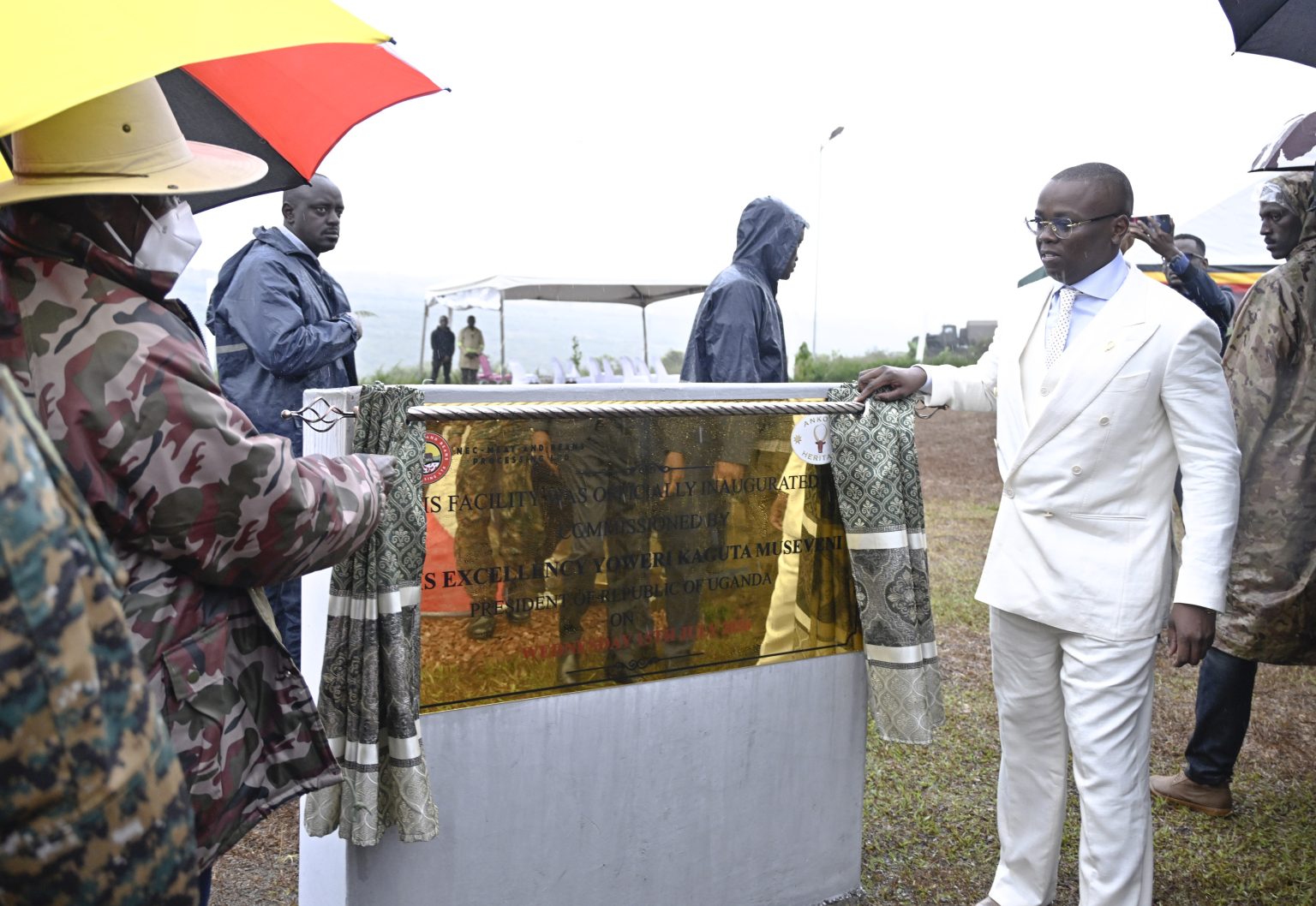
GOMBA, July 16, 2026 — President Yoweri Kaguta Museveni has commissioned the National Enterprise Corporation [NEC] Meat and Beans Processing Factory at Katonga in Kisozi, Gomba District, urging farmers to embrace commercial production to support Uganda’s agro-industrialisation agenda.
The modern processing facility is a joint venture between NEC, the commercial arm of the Uganda People’s Defence Forces [UPDF], and Kenyan investor Francis Ragwa, who serves as Managing Director of the NEC Meat and Beans Processing Plant.
Speaking at the commissioning ceremony, President Museveni congratulated Ragwa for investing in Uganda’s agro-processing sector, describing the factory as an important milestone in promoting value addition, creating jobs, and expanding the country’s industrial base.
“First of all, I want to congratulate Ragwa for taking the initiative. Yes, NEC has given you the land, but the ideas were yours, and I thank and congratulate you,” Museveni said.
The President said Uganda has the capacity to provide the raw materials required by the factory, noting that the main challenge has been organising farmers and creating reliable markets rather than production.
“The issue of supplying the required raw materials is just organisational. Uganda is now the biggest producer of coffee in Africa. Once I got the economics right, I realised that our small-scale farmers could earn good money even from one acre of land,” he said.
Museveni cited the growth of Uganda’s coffee sector as an example of how proper planning and farmer mobilisation can transform production. He noted that coffee output has increased from three million bags to about nine million bags and is projected to reach 12 million and eventually 20 million bags.
He also highlighted developments in the dairy sector, where production has grown from 200 million litres annually in 1986 to about 5.4 billion litres today, attributing the progress to improved economic planning and farmer mobilisation.
The President further pointed to the expansion of Uganda’s livestock sector, noting that cattle numbers have increased from about three million in 1986 to approximately 16 million today.
“What remains is to streamline production because the real stimulus is the market. Once I am sure about the market, I can mobilise Ugandans using the correct economics,” he said.
Museveni said the government would assess the most appropriate model for supplying the factory, whether through large-scale commercial farmers or organised smallholder farmers.
“We have to decide whether to rely on intensive farming or extensive farming. If we decide to use large-scale farmers, even 100 farmers producing about 300 cattle annually can sustain this factory. If we choose to involve peasants, we shall mobilise them once we know exactly what is required,” he said.
The President also challenged government leaders to take proactive responsibility in supporting investments within their respective sectors, describing ministers as “pastors” responsible for guiding and developing their sectors.
He questioned why some licensed investments continue to face challenges such as inadequate electricity supply after receiving government approval, saying relevant authorities should ensure that all necessary infrastructure is in place before projects begin operations.
“Once the Uganda Investment Authority licenses a factory, the government should already know where it is going to operate and ensure all the necessary infrastructure is available,” Museveni said.
He expressed confidence that the new government team would improve coordination and address bottlenecks affecting industrial growth.
Factory to boost local production and reduce imports
The Minister of Defence and Veteran Affairs, Kiryowa Kiwanuka, welcomed the commissioning of the factory, describing it as another milestone in Uganda’s industrialisation journey.
He thanked President Museveni for supporting initiatives aimed at transforming Uganda through industrialisation and commended Ragwa, NEC engineers, contractors, and UPDF personnel for their contribution to the project.
“The UPDF is not only a fighting force but also a productive force. This factory is not just about business; it is about strategic logistics, troop welfare and national economic transformation,” Kiryowa said.
The minister noted that Uganda had for many years relied on imported canned beef and beans for military operations, adding that the new facility would reduce dependence on imports and strengthen national self-sufficiency.
He pledged that the Ministry of Defence and Veteran Affairs would prioritise procurement from the factory and encouraged other government institutions to support locally manufactured products.
Kiryowa said the factory has already created employment opportunities for engineers, food scientists, technicians, and other young Ugandans, while providing a ready market for livestock and bean farmers.
“Rather than exporting raw materials, Uganda is now processing, adding value and earning more from its own products. This is fully aligned with the government’s agro-industrialisation agenda and the tenfold economic growth strategy,” he said.
NEC highlights export potential
NEC Managing Director Lt. Gen. James Mugira said the project was initiated more than seven years ago but was delayed by the COVID-19 pandemic before construction resumed.
He said the factory would contribute to value addition, industrialisation, employment creation, and reduce government expenditure on imported canned food products, including canned beans previously sourced from Brazil.
Mugira encouraged livestock farmers to take advantage of the guaranteed market created by the facility, saying Uganda has the potential to become a major global beef exporter.
He cited Botswana as an example of a country that has benefited from beef exports despite having fewer cattle than Uganda, owing to investment in veterinary services, disease control, vaccination, and export systems.
“Uganda has a better climate, abundant pasture, sufficient labour, and our Ankole cattle are internationally recognised for producing quality beef with low cholesterol. If the Ministry of Agriculture strengthens disease control, vaccination, and export certification systems, Uganda can become a major player in the global beef market,” he said.
Ragwa said the partnership with NEC demonstrates the potential of regional cooperation and private sector investment.
He explained that the joint venture agreement was signed in 2019 but faced delays due to the COVID-19 pandemic. He thanked NEC for providing land and supporting the establishment of the facility.
“We are proud that today we have made it happen. This factory is proof that Africans can invest, create industries and employ themselves. We currently have about 100 workers,” Ragwa said.
He said Uganda’s Ankole cattle present significant opportunities for value addition and exports, urging the country to capitalise on its unique livestock resources.
Ragwa also commended President Museveni for maintaining peace and stability, saying the secure environment has enabled investors to establish businesses in Uganda.
The commissioning ceremony was attended by Finance Minister Henry Musasizi; Trade Minister Sanjay Tanna; Permanent Secretary and Secretary to the Treasury Ramathan Ggoobi; Executive Director of Uganda Industrial Research Institute Prof. Charles Kwesiga; senior UPDF officers, investors, and local leaders.
https://thecooperator.news/museveni-commissions-us-300mln-yaobai-cement-factory-in-moroto/
Buy your copy of thecooperator magazine from one of our country-wide vending points or an e-copy on emag.thecooperator.news


