
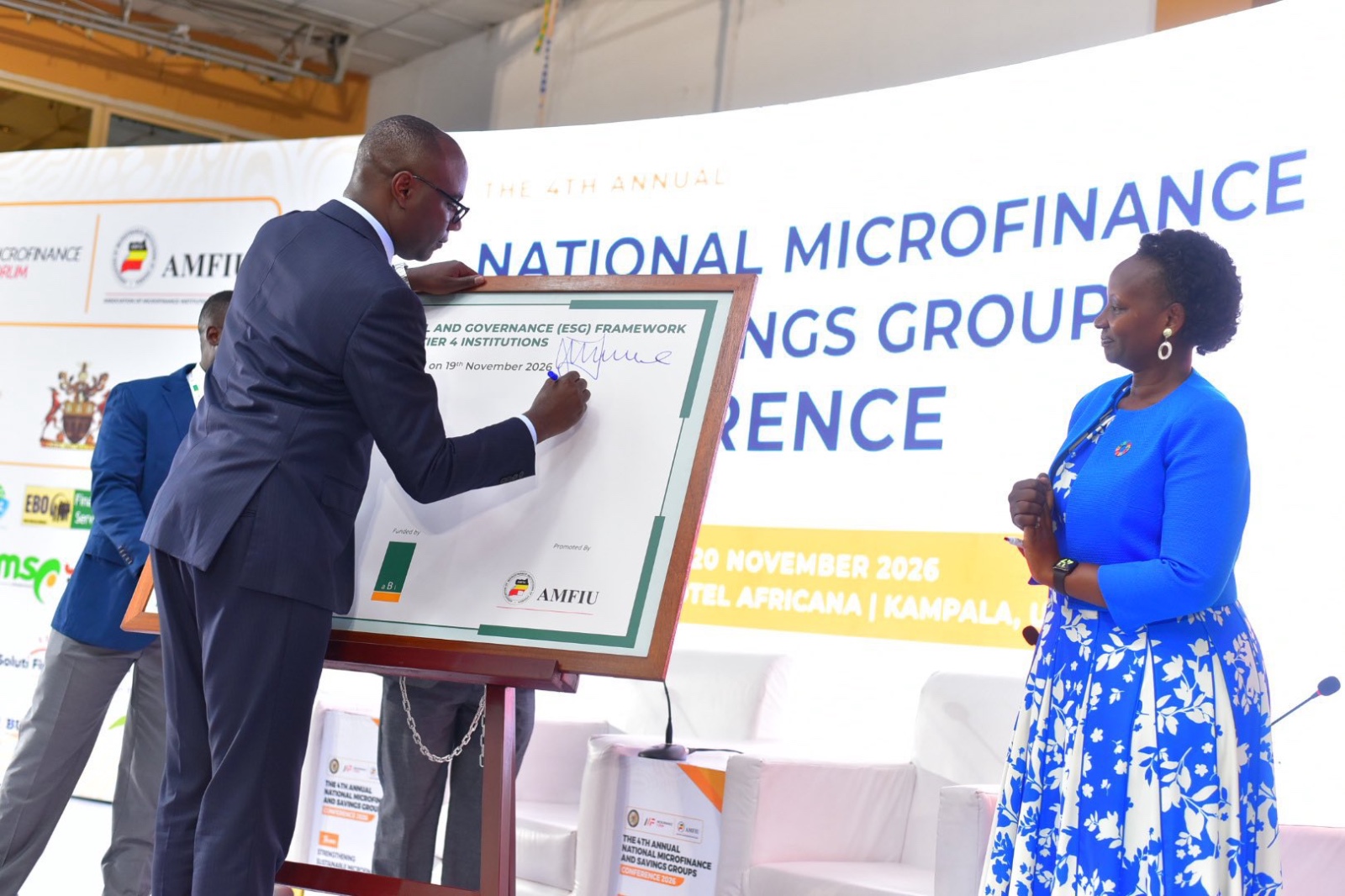
KAMPALA, November 26, 2026 — Finance Minister, Henry Musasizi has challenged Savings and Credit Cooperative Organisations [SACCOs] and microfinance institutions to intensify public awareness of government financing programmes as billions of shillings committed to wealth creation remain inaccessible to many Ugandans because they do not know about the available opportunities.
Musasizi said government had invested trillions of shillings in programmes such as the Parish Development Model [PDM], Emyooga, the Agricultural Credit Facility [ACF], Uganda Development Bank [UDB] and the Small Business Recovery Fund [SBRF], but many potential beneficiaries remained unaware of how to access the money.
He made the remarks recently while officiating at the fourth Annual National Microfinance and Savings Groups Conference 2026 at Hotel Africana in Kampala, where he called on financial institutions to become government ambassadors in taking information about affordable credit to communities.
“Most of these programmes are there, but people don’t know about them. So be our mouthpieces, be our ambassadors. Join us in the effort of ensuring that every Ugandan is involved in an activity that brings him or her income,” Musasizi said.
He said the different financing interventions were designed to support Ugandans across the economic spectrum, from households operating small enterprises at parish level to larger businesses seeking financing for expansion.
According to Musasizi, government has so far invested Shs 4.4 trillion in the Parish Development Model, supporting 1,589 SACCOs and reaching approximately 3.57 million beneficiaries.
Under Emyooga, government has provided Shs 760bln to support enterprise groups and community-based economic activities, while the ACF has disbursed Shs1.35trn to finance approximately 1,400 projects.
He added that UDB had extended more than Shs 2trn in financing to businesses, with government providing an additional Shs 442.2bln in capitalisation for the development bank in the 2026/2027 financial year.
Under the SBRF, government has provided Shs 200bln in capital, with eligible businesses able to borrow up to Shs 500mln.
Musasizi said the interventions were intended to make affordable financing available to Ugandans who would otherwise struggle to access commercial loans because of high interest rates and other lending conditions.
“We want to ensure that there is cheap credit, cheap sources of finance in this economy for all the people, from the lower to the upper levels. At the lower level, we have PDM and Emyooga, while at the upper level we have UDB, the Agricultural Credit Facility and other financing programmes,” he said.
He urged SACCOs to move beyond simply mobilising savings and lending to their members, arguing that their contribution to economic transformation should be measured by their ability to help households generate sustainable incomes.
The minister also challenged SACCO leaders to rethink their business models, warning against investing heavily in office buildings at the expense of improving financial services and reaching more customers.
He said the core business of SACCOs was mobilising savings and providing financial services rather than accumulating physical assets, adding that advances in technology had made it possible for members to access services without visiting offices.
“What is the core business of a bank? Is it building? What is the core business of a SACCO? Is it money? The core business of a SACCO is money, not owning buildings,” he said.
Musasizi encouraged SACCOs to embrace digital financial services, improve their systems and make it possible for members to save, borrow and transact using mobile phones.
“Our people want to transact from home. They do not want to keep coming to your offices. I therefore encourage you to digitise your operations and make it possible for people to access your services through their phones,” he said.
He argued that digitisation would reduce operational costs, improve efficiency and attract younger people into the savings and credit sector, while helping institutions improve accountability and safeguard members’ money.
The minister further challenged SACCOs to strengthen savings mobilisation by supporting income-generating activities, saying households could only develop a meaningful savings culture when they had reliable sources of income.
He said government wanted to move more Ugandans from subsistence activities into the money economy, where households could earn, save, invest and improve their living standards.
“We cannot save when we do not have money. Therefore, we must make sure that our households have good incomes, and then they can be able to save. Our people must start working and generating income so that they can save,” Musasizi said.
SACCOs seek favourable tax and regulatory environment
On taxation, Musasizi said the government had previously introduced tax exemptions for SACCOs through an amendment passed in Parliament in 2017, providing a 10-year exemption.
He said the government was studying the impact of the tax relief ahead of its expiry, with a view to determining whether it should be extended.
The minister also addressed concerns raised by SACCO stakeholders over regulation, particularly calls by large SACCOs for a single regulator.
He said government was willing to listen to the industry but noted that any regulatory changes would have to take into account financial stability and Uganda’s obligations in combating money laundering and other financial crimes.
Musasizi said the country had made progress in strengthening its financial integrity systems and warned that institutions in the sector needed to maintain proper records and accountability to protect that progress.
He urged SACCOs to improve their financial management practices and ensure that their operations complied with the required standards.
Meanwhile, Minister of State for Microfinance Shartsi Kutesa Musherure reaffirmed government’s commitment to strengthening financial inclusion, particularly among low-income households and communities that have limited access to affordable financial services.
Musherure said microfinance institutions, SACCOs and community savings groups remained critical to government’s efforts to bring more households into the money economy.
Having spent three months in the office, she said she had been impressed by the potential of the microfinance sector to support Uganda’s socioeconomic transformation.
“Microfinance is indeed the heartbeat of our economy. Having spent three months in this office, I am amazed by the great zeal and the opportunity microfinance presents towards Uganda’s socioeconomic transformation, and I look forward to making a meaningful contribution to this vital sector,” Musherure said.
She said the ministry was working towards increasing access to affordable financial services, improving the safety of savings, strengthening microfinance institutions and improving consumer awareness.
Musherure highlighted the PDM as one of government’s major interventions aimed at increasing household incomes through access to affordable financing.
Under the programme, each parish is allocated Shs 100mln annually through its revolving fund, with loans offered at an interest rate of six per cent per annum.
She said women accounted for more than half of the PDM beneficiaries, while digital delivery had also improved access to the programme, with more than 2.5mln beneficiaries receiving funds through Pearl Bank’s Wendi wallet.
On Emyooga, Musherure said the government had provided Shs 592.8bln in seed capital to 7,161 circles, with more than 607,000 individual beneficiaries accessing credit through the programme.
She also highlighted the role of the Microfinance Support Centre [MSC], which provides affordable credit and business development services to organised groups, SACCOs and community savings groups at an interest rate of eight per cent per annum.
Musherure urged SACCOs and savings groups to take advantage of these interventions and extend affordable financing to their members to support businesses, household incomes and employment creation.
A major announcement from her address was that the Ministry of Finance was finalising a Savings Groups Coordination Strategy intended to improve the organisation, coordination and oversight of savings groups across the country.
“The Ministry is finalising the development of the Savings Groups Coordination Strategy aimed at strengthening coordination, harmonization and oversight of savings groups in Uganda,” she said.
She explained that the strategy would help formalise informal savings groups, improve collaboration among stakeholders, address gaps in implementation and strengthen the sustainability of community-based savings initiatives.
Musherure also addressed calls from large SACCOs for a single regulator, saying government had taken note of the concerns and would engage stakeholders before making a decision.
“We have taken note of the request by the large SACCOs to have one single regulator. I wish to assure the SACCO fraternity that, in due course, we shall engage widely and seek a Cabinet decision on the best way to license and regulate large SACCOs, taking into consideration the industry expectations, financial stability, as well as other regional and international obligations,” she said.
She said the government wanted a regulatory environment that would protect members’ savings without undermining the ability of SACCOs and microfinance institutions to serve communities.
The two-day conference, organised by the Association of Microfinance Institutions of Uganda [AMFIU], was held under the theme Strengthening Sustainable Financial Inclusion for Socioeconomic Transformation of Uganda.
It brought together government officials, financial institutions, SACCOs, savings groups, development partners and other stakeholders to discuss ways of strengthening the microfinance industry and expanding access to affordable financial services.
The programme included discussions on financial sector data, institutional coordination, environmental, social and governance standards, digital financial services, partnerships and the regulatory environment governing Tier 4 financial institutions.
The conference also featured representatives from the Bank of Uganda, Ministry of Finance, CARE Uganda, the Gates Foundation, commercial banks and other financial sector institutions.
AMFIU President Veronicah Namagembe was among the sector leaders who addressed the gathering, highlighting the importance of strengthening institutions, consumer protection and responsible financial services.
Musasizi officially opened the conference by calling on the sector players to work with government to ensure that access to affordable credit translates into improved household incomes, business growth and economic transformation.
https://thecooperator.news/spiro-boda-boda-riders-urged-to-form-saccos-for-financial-independence/
Buy your copy of thecooperator magazine from one of our country-wide vending points or an e-copy on emag.thecooperator.news


