
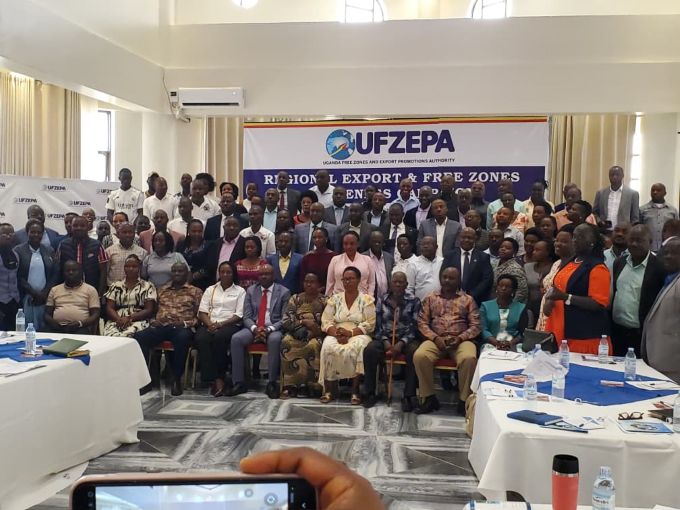
MBARARA CITY, July 30, 2026 — Micro, Small and Medium Enterprises [MSMEs] across Ankole Subregion have been urged to formalise their businesses, comply with international quality standards and embrace research-driven production to unlock regional and global export markets.
The call was made during a Regional Export and Free Zones Awareness Meeting held on Friday at Las Vegas Garden Hotel in Mbarara City.
The engagement, organised by the Uganda Free Zones and Export Promotions Authority [UFZEPA], sought to prepare MSMEs in Greater Mbarara and Greater Bushenyi in the Ankole Subregion to compete under regional, continental and global trade frameworks.
The nationwide sensitisation campaign is part of the government’s strategy to expand SME participation in international trade while supporting Uganda’s Vision 2040 and the Ten-Fold Growth Strategy.
Speaking on behalf of UFZEPA Executive Director Rebecca Wamono Nalumu, the authority’s Senior Manager for Special Economic Zones Operations and Compliance outlined UFZEPA’s mandate following the merger of the former Uganda Free Zones Authority and the Uganda Export Promotion Board.
“This afternoon, we organised a regional sensitisation engagement targeting exporters, especially those in value addition, as well as small and medium enterprises, to increase awareness of regional, continental and international market opportunities,” Nalumu said.
“We are also providing information on the Free Zone and Special Economic Zone schemes, government initiatives established to promote value addition, drive industrialisation and generate sustainable employment.”
Inter-agency coordination and regulatory enforcement
The workshop brought together manufacturers, exporters, local government leaders and regulatory bodies, including the Uganda National Bureau of Standards [UNBS], Uganda Registration Services Bureau [URSB], Uganda Revenue Authority [URA] and the Ministry of Agriculture, Animal Industry and Fisheries [MAAIF].
Nalumu acknowledged growing concerns among local entrepreneurs over inadequate grassroots sensitisation by central government agencies, noting that many regional enterprises have strong production capacity but lack critical regulatory guidance.
“Many companies operating in the western region struggle with where to find information,” Nalumu said.
“New regulations have emerged, such as the European Union Deforestation Regulation [EUDR] requirements for coffee producers, processors and exporters to register for traceability. Because many of our companies remain informal, they miss out on these lucrative market opportunities. To access the growing East African Community [EAC] market and the African Continental Free Trade Area [AfCFTA], businesses must formalise their operations.”
Nalumu also highlighted how poor inter-agency coordination has allowed substandard agro-inputs, counterfeit pesticides and ineffective acaricides to enter the local market, potentially damaging the international reputation of Ugandan exports.
“The issue has largely been one of coordination,” she said. “When substandard pesticides or chemicals enter the market, they compromise the safety of our agricultural exports. It is not just the individual exporter who suffers; the reputation of the entire country is affected.”
“Moving forward, UFZEPA plans to engage at least 100 private-sector associations annually to bridge this information gap and build grassroots compliance.”
Reinforcing the regulatory mandate, Emmanuel N. Blair from MAAIF’s Department of Crop Inspection and Certification said the ministry was working to protect farmers from counterfeit agrochemicals and ensure compliance with food safety standards.
“People are producing fake acaricides, but our warning is clear: if you do not comply and we find counterfeit products during enforcement, we will seize them,” Blair warned.
“We also have a division responsible for seed quality, continuously applying research innovations to protect consumers.”
Blair said new regulatory frameworks were being developed to strengthen pesticide residue monitoring across the country.
“When the Agricultural Chemicals Control Act was enacted in 2006, it adopted regulations from 1993,” Blair explained. “We recently updated these regulations to address emerging chemical issues. As of last week, we had drafted new regulations specifically for pesticide monitoring and submitted them to the Solicitor General for review before enactment so that we can commence strict pesticide residue monitoring.”
Addressing qualification standards for agro-dealers, Blair urged the public to act as whistleblowers to help curb illicit trade.
“To operate an agro-shop, individuals previously completed a two-week agricultural course at Makerere University, but because farmers need actual extension guidance, we are raising the requirement to a Diploma in Agriculture,” Blair said.
“MAAIF cannot be everywhere at once, so citizens must act as government watchdogs. Report unqualified agro-dealers and counterfeiters to us so we can target them directly and take enforcement action.”
Local government and private-sector perspectives
Addressing the forum, Aggrey Ategyeka, Principal Commercial Officer for Bushenyi-Ishaka Municipal Council, urged central government ministries and agencies to streamline their outreach programmes to avoid duplication when engaging local producers.
“At the local government level, our core mandate is grassroots mobilisation of farmers and MSMEs to increase production,” Ategyeka said.
“However, we still face challenges of limited coordination. Just recently, we were at the Mbarara District Council having a similar discussion organised by the Ministry of Trade. We need stronger collaboration so that we can utilise the same resource envelope to achieve the broader national objective.”
Ategyeka also urged small businesses to adopt data-driven management practices to support evidence-based decision-making.
“Decision-making relies on evidence-based information,” he said. “As government, we are leveraging research agencies to make data-driven decisions. However, when we engage SMEs, we find many struggling because they lack proper record-keeping systems.”
Representing the business community, Simon Seith Mwijuka, Chairman of the Mbarara City Traders Association (MBACITA), criticised institutional bureaucracy and called for specialised trade financing tailored to local manufacturers.
“Much as entrepreneurs have tried their best to produce, we are working with government agencies that often seem disconnected, leaving us without clear direction,” Mwijuka said.
“When we manufacture, MAAIF handles raw production, UNBS certifies, URA demands digital stamps, URSB handles registration, and the Free Zones Authority looks for markets. Why can’t these entities coordinate better instead of requiring local producers to constantly carry samples back and forth to Kampala for testing?”
Mwijuka also identified high interest rates and rigid collateral requirements as key obstacles to sustained production.
“Access to capital remains a major hurdle,” he said. “Commercial bank credit does not offer sufficient flexibility for manufacturing and production cycles. While the government has introduced financing programmes, the conditions attached to bank loans remain prohibitively high. We need policymakers to unlock affordable trade financing for our producers.”
Gerard Nuwagaba, Ntungamo District Principal Assistant Secretary to the Chief Administrative Officer [CAO], emphasised the need to support livestock farmers facing climate-induced pasture and water shortages, as well as degraded rural roads that affect the quality of produce during transit.
“When hit by dry seasons, farmers lack nutritious pasture and water for their livestock,” Nuwagaba said. “Many still rely entirely on nature and are vulnerable to climate hazards. We need technical officers to train farmers on modern practices, such as harvesting rainwater and planting nutrient-rich pasture, while improving our rural road network to ensure produce reaches markets without quality loss.”
Meeting international standards: quality, quantity and consistency
Mbarara City Commercial Officer Allan Buhanda Karakure reaffirmed the commitment of local trade officers to guide small businesses through certification processes.
“Our duty as commercial officers is to promote trade and guide local businesses,” Karakure said. “Many beginners lack technical knowledge, capital and information on certification requirements. Penetrating global markets requires meeting three strict parameters: quality, quantity and consistency of supply.”
Karakure added that farmers must move away from dependence on rain-fed agriculture by adopting modern technologies such as greenhouse farming and solar-powered irrigation to maintain steady production throughout the year.
Herbert Mugisha, CEO of Green Cane Innovations, advised SMEs to align their production processes with international standards from the outset rather than focusing solely on domestic consumers.
“Design your production and processing around international standards, strategic partnerships and global trade requirements,” Mugisha advised.
“If you focus only on the local market, compliance tends to slip. We must also push for natural, organic products to avoid export rejections caused by chemical residues.”
Adding a cooperative perspective, Joan Kisakye Nabwemi, Agribusiness Lead at the Federation of Small and Medium-Sized Enterprises, encouraged smallholders to pool their resources.
“The majority of MSMEs cannot individually meet the large production volumes demanded by international buyers,” Nabwemi said.
“By operating through cooperatives, smallholders can pool yields, meet export quotas and maintain consistent supply chains.”
Government reaffirms export-led industrialisation policy
Delivering a speech on behalf of the Minister of State for Trade, Industry and Cooperatives, Sanjay Tanna, UFZEPA Senior Manager for Export Development and Promotion David Katungi reiterated the government’s commitment to export-led growth under the Fourth National Development Plan [NDP IV].
“The Government of Uganda recognises exports as a critical driver of economic transformation, job creation, foreign exchange earnings and industrial growth,” Tanna said in his remarks.
“This engagement directly aligns with NDP IV and the government’s Ten-Fold Growth Strategy, which aims to expand Uganda into a 10-times larger economy of about US$ 500 billion. Under this strategy, we seek to raise the ratio of exports to GDP from 12 percent to 50 percent, increase the share of manufactured exports to 50 percent, and boost medium-to-high technology products within our export portfolio.”
Highlighting recent economic performance, the Minister pointed to significant growth in national export revenues alongside increased product diversification.
“Uganda’s exports of goods and services have grown by approximately 204 percent over the last five years, rising from US$ 5.93bln in the 12 months ending March 2022 to US$ 18.4bln in the 12 months ending March 2026,” Tanna said.
“Our export basket continues to diversify, with strong performance in gold, coffee, cocoa, fish products, steel products, sugar and an increasing rate of manufactured products. These achievements give us confidence that Uganda is steadily positioning itself as a competitive manufacturing and export hub within the region and the world.”
The Minister pledged government support to strengthen MSMEs on the international stage while emphasising the link between export readiness and household wealth creation.
“Sustainable prosperity will only be realised when we move beyond primary production to value addition, processing, packaging, branding and export marketing,” Tanna said.
“Small and medium enterprises form the backbone of production, innovation, industrial growth and employment creation. However, many MSMEs continue to face challenges related to access to finance, standards compliance, quality certification, packaging, logistics and market information.
“It is therefore imperative that government institutions, financial institutions and the private sector work together to build the capacity of our enterprises. Producers must position themselves strategically by increasing production, improving quality, embracing innovation, adopting modern technologies and complying with international standards.”
The Minister officially declared the regional awareness workshop open, urging local governments across the Western Region to integrate export development and industrialisation directly into their Local Economic Development [LED] frameworks.
https://thecooperator.news/ugandas-annual-export-receipts-jump-12-8-percent-in-may-2026/
Buy your copy of thecooperator magazine from one of our country-wide vending points or an e-copy on emag.thecooperator.news
-

-

-

-


