
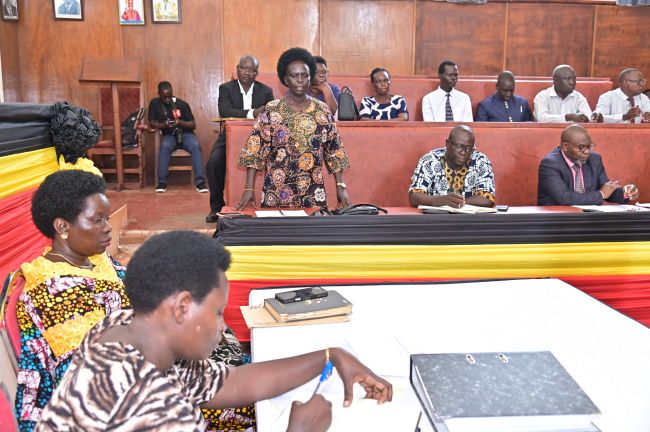
LIRA, September 18, 2026 — Three Lira District officials, including Resident District Commissioner [RDC] Lillian Eyal, Assistant RDC Richard Okello and Parish Development Model [PDM] Focal Person Michael Okello, have been arrested by the State House Anti-Corruption Unit over alleged irregularities in the use and disbursement of PDM funds to beneficiaries.
The three suspects were arrested at Lira district headquarters and later taken to Lira Central Police Station for further investigation.
Their arrest followed complaints from PDM beneficiaries during a monitoring exercise conducted by officials from the Directorate of Socio-Economic Monitoring and Research in the Office of the President.
The beneficiaries of the government programme alleged that they had been forced to use part of their Shs 1 million PDM funds to acquire agricultural inputs they had not requested.
The agricultural inputs, which beneficiaries said were supplied through a company linked to Assistant RDC Richard Okello, included spray pumps, fertiliser and maize seeds.
The beneficiaries said the cost of the inputs was deducted from their Shs 1 million allocation, leaving some with Shs 540,000 and others with as little as Shs 330,000.
Odyek Jimmy, a resident of Te-Tyang Parish in Itek Subcounty, said beneficiaries had been told by the Assistant RDC that changes had been made to the PDM programme and that they would receive tangible items instead of the full Shs 1 million.
“We understood that the government had brought Shs 1 million for us, but some people came up with new arrangements and said there had been changes to the PDM programme. They told us that if you were expecting to receive the Shs 1 million in cash, you were wasting your time. Instead, you would go home with items such as maize seeds, a spray pump, a tarpaulin, fertiliser and pesticides,” Odyek said.
He said the distribution of the inputs was launched by the Assistant RDC, Richard Okello Ogweng.
Odyek also questioned how beneficiaries would repay the PDM loan, arguing that the maize seeds had been distributed late and might not produce a harvest.
“We asked: if you have given us seeds, how are we going to repay the money? We know that PDM is a loan, but the weather is changing. What happens if the seeds fail to produce a harvest?” he said.
Agnes Akia, a member of Imaki Ojale PDM SACCO in Itek Subcounty, said the Assistant RDC insulted beneficiaries when they protested against the distribution of the inputs.
“When we were gathered at Ajia Parish, I was among those who objected to receiving the seeds. The Assistant RDC, Richard Okello Ogweng, told us that we were not knowledgeable and that there was something wrong with our heads that he needed to ‘slap’ out. We then kept quiet,” Akia said.
“He started teaching us how to plant the seeds. Each of us was given a carton of maize seeds, our photographs were taken, and we went back home with the seeds that had been brought to our parish,” she added.
Akia said beneficiaries eventually accepted the seeds and other agricultural inputs because they felt they had no alternative.
She said they were later given Shs 540,000 each.
“What pains us is that a local person struggles from August to May, which is not easy. So, people accepted the seeds because they felt they had no choice. Each of us was given a carton of maize seeds and a 50-kilogramme sack of fertiliser. We were then taken to a church, where we were given Shs 540,000 in cash as the balance from the Shs 1 million,” Akia said.
Akia further alleged that beneficiaries’ mobile phones had been taken away for a week before they received the funds, and that they had been asked to pay additional money to access the programme.
“They took our phones, PINs and telephone numbers and took them to Lira Town for a week. They created WENDI accounts for us. During that week, they told us that we needed to pay Shs 25,000 for our names to be entered into the system. They also kept telling us that if we did not send Shs 8,000, we would not receive the money,” Akia said.
“When our phones were returned, we found that Shs 1 million had been deposited into our accounts,” she added.
Agnes Aciro, a resident of Ogur parish, said she was instructed to travel to Lira Town at her own expense, where she was given agricultural inputs and Shs 330,000.
“We were told to take a boda-boda to Lira City and go to Amulam Building. When we arrived, he went and bought the inputs. He told me that a sack of fertiliser cost Shs 260,000, a carton of maize seeds Shs 250,000, a spray pump Shs 90,000 and a tarpaulin Shs 90,000. He then gave me Shs 330,000, which I took back home,” Aciro said.
“However, I also had to spend money on loading the items, food, which cost Shs 5,000, and Shs 10,000 on transport to take them home,” she added.
However, Col [Rtd] Charles Obeny, the Operation Wealth Creation [OWC] coordinator for Lira City and Lira District, denied that farmers had been forced to buy the agricultural inputs.
He said beneficiaries had been free to choose the enterprises and inputs they wanted.
“We realised that some of the implements that were brought were not suitable. The farmers, through their enterprise groups, had profiled the particular inputs they wanted, and they had the authority to choose what to buy. We did not force them to buy anything that day. The maize seeds were available, and chickens were also available,” Obeny said.
However, Molly Kia, the Lira District Deputy Resident Commissioner, confirmed that complaints had been received and said the district had identified the agricultural input dealers who supplied the PDM beneficiaries.
“One of the suppliers was the wife of our Assistant RDC. We can still go back to these suppliers and ask them to refund the farmers so that they can repay the money in future. We have a list of the beneficiaries who were supplied, as well as the names of the companies involved,” Kia said.
Joan Ayebare, Principal Economist in charge of Economic Monitoring at the Office of the President, who represented the State Minister for Economic Monitoring, Santa Alum Ogwang, questioned the role played by the RDC’s office in the transactions.
She said district officials should have intervened when beneficiaries were being compelled to accept agricultural inputs they had not requested.
“We should have acted there and then. If people were unwilling to take the inputs, we should have engaged the suppliers to take them back and refund the money. We are aware that there were 10 people supplying these inputs, so we became part of the process,” Ayebare said.
“It is unfortunate because we are supposed to act in the interests of the people, not in our own interests. I think, on our part, we did not do what we were supposed to do. We are also aware that these people were being intimidated and told: ‘Either you buy, or you do not benefit,’” she added.
Ayebare also questioned whether the role of the RDC’s office had shifted from monitoring Government programmes to directing beneficiaries on what to buy.
“I am asking myself: in the allocation of PDM funds, the role of the RDC’s office is to monitor the list of beneficiaries who have received their money. So, where does the authority to tell people that they must buy particular items come from?” she asked.
“We even went as far as becoming implementers rather than monitors, yet the Assistant RDC had already confirmed that some of the inputs were not suitable,” Ayebare added.
She expressed concern about the treatment of beneficiaries in the district, saying it was unfair to compel them to purchase agricultural inputs instead of allowing them to access and use the funds for their intended enterprises.
“I think this is very unfair, and we shall take up the matter. I have a team that is already handling it, and it will follow the matter through to its conclusion because we are supposed to protect these people,” Ayebare said.
“Fortunately, the minister will soon join us and take up the matter to its conclusion, including at our office, so that we can establish why the RDC and the Assistant RDC, who is part of us, became involved in this process,” she added.
Funds disbursed under the PDM are supposed to be invested in selected enterprises such as coffee, dairy, fish farming, piggery, poultry keeping, and crop farming among others.
Buy your copy of thecooperator magazine from one of our country-wide vending points or an e-copy on emag.thecooperator.news


