
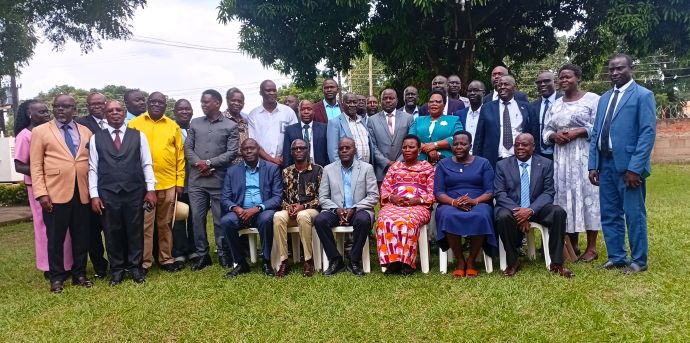
LIRA CITY, October 30, 2026 — Stakeholders in the Lango Sub-region have commended the involvement of the Inspectorate of Government [IG] in the implementation of the Northern Uganda Social Action Fund [NUSAF] IV project, saying its Strengthening Transparency, Accountability and Anti-Corruption [TAAC] model will help combat corruption.
The stakeholders made the remarks during an orientation meeting on NUSAF IV implementation held recently at Margarita Palace Hotel in Lira City. The meeting brought together representatives from the nine districts and one city in the Lango Sub-region.
Charles Enyok, an Assistant Director at the Inspectorate of Government, who presented on the TAAC model, said the approach had been adopted by the IG to track the implementation of Government projects and identify risks that could undermine their success.
“We are going to deploy the TAAC approach, so it is a new model that we have adopted in the IG, focusing mainly on Government projects because Government projects like NUSAF IV have a time period,” Enyok said.
He said the model would involve various stakeholders, including oversight institutions and project implementers, in addressing corruption risks.
“This project has responsibilities across from the oversight institution to the peace and then to you who are implementing. This system, for example, is handling cases of corruption, and corruption has become a cross-cutting issue under NDP4. TAAC must be mainstreamed; TAAC should be part and parcel of any operations of any systems across Government,” he said.
Enyok urged the Government to align its operations with the TAAC model, saying existing systems should also be assessed and strengthened to address corruption risks.
“It’s our obligation as Government to make sure our processes, budgets and work plans have interventions that can promote TAAC. The focus is NUSAF, but we are putting NUSAF in certain existing systems; we now have to address issues within those systems as well,” he said.
“We are going to do it through government mainstreaming and we want to make sure that those risks associated with those systems are identified and we put in mitigation measures for all of us who are implementing. Those that we fail to mitigate, we have to make sure we minimise the impact.”
He also asked the accounting officers of districts in the Lango Sub-region to support the model by appointing focal point persons who would help manage emerging risks.
“We need to get focal point persons and bring them on board immediately. Even the IG will not be with you all the time. At least we need the focal point persons whom we can give some capacity to coordinate other stakeholders as well as bridge the resolution of some of these risks,” Enyok said.
“So, CAOs, this should be a priority.”
Rhoda Oroma, the Amolatar District Chief Administrative Officer [CAO], welcomed the inclusion of a mindset-change component in NUSAF IV, saying communities also needed to be sensitised about corruption.
“I’m happy that the component of mindset change is in this NUSAF IV. Corruption is no longer with us, the technical staff. Like in Amolatar, we have zero tolerance to corruption, and we have a district committee addressing that,” Oroma said.
She, however, accused some community members of engaging in corrupt practices, particularly in programmes where beneficiaries are required to repay funds.
“Communities have become more corrupt. Even when a project is geared towards refunding money, like PDM, they are the ones conniving not to refund the money,” she said.
Meanwhile, Lawrence Egole, the Lira City Resident Commissioner, said the involvement of the Inspectorate of Government in NUSAF IV was timely, arguing that some beneficiaries undermine Government programmes.
Egole said beneficiaries who abuse the programme should also be held accountable in accordance with the law.
“When such programmes come, we are also let down by the beneficiaries. I’m glad this time the OPM carefully involved the Inspectorate of Government in this programme, and I know they have a good role to play,” he said.
“Let the role also extend not only to technical people but also to the beneficiaries who abuse these programmes. I think that will help us to move forward.”
Ambrose Agenye Opio, the Chairperson of Apac District Local Government, supported Egole’s call for stronger enforcement against people who misuse NUSAF IV funds.
“When the beneficiaries get the money, let’s have the task force on board because the beneficiaries are the very persons abusing this money that Government is giving to them,” Opio said.
He cited cases where beneficiaries receive funds but fail to use them appropriately.
“You realise that after giving them Shs1 million, they become very disturbing and they don’t know what to do with that money. So I’m saying, let’s have an enforcement which we are going to target at them, and then they can utilise that money well,” he said.
“Let them and other local people be punished. Let’s not only arrest the technical staff.”
Meanwhile, Jillian Akullo Omara, the Kole Resident District Commissioner, urged the Government to ensure that NUSAF IV implementation does not create opportunities for extortion.
She warned that some officials could be tempted to demand money from beneficiaries in exchange for facilitating their participation in the programme.
“These people are tempted to go and ask for money from our community members in the name of moving to the office so that their names are submitted for repayment. Are we having that in our programme for our people to be supported so that we stop this?” Akullo asked.
“If not, IGG, get ready; you will be moving left and right because these offices are tempted always in that line with the issues of PDM,” she said.
Horace Sabiiti Bashaija, the NUSAF IV Deputy Project Coordinator, called on Chief Administrative Officers to work together in implementing the project, saying district and sub-county implementation support teams should be appointed.
“We shall have Chief Administrative Officers nominating the desk officers, District Implementation Support Team at the district level and the Subcounty Implementation Support Team,” Bashaija said.
He also urged local governments to integrate NUSAF IV into their existing services and departments rather than treating it as a stand-alone project.
“I also want to encourage the local governments to ensure that we mainstream the implementation of NUSAF IV with the different services and departments. Let NUSAF IV not be a standalone project done by the desk officers; let’s ensure that all the departments take part in the implementation of the project,” he said.
Bashaija further urged local governments to complement NUSAF IV with existing Parish Development Model [PDM] structures at parish level.
Officially rolled out starting in July 2025, NUSAF IV is a five-year, US$ 276 million World Bank-backed social protection and resilience-building program led by the Government of Uganda through the Office of the Prime Minister.
This project aims to tackle persistent poverty, vulnerability to climate shocks, and socio-economic inequalities in Northern and Eastern Uganda, where communities face challenges such as limited access to livelihoods, environmental degradation, and exposure to recurrent disasters.
The project intends to promote sustainable livelihoods, enhance the resilience of poor and vulnerable households to shocks, and strengthen adaptive social protection systems in Uganda. The project primarily targets vulnerable populations, including women, youth, refugees, and host communities, and is implemented across multiple districts characterised by high poverty rates and climate vulnerability.
https://thecooperator.news/world-bank-approves-nusaf-iv-to-support-northern-uganda/
Buy your copy of theCooperator magazine from one of our countrywide vending points or an e-copy on emag.thecooperator.news


