
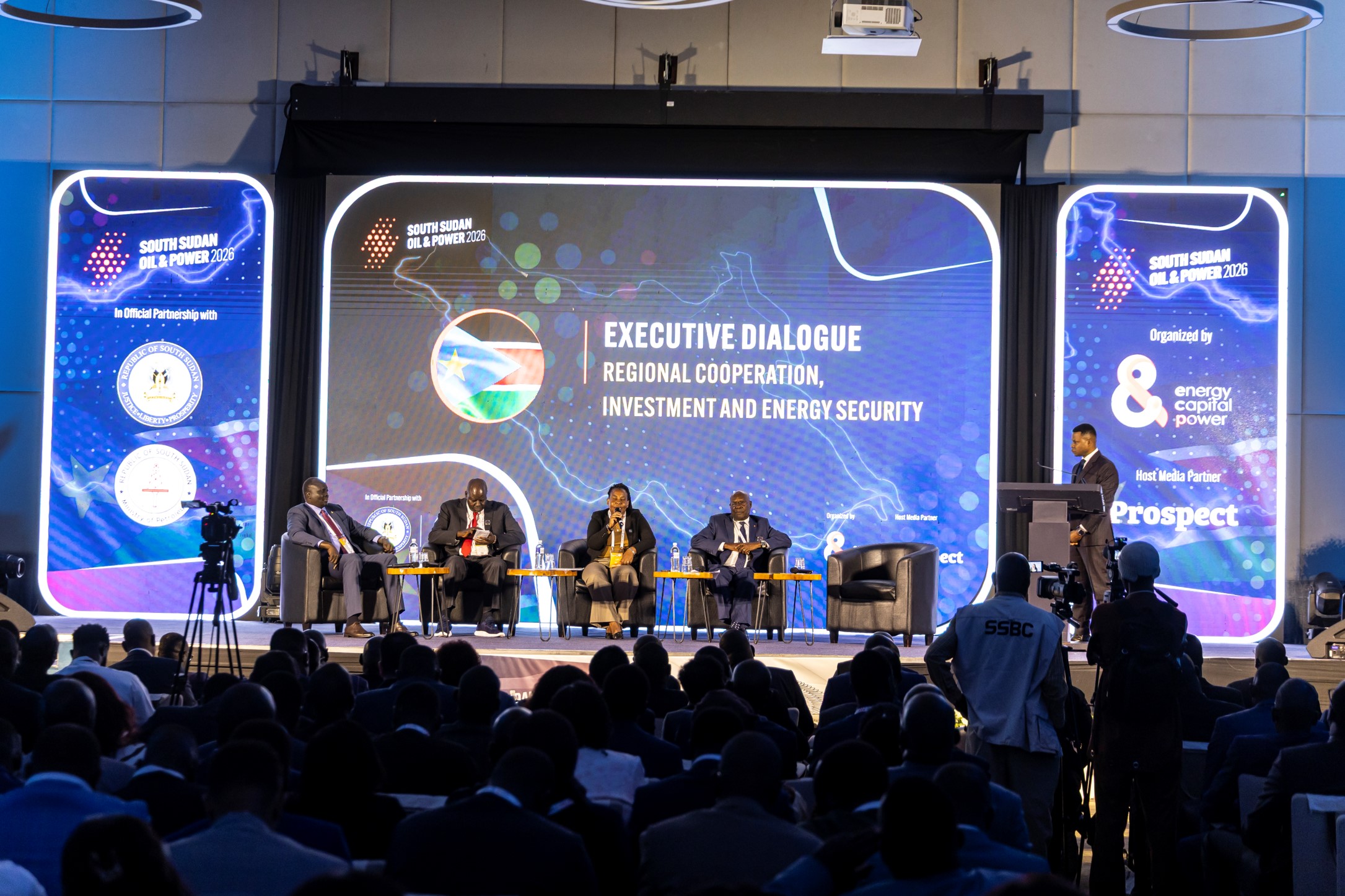
JUBA, November 27, 2026 – Kenya plans to commence commercial oil production at 20,000 barrels per day [bpd] before the end of December 2026, with output expected to increase to 50,000 bpd in 2027, Dr Silvester Kasuku, Kenya’s Presidential Advisor on Governance, has announced.
Kasuku made the announcement during a ministerial panel at the South Sudan Oil & Power [SSOP] 2026 conference in Juba, where regional energy leaders discussed strategies for accelerating first oil in emerging African oil-producing countries while maximising domestic and regional value addition.
“As we go to 2031, we target 120,000 bpd,” Kasuku said, noting that the phased production programme is intended to commercialise the 13 oil discoveries made by Kenya to date.
Providing an update on Uganda’s upstream and midstream developments, Okaasai Sidronius Opolot, Uganda’s Minister of State for Energy, said the country’s ambition to achieve first oil must go hand in hand with domestic refining to ensure more economic value is retained within the region.
“First oil production is coming, and it is a reality,” Opolot said. “We have two investments – the Kingfisher and Tilenga fields – and we have the East African Crude Oil Pipeline [EACOP] advancing.
“We are deliberately asking: why would you export crude oil and then import petroleum products? We have been given priority to refine at home.”
On Zimbabwe’s oil and gas prospects, Yeukai Simbanegavi, the country’s Deputy Minister of Energy and Power Development, highlighted the importance of cross-border pipeline infrastructure in commercialising gas and condensate discoveries.
Zimbabwe is currently advancing the development of the Cabora Bassa project, its first commercial gas project, led by Invictus Energy.
“We were not sure that we would discover anything, but we have realised that there is substantial gas and condensate that we believe can help us as a country. Through all this, we need to ensure we create added value,” she said.
“We want to have more gas pipelines, and we want to build through Mozambique, Zambia and South Africa and connect with them. We have MoUs in place to discuss how we can progress the pipelines.”
Meanwhile, South Sudan’s Caretaker Minister of Petroleum, Eng Awow Daniel Chuang, said regional transport and logistics networks were critical to attracting investment and unlocking the continent’s energy potential.
“Regional connectivity is a key factor for success because one of the biggest challenges we are facing is a lack of connectivity,” Chuang said.
“Oil is about logistics, and when we talk about investment, it has to make sense. Our connection with Uganda, Kenya and even the Democratic Republic of Congo [DRC] is key. The only country we are connected to currently is Uganda.”
To address the infrastructure gap, South Sudan plans to expand the construction of permanent roads linking oil-producing fields directly to regional markets to ease the movement of goods and services.
https://thecooperator.news/kenya-launches-national-coffee-flavour-atlas/
Buy your copy of thecooperator magazine from one of our country-wide vending points or an e-copy on emag.thecooperator.news
-

-

-

-


