
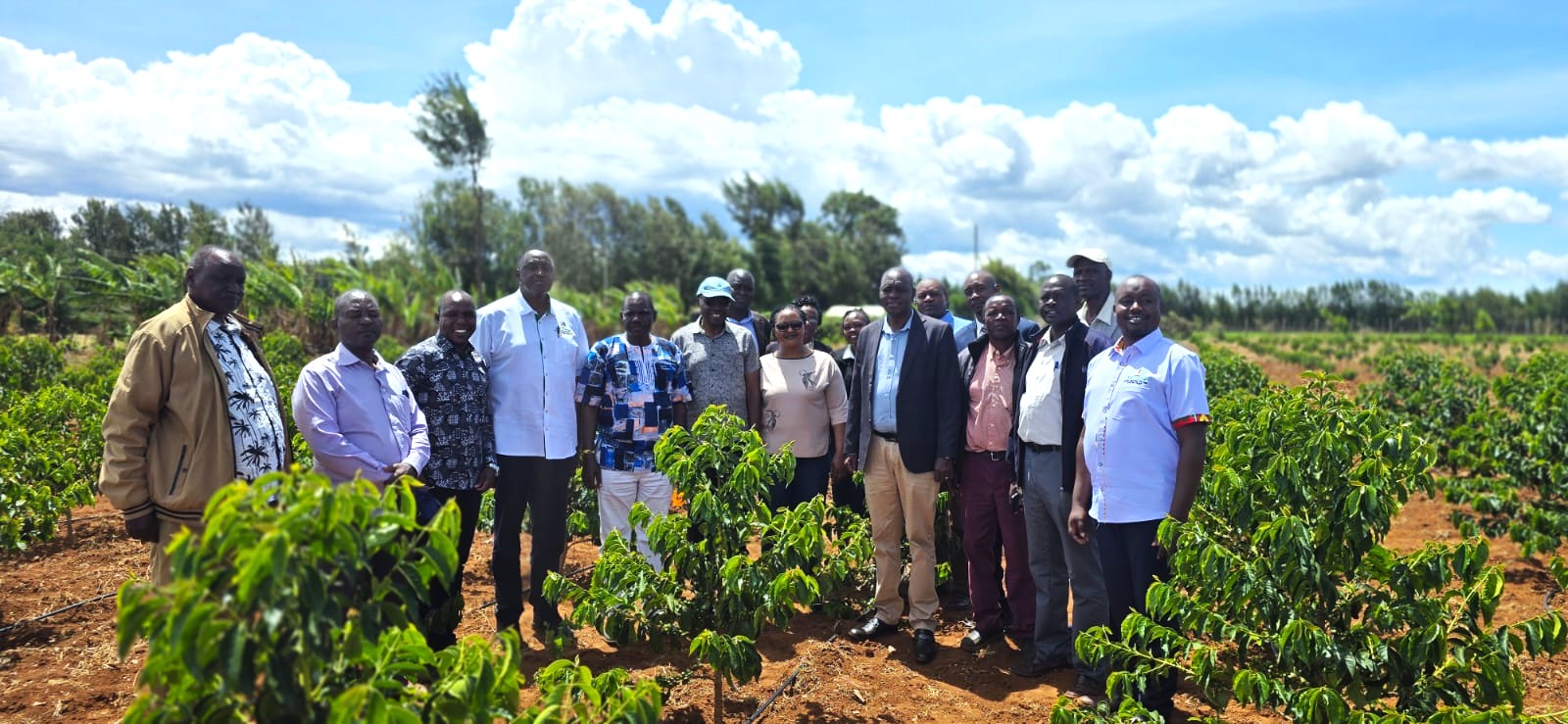
NAIROBI, June 30, 2026 — The Kenyan government has reaffirmed its commitment to reviving the country’s coffee industry following the enactment of the Coffee Bill, a key reform package aimed at increasing farmers’ earnings, boosting production and restoring Kenya’s standing as a leading global coffee producer.
Two Cabinet Secretaries whose ministries play a central role in the sector — Agriculture and Livestock Development Cabinet Secretary Mutahi Kagwe and Cooperatives and Micro, Small and Medium Enterprises Development Cabinet Secretary Wycliffe Oparanya — described the reforms as a roadmap for transforming the industry.
Speaking during the Coffee Revival Programme in Gichugu, Kirinyaga County, Kagwe thanked President William Ruto for assenting to the Coffee Bill, describing the move as a major milestone in strengthening the coffee value chain and addressing long-standing challenges affecting growers.
Kagwe said the new law reinforces institutions responsible for overseeing the sector, including the Coffee Board and the Coffee Research and Training Institute, enabling them to deliver improved regulation, research, quality assurance and farmer support services.
He said stronger institutions would help farmers adopt modern agronomic practices, access improved coffee varieties, manage pests and diseases more effectively, and enhance the quality of their produce.
According to Kagwe, expanded research and continuous farmer training are expected to improve productivity while ensuring Kenyan coffee remains competitive in international markets.
“The Coffee Bill provides a strong legal framework to safeguard farmers’ interests while ensuring the sector is professionally managed from production through to marketing,” he said.
Kagwe added that the government expects to complete the process of fully operationalising the Coffee Board within the next 60 days under the new Coffee Act.
Once established, the Board will assume responsibility for regulating the sector and implementing reforms intended to improve governance, strengthen accountability, enhance quality assurance and deliver a more efficient coffee value chain.
He said the measures are expected to rebuild farmers’ confidence in coffee production, attract greater investment into the sector and ultimately raise incomes for growers across the country.
Oparanya said the government had already made progress in tackling structural challenges facing the industry through targeted interventions aimed at increasing output and improving livelihoods.
These measures include the distribution of improved coffee seedlings, subsidised fertiliser programmes and strengthened agricultural extension services to equip farmers with technical knowledge and promote best farming practices.
He added that the government would intensify training for extension officers to ensure they are equipped with modern agricultural skills and technologies that can be passed on directly to farmers.
“Extension officers are the bridge between research institutions and farmers. By empowering them, we will ensure every coffee-growing region receives the guidance needed to improve productivity and quality,” he said.
Oparanya said the government aims to increase Kenya’s annual coffee production to 150,000 tonnes by 2028, largely by raising average yields from the current estimated two kilogrammes of cherry per coffee stem through improved husbandry, quality inputs and modern farming techniques.
He urged farmers in low-producing areas to embrace the government’s interventions and improve management of existing coffee plantations, while encouraging growers in suitable but underutilised regions to consider expanding coffee cultivation to widen the country’s production base.
Buy your copy of thecooperator magazine from one of our country-wide vending points or an e-copy on emag.thecooperator.news


