
KIGALI, September 7, 2026 — Access to climate adaptation finance remains a significant challenge for smallholder farmers and rural businesses across Africa, with available capital often failing to reach those who need it most.
To help bridge this financing and delivery gap, the International Fund for Agricultural Development [IFAD] and Equity Group today launched the Africa Rural Climate Adaptation Finance Mechanism [ARCAFIM] – a US$ 200 million, private sector-led mechanism designed to expand access to climate adaptation finance for smallholder farmers and rural businesses across East Africa. The mechanism was launched at the Africa Food Systems Forum 2026 in Kigali, Rwanda.
ARCAFIM is being implemented with co-financiers of the Green Climate Fund, the Ministry for Foreign Affairs of Finland and the Nordic Development Fund, and is also co-financed by the Government of Denmark and the European Union.
The mechanism will run for 12 years and is structured in two parts: US$ 180mln in lending capital and approximately US$ 20mln in technical assistance. Because the lending capital will revolve through roughly four investment cycles, it is expected to generate about US$ 266mln in loans to micro, small and medium-sized enterprises [MSMEs] and smallholder farmers across East Africa’s food systems.
What distinguishes ARCAFIM is its detailed climate change adaptation taxonomy, which will help transfer knowledge on viable climate adaptation investment options to participating financial institutions, smallholder farmers and agribusinesses. It also ensures that a commercial bank carries risk alongside public capital rather than simply administering it.
Of the US$ 180mln lending base, US$ 90mln will come from Equity Group’s own balance sheet, matching the concessional contribution on a one-to-one basis. Credit protection is structured across the portfolio, with international financing partners covering a first-loss layer, a mezzanine layer shared with the bank, while the bank carries the senior risk.
The programme will operate in Kenya, Uganda, Tanzania and Rwanda, with the ambition of providing financing to approximately 260,000 smallholder producers and 500 rural micro and small-scale enterprises [MSMEs]. At least 50 per cent of the intended beneficiaries will be women and 30 per cent youth.
The initiative is expected to strengthen food security for approximately 1.2mln people and benefit an estimated 1.5mln people directly and indirectly, while helping rural communities and businesses invest in measures that enable them to better withstand the effects of climate change.
The measure of success is commercial permanence. ARCAFIM is designed to ensure that lending for climate resilience continues as an ordinary business line for African financial institutions long after the concessional capital has been spent.
Speaking during the launch, Gérardine Mukeshimana, Vice President of IFAD, said the success of climate adaptation finance will ultimately depend on its ability to translate global commitments into tangible investments in rural communities.
“Africa Rural Climate Adaptation Finance Mechanism [ARCAFIM]‘s ambition is to make rural climate adaptation a recognisable, viable and sustainable business line for African financial institutions. It will support tailored financial products and a climate adaptation financing taxonomy, so that participating institutions gain the experience, systems and confidence to continue expanding adaptation finance. The mechanism is starting in East Africa, but it is designed to be adapted and replicated across Africa,” said Mukeshimana.
The technical assistance component is part of the financial architecture rather than an add-on. It will build the capacity of participating microfinance institutions and Savings and Credit Cooperative Organisations [SACCOs] to originate adaptation lending and give farmers and rural enterprises the technical knowledge to identify investments that will actually protect them – including irrigation and water harvesting, dairy and livestock resilience, post-harvest storage, renewable energy and climate-resilient agro-processing.
James Mwangi, Group Managing Director and Chief Executive Officer of Equity Group Holdings Plc, said the mechanism reframes how African finance views the rural borrower.
“Africa’s smallholder farmers are not waiting to be rescued. They are entrepreneurs operating in the most demanding risk environment on earth, and what they have lacked is a financial system built to back them. ARCAFIM changes that equation.
“By committing our own balance sheet alongside concessional capital, we are not funding a project – we are building a market, one in which lending for climate resilience becomes an ordinary banking business rather than an act of charity. Dignity begins with being seen as bankable. If we prove this in East Africa, the model belongs to the whole continent,” said Mwangi.
Moses Nyabanda, Managing Director of Equity Bank Kenya Limited, said the bank will play a direct role in translating climate adaptation finance into practical investments for farmers and agricultural value chain businesses.
“Through ARCAFIM, we will finance smallholder farmers and agricultural producers directly and through microfinance institutions, SACCOs and value chain companies, while extending financing to rural MSMEs. We will also build capacity in climate adaptation finance and promote sustainable agricultural practices and technologies.
“The goal is simple: enable farmers and agricultural businesses to adapt, increase production, grow revenues and incomes, and become more resilient to the effects of climate change,” said Nyabanda.
“ARCAFIM is an important example of Green Climate Fund’s [GCF’s] catalytic role in bringing partners and capital together to scale up investment in climate-resilient agriculture. Through its US$55 million commitment and close collaboration with IFAD and the programme’s financing partners, GCF helped structure a mechanism that mobilises substantial commercial investment from Equity Group and expands access to adaptation finance for smallholder farmers and rural businesses across East Africa,” said Catherine Koffman, Director of the Department of Africa Region at the Green Climate Fund.
“Mobilising private capital for sustainable development is central to Finland’s development policy. ARCAFIM demonstrates how public-private collaboration can unlock financing for sustainable investments and channel capital to where it is needed most. Strengthening the resilience of agriculture to climate change is a smart investment that benefits both communities and businesses: it increases productivity and incomes for smallholder farmers while reducing the risks associated with agricultural finance,” said Juha Savolainen, Director General at the Ministry for Foreign Affairs of Finland.
Nordic Development Fund [NDF] Managing Director Satu Santala said the fund’s support for ARCAFIM from its inception reflected the importance of building mechanisms capable of unlocking greater investment in climate adaptation.
“NDF is pleased to have supported ARCAFIM from the very beginning, helping lay the foundations for a mechanism that can unlock greater investment in climate adaptation. Together with our Nordic and international partners, we are proud to reduce investment risk and mobilise financing for smallholder farmers and rural MSMEs.
“ARCAFIM demonstrates how innovation, partnerships, risk-sharing and catalytic finance can help accelerate climate adaptation where it is needed most,” said Santala.
The launch brought together representatives of IFAD and the financing institutions, government representatives from Kenya, Uganda, Tanzania and Rwanda, private-sector investors, development partners and climate finance institutions.
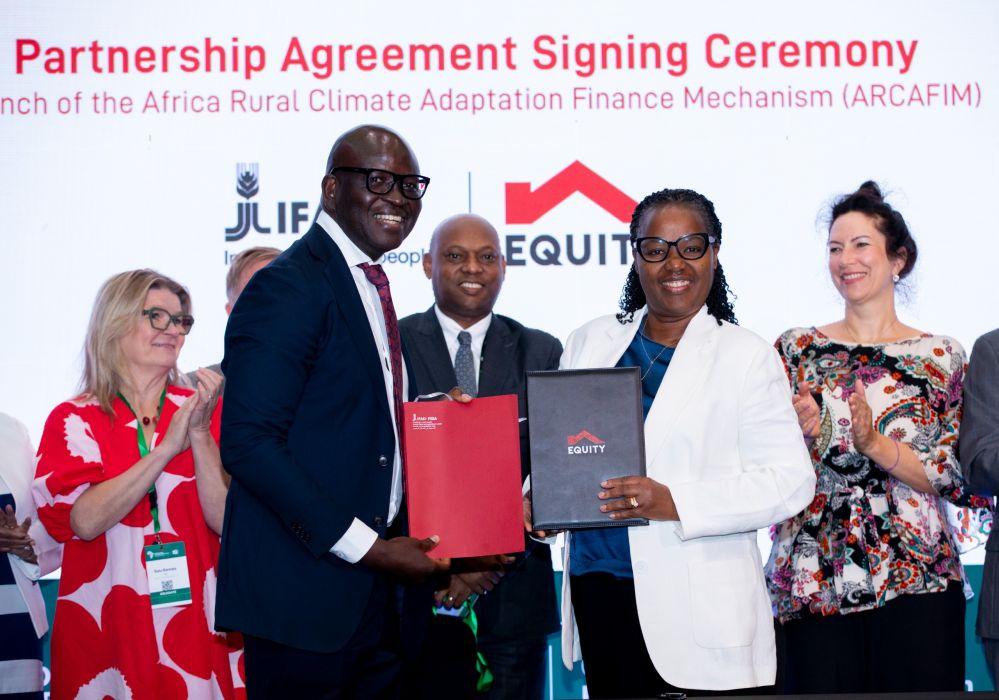
The agreements were signed by Gérardine Mukeshimana for IFAD and Moses Nyabanda for Equity Bank Kenya in a ceremony presided over by Hannington Namara, Managing Director of Equity Bank Rwanda.
By strengthening financial intermediation and private lending channels across agricultural value chains, ARCAFIM seeks to demonstrate how climate adaptation finance can become a sustainable business line while improving access to finance for underserved rural communities.
The initiative also seeks to generate practical lessons that can inform the replication of blended climate finance approaches in other regions of Africa facing similar challenges in financing climate resilience. IFAD and Equity Group have identified Southern and West Africa as the next candidate regions.
Buy your copy of thecooperator magazine from one of our country-wide vending points or an e-copy on emag.thecooperator.news
-

-

-

-


