
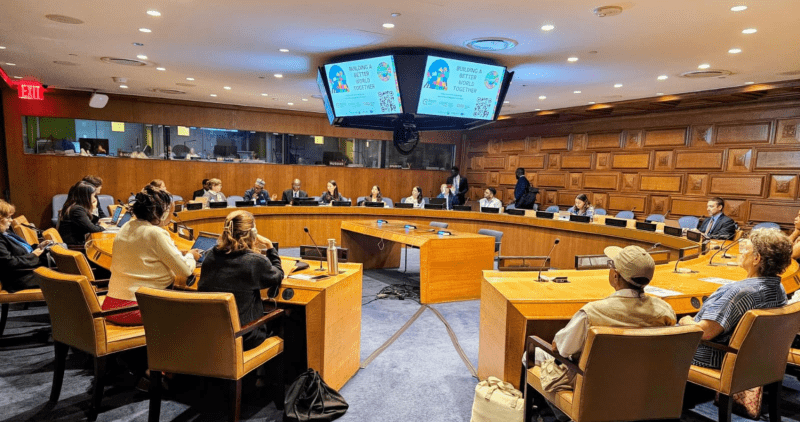
NEW YORK, July 8, 2026 — Cooperatives can play a critical role in driving inclusive, locally led and sustainable development as the world accelerates efforts to achieve the Sustainable Development Goals [ SDGs ], global cooperative leaders and development experts have said.
The call was made during a side event hosted by the International Cooperative Alliance [ICA] and the Committee for the Promotion and Advancement of Cooperatives [COPAC] on July 6, 2026, during the High-level Political Forum on Sustainable Development 2026 [HLPF].
The session, titled “Cooperatives as Drivers and Partners of Transformative and Localised SDG Action,” brought together policymakers, cooperative leaders, development organisations and community representatives to examine how cooperatives contribute to sustainable development through inclusive and community-based approaches.
The event was held alongside the 2026 International Day of Cooperatives, celebrated on July 4 under the theme “Cooperatives for a Peaceful World.”
Speaking at the event, Enkhtsetseg Battsengel said sustainable peace depends not only on political agreements but also on inclusive economic opportunities, social justice, community trust and meaningful participation.
“Economic uncertainty, widening inequalities, climate change and conflicts continue to place considerable pressure on our societies,” Battsengel said, adding that solutions to these challenges must be innovative, inclusive and rooted in local communities.
She noted that the discussions came at a critical time, with only four years remaining until 2030, the deadline set by the United Nations for achieving the SDGs.
Kalilu Totangi shared his personal experience of the impact of cooperatives in reducing poverty in communities.
“The cooperative, in my own circumstance, helped to reduce poverty in our community,” Totangi said, stressing that localisation is not merely a development principle but a necessity.
“Communities best understand their priorities, resources and challenges. When citizens are empowered to organise collectively and participate democratically in economic life, development becomes more resilient, equitable and sustainable,” he said.
In a video message, Gilbert F. Houngbo highlighted the global contribution of cooperatives, noting that they represent more than one billion people worldwide and generate combined annual turnover exceeding US$2.7 trillion.
Houngbo said cooperatives create jobs and livelihoods, retain value within local economies and give people a voice in economic decision-making.
Meanwhile, Ariel Guarco said cooperation was closely linked to peace, encouraging cooperatives worldwide to support freedom, democracy and prosperity.
The event also marked the launch of a series of 17 SDG Policy Briefs developed by the global cooperative movement. The briefs highlight evidence and case studies demonstrating how cooperatives contribute to each of the SDGs and serve as partners for governments, United Nations agencies, development institutions and local communities.
Joseph Njuguna said the briefs were developed to provide policymakers with practical examples of cooperative success stories that can be replicated and expanded.
“We wanted to demonstrate how cooperatives contribute, highlight practical evidence from around the world, and provide policymakers with examples that can be replicated and scaled,” Njuguna said.
He called for greater integration of cooperatives into national development plans, sector strategies and future voluntary national reviews, alongside supportive legal frameworks, improved access to finance and stronger statistical systems to measure their contribution.
A panel discussion during the event examined how cooperatives support localised SDG implementation and strengthen peace, resilience and social cohesion.
Natalie Petrulla highlighted how organising farmers into cooperatives enables them to market products collectively, meet buyer requirements, access global markets and better serve their members.
She said cooperatives are central to Fairtrade International’s approach because farmers understand their own needs and priorities.
Representing National Cooperative Business Association CLUSA and National Co+op Grocers, Michelle Schry urged governments and international institutions to view cooperatives not only as stakeholders but also as implementation partners.
She called for cooperatives to be included in national and local SDG strategies, with supportive policies covering procurement, financing and technical assistance.
“The SDGs will not be achieved by policy alone. They will be achieved through institutions and businesses that people trust, that they own and that they use every day — and cooperatives are those institutions,” Schry said.
Palakh Khanna stressed the importance of recognising young people as current contributors to sustainable development rather than only future leaders.
“Young people are not waiting. Across India, where I come from, across Asia and across the world, young people are already on the ground,” Khanna said.
She said sustainable development must be built together with communities, adding that young people, when trusted and supported, are among the most effective community builders.
Francesca Ottolenghi also presented the Mapping International Cooperative Development Programmes (MiCDP) project, which provides access to information from about 30 Cooperative Development Organisations [CDOs].
She said the initiative aims to strengthen cooperation among development organisations, encourage knowledge exchange and connect CDOs with new partners.
“As we move closer to 2030, achieving the Sustainable Development Goals requires approaches that are locally driven, inclusive and sustainable. The cooperative model already promotes this principle through collaboration, innovation and shared commitment,” Ottolenghi said.
The ICA will host another session during the 2026 HLPF on July 10, in partnership with United Nations Department of Economic and Social Affairs [UNDESA] and Pathfinders for Peace, Just and Inclusive Societies at NYU Center on International Cooperation.
The session will focus on advancing peace, justice and partnerships while examining SDG implementation at national and local levels.
The events are organised under the ICA-EU Partnership [2024–2028], also known as #coops4dev, a five-year cooperative development programme aimed at strengthening the ICA network and positioning cooperatives as important actors in international development.
Buy your copy of thecooperator magazine from one of our country-wide vending points or an e-copy on emag.thecooperator.news
-

-

-

-


