
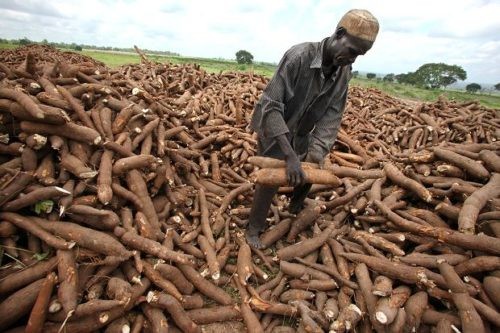
BULIISA, May 20, 2026 — Ngwendo Farmers’ Cooperative Society Limited in Buliisa district has identified cassava bulking and collective marketing as a reliable way of improving members’ incomes.
Previously, individual members sold their produce to dealers and middlemen who transported the produce to markets in Kampala, where they earned significantly higher profits.
The farmers have now resolved to bulk cassava from all members and market the produce collectively in order to access better markets and negotiate improved prices. During a cooperative management meeting, members agreed to collect cassava from across the cooperative to strengthen their bargaining power.
The chairperson of the cooperative, Deus Kagirita, urged members to trust the cooperative with their produce in order to improve both cooperative earnings and individual household incomes.
Cassava is one of the most widely grown food crops in Buliisa district and has become a major source of income for many farmers.
Most farmers in the district currently sell their cassava to middlemen and traders operating in Kampala, Gulu and Lira cities.
Cassava is used as a raw material in factories producing biscuits, starch and various medicinal products, among others.
Most farmers in the district grow soft cassava varieties, which are suitable for industrial processing and other commercial purposes in addition to household consumption.
Kagirita said the cooperative would enable farmers to negotiate better prices collectively rather than dealing with buyers individually.
“We are always cheated by middlemen because they deal with us as individual farmers. Many of our farmers plant cassava with a business mindset,” Kagirita said.
He added that several members of the cooperative had increased their harvests after accessing extension services from the district and receiving guidance from scientists at Bulindi ZARDI.
Farmers have also benefited from support provided by oil companies operating in the Albertine region, including TotalEnergies EP, which has helped them access more resilient and high-yielding cassava varieties that have improved productivity.
Ben Angoroth, a member of the cooperative, said disease-resistant cassava varieties had significantly improved yields.
“The disease-resistant cassava varieties have helped us improve our yields over time. These varieties mature very fast and can also resist diseases,” he said while showing off his harvest.
The cassava variety known as NAROCASS 1 was distributed to farmers by NARO through Bulindi ZARDI to help improve production. The variety matures within eight to 12 months.
Farmers have long faced challenges related to post-harvest handling, with many lacking the knowledge and facilities needed to minimise losses.
Most farmers rely on sun-drying cassava on bare ground, exposing the produce to soil contamination and unpredictable weather conditions that often lead to rotting and reduced quality.
However, under the cooperative’s new bulking initiative, produce will be handled more professionally. Tarpaulins have already been procured, while plans are underway to construct a solar drying facility.
The secretary of the cooperative, Michael Adwoli, said the cooperative also plans to procure a cassava hulling machine to support value addition.
“This hulling machine will help us increase cooperative revenues through the provision of hulling services. Even private traders will be served at a cost to help us generate income,” Adwoli said.
The Production Officer for Buliisa District, Wycliffe Atulinda, said value addition to cassava had previously been limited due to a lack of suitable varieties, infrastructure and modern equipment.
“We lacked varieties suitable for processing, while infrastructure and modern equipment remained major challenges for farmers,” he said.
The District Agricultural Officer for Buliisa, Doreen Bihemaiso, noted that cassava production in the district had increased significantly, creating the need for organised structures such as farmers’ cooperatives to provide reliable markets.
She said cassava production in the district currently stands at between 15,000 and 22,000 tonnes annually. However, annual losses are estimated at more than 42 per cent due to pests, diseases, poor hygiene and inadequate post-harvest knowledge.
The cooperative plans to acquire additional cassava stems to increase production, while a silo, chipping machine and drying racks are also among its priorities in addressing post-harvest challenges.
It also plans to install a milling machine to process, package and label fine cassava flour for sale at more competitive prices.
“We target supplying cassava flour throughout Buliisa district, and we shall later expand across the Bunyoro Subregion and beyond. Cassava is our staple food, so the market will always be available,” Adwoli said.
https://thecooperator.news/buliisa-farmers-count-losses-as-stray-cows-destroy-crops/
Buy your copy of theCooperator magazine from one of our countrywide vending points or an e-copy on emag.thecooperator.news


