
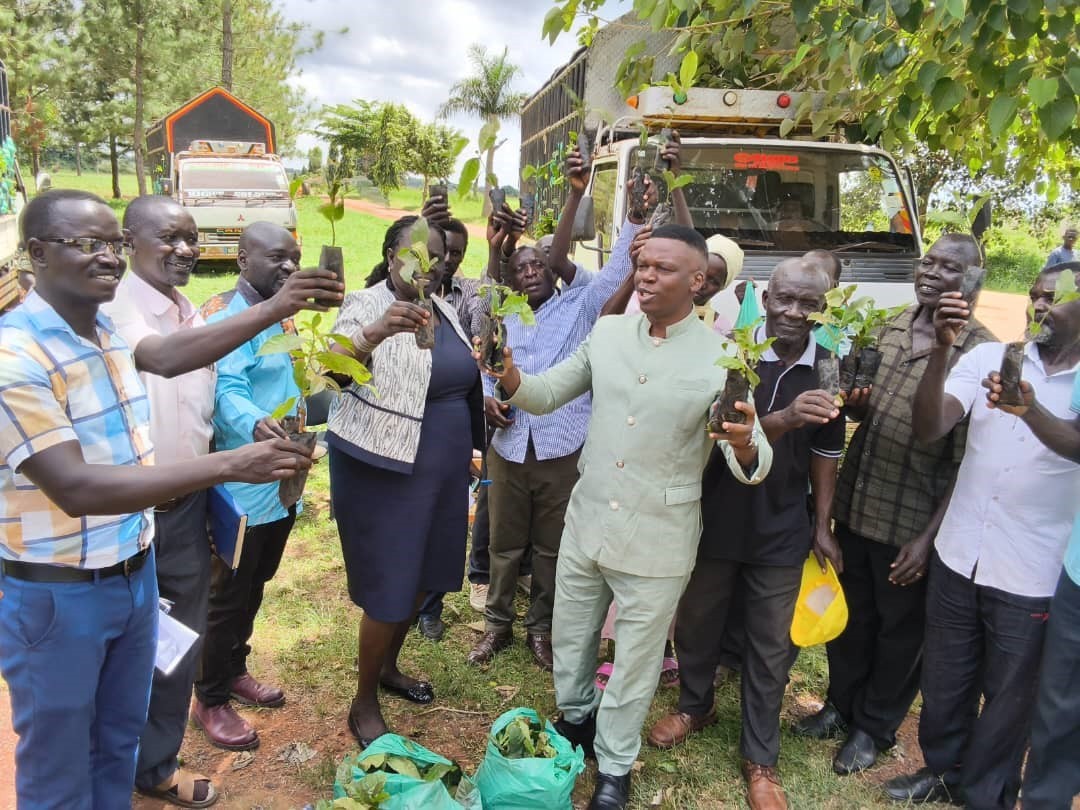
AMOLATAR, April 30, 2026 — The Amolatar Resident District Commissioner [RDC] has called on extension workers in the district to follow up farmers who have received coffee seedlings to ensure they are not wasted.
Francis Okello Rwotlonyo made the call while flagging off the distribution of coffee seedlings to 16 sub-counties at an event held recently at the District Production Department.
Amolatar district received 250,000 coffee seedlings from the Ministry of Agriculture, Animal Industry and Fisheries [MAAIF], valued at Shs 500 million.
According to Okello Rwotlonyo, the government is committed to improving the socio-economic wellbeing of Ugandans through various interventions, such as the distribution of free coffee seedlings through Operation Wealth Creation [OWC], the Parish Development Model [PDM] and Emyooga, among others.
“I want to urge the extension workers and parish chiefs to follow up as farmers take these seedlings. Let us consistently monitor government programmes to ensure that beneficiaries are utilising them well,” Okello said.
He noted that following up beneficiary farmers would help the government determine whether the seedlings are being properly managed to improve household incomes or are being wasted.
“We do not just stop at distributing the coffee seedlings; we need to see whether they have been planted. There was a case in one district where a person received over 1,000 coffee seedlings and, instead of planting them, sold some and dumped the rest in the bush. We do not want such cases in Amolatar,” he warned.
He emphasised that his office would also follow up with farmers to monitor progress and ensure the success of the project.
The Chief Administrative Officer of Amolatar, Rodha Oroma, said the coffee distribution initiative is part of a broader government programme aimed at promoting sustainable development and transitioning citizens from subsistence living to middle-income status.
She tasked the Amolatar District Production Department with establishing a demonstration farm to enable farmers to learn best agricultural practices.
“To the Department of Production, we should have a demonstration farm around the district headquarters—at least two acres—so that we can show people that it is a reality. From that, we shall establish a baseline of how much can be produced per acre and be able to advise the community accordingly,” Oroma said.
Andrew Okello Awany, the Regional Agricultural Officer for Lango, commended the government for the timely distribution, addressing previous concerns about delays that often affected the success of agricultural inputs.
He expressed optimism about the expected yields from the supplied clonal coffee variety, noting its resistance to diseases compared to other types.
Okello added that efforts would continue to strengthen the capacity of agricultural extension officers to better support farmers in adopting modern and productive farming practices.
He further noted that, in addition to coffee seedlings, there are ongoing efforts to lobby for more government support in the form of other crop varieties, such as bananas, as well as agrochemicals and additional farm inputs.
The District Secretary for Production, Patrick Eumu, said adequate sensitisation of farmers has already been conducted and they are now ready to receive and plant the seedlings.
Coffee farming is steadily expanding across the Lango Sub-region in Northern Uganda as part of a broader economic transformation strategy. The shift from traditional cotton farming to high-value, drought-tolerant Robusta coffee is expected to enhance household incomes and resilience.
https://thecooperator.news/lira-city-schools-receive-coffee-seedlings-to-support-practical-learning/
Buy your copy of thecooperator magazine from one of our country-wide vending points or an e-copy on emag.thecooperator.news
-

-

-

-


